India’s Security Scenario: An Assessment of its Continental and Maritime Challenges
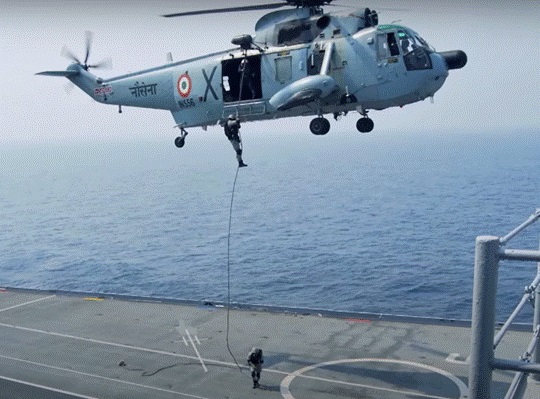
India’s security environment is shaped by the simultaneous pressures of continental threats and maritime competition, requiring a strategic balance between territorial defence, regional diplomacy, and power projection. Historical conflicts with China and Pakistan, unresolved border disputes, nuclear deterrence dynamics, and the persistent risk of a two-front scenario continue to define India’s continental security calculations. At the same time, the growing strategic importance of the Indian Ocean and the broader Indo-Pacific has elevated maritime security to the centre of India’s geopolitical thinking. This article examines how India’s strategic posture has evolved through military modernization, maritime partnerships, defence diplomacy, and initiatives such as the Quad, while also highlighting the tensions between strategic autonomy, regional competition, and emerging great-power rivalries
Geopolitics of the Terrain:
India’s Security Scenario and Strategic Thinking have evolved through historical trajectories, geography, and the presence of external pressures. India has a precarious location resulting in facing repeated challenges from its neighbouring countries, and China and Pakistan. Early Military Engagements have posed a threat to India’s overall sense of territorial integrity evident in the Indo-Pak War of 1947–1948 or even the integration of princely states such as Hyderabad and Goa, demonstrating how the army had adapted itself into a nationalist institution. Similarly, the 1962 Sino-Indo War exposed India’s military weakness wherein it lost important areas, such as Aksai Chin. By the 1980s, the Sumdorong Chu standoff highlighted the ongoing friction between India and China. On the other hand, Pakistan despite being a geographically small state, has historically allocated a disproportionately large share of their nation’s resources behind military expenditure. This reflects how their strategy revolves around waging proxy wars to keep India internally engaged and weaken it through sustained low intensity warfare rather than engaging in direct military confrontations. India’s response to this evolving landscape has been particularly defensive, where it intends to protect their own territorial integrity and sovereignty. With time, both India and Pakistan have developed their own nuclear capabilities, thus forming a “nuclear umbrella” which relies heavily on the concept of “reasonable deterrence” where conflicts remain limited. In such a scenario, India’s foreign policy has deployed the use of diplomacy and negotiation which over the passage of time underscores India's need to balance military preparedness, economic strength, and strategic partnerships to maintain flexibility and its own strategic autonomy.
Geographically, India is located in a unique position as both land and sea power, which further complicates its strategic orientation. India’s border areas continue to remain sensitive and volatile, especially along the Line of Actual Control (LAC) with China, which is not clearly demarcated and can shift based on perception, unlike the Line of Control (LOC) with Pakistan, which is more defined. Flashpoints such as Doklam (2017), areas near the Siliguri Corridor (Chicken’s Neck), and Pangong Lake underscore these strategic vulnerabilities India faces, including the risk of a two front war scenario., India therefore, has strengthened its border management through what can be understood as “one border, one force,” which implies to assigning specific paramilitary forces to different frontiers, for example, Border Security Force (BSF) for Pakistan and Bangladesh borders, ‘Sashastra Seema Bal’ (SSB) for Nepal-Bhutan, ‘Indo-Tibetan Border Police’ (ITBP) for China, and Assam Rifles for Myanmar. Historically, India adopted a defensive posture along the Chinese border wherein China adopted the strategy of “salami slicing”.
The Indian Army’s greatest conventional military success came in 1971 with the creation of Bangladesh. During the 1980s Indian army witnessed pivotal changes due to the evolving security dynamics, economic necessities, alongside the emergence of new political and military leadership in South Asia. Therefore, the army adopted mechanised warfare wherein it acquired new weapons and reorganised its structure under General Krishnaswami Sundarji who carried out large-scale exercises like Exercise Brasstacks in Rajasthan. Moreover, the development of nuclear weapons in the late 20th century, particularly after the 1998 Pokhran-II tests, significantly altered India’s nuclear posture. After the Pokhran-I (1974), which was described as a “peaceful nuclear explosion,” the government kept the military separated from nuclear planning, viewing nuclear weapons primarily as political weapons instead of military. With the Kargil conflict, heightened tensions particularly after the 2001 Indian Parliament attack, led India to launch Operation Parakram, its largest troop mobilisation since 1971. This led to the emergence of the Cold Start Doctrine, which emphasizes rapid mobilization, swift and limited strikes against Pakistan within 48 hours, and Integrated Battle Groups (IBGs), capable of achieving specific objectives within a short timeframe without crossing nuclear thresholds. Besides dealing with conventional threats, the Indian Army became involved in internal security operations, dealing with insurgencies in Punjab, Assam, Kashmir, and the Northeast. India has incorporated both coercive and persuasive strategies in dealing with these sub-conventional threats. In 2008, Rajesh Rajagopalan argued that the Indian Army is not able to develop an effective counter-insurgency doctrine because it has traditionally focused on external warfare.
Power and Vulnerability at Sea:
According to Colin Fritz, Geopolitics is all about spaces and places focusing on power or ability to achieve goals in the face of opposition or adversaries. Geography is important in determining power politics since the ocean plays an important role to connect or disconnect. K.M. Panikkar emphasized the importance of this maritime power, assuming that a control over the Indian Ocean would directly influence a control over South Asia. Similar ideas were attributed to Alfred Mahan who suggested sea domination is a crucial aspect for achieving geopolitical power. Thus, arguably, India’s maritime future is deeply entangled with enhancing its maritime capabilities. In 1948, an initial idea proposed that instead of relying foreign bases, India should build on aircraft carriers and mobile maritime infrastructure. However, financial constraints have been a weak point to this naval aspiration since building and maintaining an effective naval ecosystem including aircraft carriers, submarines, destroyers, and helicopters would be costly. Contrary to this, India has developed carriers like INS Vikrant, acquired INS Vikramaditya from the former Soviet Union and INS Viraat, reflecting gradual yet steady naval expansion. Freedom of navigation remains a key principle, alongside ensuring security across sea routes placing India as net security provider in the region. Thus, one can argue that India’s geographical location, especially as a peninsular country in the Indo-Pacific region, is strategically very important.
The Cold War period reflected on Oceans as a wider contested space with the emergence of military bases, like Diego Garcia. After independence, India carefully crafted its naval strategy where it started maintaining multilateral ties, enhancing maritime security and extended assistance to other countries. In the maritime context, strategic chokepoints stretching from the Strait of Hormuz, the Persian Gulf, and the Strait of Malacca are crucial for global trade, energy and resilient supply chain movement. The Indian Ocean, which was once viewed and even supported to be declared as a “Zone of Peace,” by the United Nations General Assembly, has continued to face external contestation. Since the 2000s, concerns have emerged over China’s expanding presence in the Indian Ocean, often termed as the “String of Pearls” strategy, widely interpreted as an attempt to encircle India. This has inadvertently contributed to steadfast competition between India and China, particularly when the Indian Ocean witnesses the presence of multiple powers like the United States, China, and India.
In the Indo-Pacific context, strategic alignments have shaped the future trajectory where countries like Japan, India, the United States, and Australia have coordinated efforts leading to the formation of the Quad (Quadrilateral Security Dialogue) in 2007. Although it does not function as any formal military alliance, the Quad focuses on upholding a strategic platform for joint collaboration. Other countries such as South Korea, Vietnam, Brazil, New Zealand and Israel are also seen as part of this broad nexus of like-minded partners known as “QUAD PLUS”. India regularly conducts military exercises with partners such as the United States and Japan. Additionally, it supports a rule based international order while at the same time, safeguarding their own national interests. The United States often sees India as a strategic partner in their efforts to counter balance China. Foundational agreements such as LEMOA (Logistics Exchange Memorandum of Agreement) and COMCASA (Communications Compatibility and Security Agreement), along with initiatives like DTTI (Defense Technology and Trade Initiative) and INDUS-X, enhance this aforementioned India-US defense cooperation. Similarly, India has strengthened partnerships with the Global South, focusing on economic, political, and defense cooperation, for instance India’s engagement with Mauritius and extending support for developmental projects including access to such arrangements as seen in the case of the Agaléga Islands.
References:
1. “India and the Indian Ocean an Essays on the Influence of Sea Power on Indian History: Panikkar, K. M: Free Download, Borrow, and Streaming: Internet Archive.” Internet Archive, 1945, archive.org/details/dli.ministry.14535.
2. Sumida, Jon. “NEW INSIGHTS FROM OLD BOOKS: The Case of Alfred Thayer Mahan.” Naval War College Review, vol. 54, no. 3, 2001, pp. 100–11. JSTOR, http://www.jstor.org/stable/26393843. Accessed 30 Apr. 2026
3. Observer Research Foundation. “Maritime Security, Strategic Studies, Programme.” orfonline.org, www.orfonline.org/programme/strategic-studies/maritime-security.
4.“Carnegie South Asia Program.” Carnegie Endowment for International Peace, carnegieendowment.org/programs/south-asia.
5. Ladwig, Walter C., III. “A Cold Start for Hot Wars? The Indian Army’s New Limited War Doctrine.” The Belfer Center for Science and International Affairs, 3 Jan. 2008, www.belfercenter.org/publication/cold-start-hot-wars-indian-armys-new-limited-war-doctrine.
6. Luthra, Girish. “The India–US Defence Technology and Industrial Cooperation: It’s Time for Delivery.” orfonline.org, 26 Feb. 2024, www.orfonline.org/expert-speak/the-india-us-defence-technology-and-industrial-cooperation-its-time-for-delivery.
7.NatStrat. “NatStrat.” https://www.natstrat.org, 22 Apr. 2021, www.natstrat.org/articledetail/publications/india-s-maritime-security-strategy-in-the-indian-ocean-region-159.html
Image Source: Press Information Bureau (PIB) https://www.pib.gov.in/FeaturesDeatils.aspx?NoteId=151135®=3&lang=2
(The views expressed are those of the author and do not represent the views of CESCUBE)