Avenues for India-Taiwan Food & Energy Security Cooperation
This article explores the strategic potential for greater collaboration between India and Taiwan, focusing on food and energy security. As global supply chains face increasing disruption and geopolitical tensions with China rise, both count...
Context- China Taiwan Relations
Cross-strait relations between China and Taiwan have slowly become a pressing issue in international politics. The seeds of the conflict were sown in 1949 when the Koumintang-controlled Republic of China government went to Taiwan in exile after they lost the civil war against the Chinese Communist Party. The CCP would go on to establish the People’s Republic of China and claim Taiwan as an integral part of China. While the sentiment for reunification with the mainland as the Republic of China was strong in Taiwan, it gradually faded and gave way to claims of de facto independence of Taiwan, especially during the rule of the Democratic People’s Party. On the other hand the sentiment of reunification as the People’s Republic of China remains strong in the Chinese mainland. China still claims Taiwan as part of its territory and fully intends to integrate it geopolitically. This puts Taiwan in a precarious condition considering its very limited number of allies with official diplomatic relationships. Economic Diplomacy, as practiced by Taiwan has somewhat helped the island to carve some negotiating place for itself in the International Forum. Additionally, with the Taiwan Relations Act of 1979, Taiwan has received military aid from the United States of America. In September 2024, the United States of America approved 567 million dollars in military aid to Taiwan. However, with Trump 2.0, the full extent of the US support to Taiwan seems uncertain considering isolationist tendencies prevalent during Trump 1.0. The extent of its prevalence remains to be seen but Trump’s withdrawal from the Paris Agreement and World Health Organization does not paint an optimistic precedence. Moreover, the sale of the American F35A Jet to Taiwan has not yet been approved which may signal growing apprehension against continuing support to Taiwan.
Context- India Taiwan Relations
India has its own shares of geopolitical tensions with China. India-China ties started cordially. After the establishment of the People’s Republic of China, the Indian government was among the first to give official diplomatic recognition to the People’s Republic of China. India -China foreign relations began as the founding fathers of an Asian solidarity bloc, however foreign relations became more tense, primarily because of the border dispute between India and China and issues of sovereignty since India has provided asylum to the Dalai Lama and the Tibetan government in exile. (Dittmer, 2019) Conflicts over borders has escalated into a war in 1962 and border skirmishes in recent times. Tensions reached an all-time high with the 2020 Galwan clash between Indian and Chinese troops along the Line of Actual Control in India’s North and North East Frontier. Moreover, China did not attend the G20 summit held in India. Beyond border issues India is also wary about increasing Chinese influence in India’s neighborhood, specifically with Pakistan. Due to tensions and conflict with India, China has been a patron of Pakistan since 1964. The two countries still share a close relationship. Nearly 70 per cent of Pakistan’s conventional armaments are of Chinese design and 90 per cent of its missile production is based on PRC aid of some sort. Pakistan has also received military aid from China most recently, the J-35A, fifth generation stealth fighter. Pakistan has been at the receiving end of various Chinese investments and loans for the development of land & sea infrastructure like the Gwadar port.
With this context in mind, shared geopolitical concerns and tensions with China create a foundation for potential cooperation between India & Taiwan. The given context highlights the need for leaders of both countries to revaluate their regional strategy when it comes to China. There are already calls for supply chain/ regional economic diversification in both countries since China is a major economic partner for both countries inspite of geopolitical tensions. This article highlights the avenues for security cooperation between India & Taiwan. While the scope of defense cooperation is limited due to lack of official diplomatic recognition and tense cross strait & cross border relations India and Taiwan share with China, there is incredible potential for food and energy security between the two countries which help both India and Taiwan to advance their economic and security interests in the region. It will help in reducing reliance on China as an economic partner which help strengthen India and Taiwan to argue for their best sovereign security interests.
India Taiwan Cooperation at Present
In 1995, the India Taipei Association (ITA) was opened in Taipei and the Taipei Economic and Cultural Association was opened in New Delhi in the same year to facilitate cooperation and coordination between the two countries. India launched the Act East policy in 2014, and Taiwan launched the New Southbound Policy (successor to the Go South policy). Both countries have used the synergy between the two policies to improve economic ties, with still a lot of potential for further improvement. Between 2016 and 2018, bilateral trade between the two nations increased by 40 per cent. (Singh, 2019) Academic exchanges between the two countries are also on the rise. Taiwanese companies like Foxconn have set up factories in India. (Singh, 2019) Nearly 200 Taiwanese companies have set up shop in India, under various industries like electronics, information and communication technology, petrochemicals, steel, shipping, footwear manufacturing, automotive and motorcycle components, finance, and construction and contributing approximately US$1.46 billion in investments and creating around 170,000 jobs in the country. 27 of the 55 electronics Taiwanese companies are in the Karnataka- Andhra- Tamil Nadu region. Indian and Taiwanese business communities meet and collaborate via forums organized by the Taiwan External Trade Development Council(TAITRA), and the Federation of the Indian Chambers of Commerce and Industry. (Singh, 2019) India hosts the third largest number of TAITRA offices after the US and China. (Singh, 2019) In 2023 bilateral trade surpassed the USD 10 billion mark. India is now Taiwan’s 16th largest trading partner and its 12th largest export destination. India’s key exports to Taiwan include mineral fuels, aluminum, iron and steel, organic chemicals and plastics. Taiwan’s major exports to India are plastics, electronic integrated circuits, organic chemicals, electrical machinery, and iron and steel. There is much potential for further growth and India Taiwan bilateral trade only presents 1 percent of the foreign trade total of both countries. With the launch of the Make in India policy, India has the resources to set up a substantial production base and help limit Taiwan’s reliance on the PRC.
Potential for Future Cooperation
Full strategic cooperation between India and Taiwan faces multiple challenges. India does not diplomatically recognize Taiwan and any measures intended to increase strategic cooperation with Taiwan’s attract negative attention from the People’ Republic of China. However, regardless India and Taiwan should not let the potential of Chinese attention stop any measures intended for deeper strategic cooperation. The value Taiwan holds in global economic supply chains is worth the risk of some diplomatic blowback from China.
Knowledge creation and Knowledge Sharing can also be applied to Food & Energy Security. Taiwan has limited arable land and limited energy resources. It is currently largely dependent on food and energy imports to meet its demands. India is making great strides in solar energy and can collaborate with Taiwan to help them achieve energy independence.
Taiwan India Food Security
Taiwan is an island and has limited arable land for agriculture. This makes the agricultural scope, like the variety of crops that can be grown on the island, quite limited. Water availability for irrigation is also somewhat unreliable in Taiwan. Taiwan is also reliant on imports of fertilizers like potassium chloride, urea and monoammonium phosphate. Hence, to meet consumer demands for variation in daily diet, Taiwan has become quite reliant on food imports. While rice has been a diet staple, demands for rice are increasing and demands for wheat and meat have seen a gradual increase. In 2023, Taiwan agricultural and related imports stood at $18.9 billion against exports of $5.4 billion. Major import categories include soybeans ($1.6 billion), beef and products ($1.3 billion), corn ($1.3 billion), dairy products ($1.1 billion), fresh fruits ($728 million), processed vegetables ($579 million) and wheat ($483 million). Taiwan also imports bulk commodities including sugar, palm oil, hay, cotton, rice, sesame, sorghum, barley, malt and oats. Additionally, domestic poultry industries are also reliant on grain imports.
India has had its fair share of food security challenges which it has made great strides in addressing. Food Grain production has increased from 50 million tonnes in 1950-1951 to nearly 300 million tonnes in 2019-2020. India is currently the ninth largest exporter of agricultural products in the world. India has become a self sufficient food producing country in the last 30 years. Through government measures likes the 2013 National Food Security Act(NFSA), Public Distribution of food reached 813 million people with subsidized monthly household rations. However, challenges remain like Fluctuating Growth rates due to climate change. Land Degradation constitutes a major threat. Unsustainable levels of ground water are also a concern alongside food contamination. The need for the hour is development of research and agricultural technology for better irrigation and water management and sustainable agriculture practices. Agricultural Technology can be a great potential area for collaboration between India and Taiwan in pursuit of Food Security. In a Niti Aayog report, “Geared up to solve Food Security Challenges: Building Agritech Ecosystem for the Global South” cross border collaboration is highlighted as key to the success of this ecosystem. The United Nations Capital Development Fund has partnered with Atal Innovation Mission to facilitate such collaboration with countries like Indonesia and Malaysia. Taiwan could also be a potential partner giving the technological strides it has made. This collaboration will help improve agriculture productivity to cater to increasing market demand and enhance smallholders’ income, building resilience against climate change and natural hazard-induced shocks and improve supply chains efficieny and transparency. Recently, India and Taiwan signed a Mutual Recognition Agreement to ease exports of organic products by avoiding dual certifications, thereby reducing compliance cost. Similar ease in exchange can be applied to technological flow between the two countries like research between agricultural universities. India’s supply of tropical fruits and vegetables could support Taiwan’s dietary diversity. India and Taiwan can collaborate on sustainable farming and improve food storage.
Energy Security
Energy Security is a cornerstone of India’s economic and environmental strategy. India is making a push towards renewability and self reliance for its energy security. India’s on-fossil fuel energy capacity has reached 217.62 GW. The CCDC(Centralized Data Collection & Coordination) Wind Initiative has significantly enhanced wind energy development, leading to 48.16 GW of installed capacity. The National Green Hydrogen Mission, launched in 2023, is positioning India as a global leader in hydrogen energy with investments exceeding ?8 lakh crore. The National Solar Mission has propelled solar energy growth, with installed capacity rising from 9.01 GW in 2016 to 97.86 GW in 2025. Additionally, PM-KUSUM and PM Surya Ghar Muft Bijli Yojana are accelerating solar adoption among farmers and households. Taiwan, on the other hand operates with an isolated electrical grid. It is reliant on fossil fuels for its energy needs, specially by its high tech industries. 96 percent of Taiwan’s energy is imported making it quite vulnerable to a disruptions in maritime traffic through an embargo. This reliance will persist after the planned phase out of nuclear power. Hence Taiwan is actively making a push towards renewable energy. Given, tensions with China, Taiwan can collaborate with India to meet its energy demands. India is one of the largest exporters of refined petroleum in the world, which Taiwan can use for its energy demands. There is also potential for collaboration in renewable energy, specifically solar energy. Both India and Taiwan have great solar potential. Currently, India outranks Taiwan when it comes to Solar Power. India has made great strides in its increase of solar energy. The International Solar Alliance can be a great mechanism for India and Taiwan to collaborate in solar energy. Taiwan is a hub for the production of solar cells and other elements needed in a solar energy power grid. India can leverage its experience in setting up solar power grids in rural areas, to help Taiwan circumvent its geographical and climate challenges in setting up and planning solar microgrids suited to Taiwan. Taiwan can also set up manufacturing hubs for solar energy components in India. By leveraging their strengths India and Taiwan can set up a quite useful renewable energy partnership that help the energy security goals of both countries.
Conclusion
There is great potential for collaboration between India and Taiwan in the areas of food and energy security. Both countries have unique strengths that, when combined, can create a partnership that serves their mutual interests. For India, this means securing access to technology, innovation, and investment. For Taiwan, it offers a way to build deeper ties with a major regional player and reduce the risks of overdependence on existing supply chains.
This cooperation can also play a key role in supply chain diversification, especially away from China. That shift is important not just for trade, but for allowing both countries to make strategic decisions based on national interest rather than external pressure. Greater self-reliance will allow more space for long-term planning and independent foreign policy.
India and Taiwan have already made progress in this direction. Past efforts—both formal and informal—have shown encouraging results. Now is the time to build on these efforts. This means creating new pathways for collaboration through government agreements, private sector partnerships, and people-to-people connections. The foundation is already there. What is needed now is the political will to take it forward.
References
- Dittmer, L. (2018). China’s Asia Triangular Dynamics since the Cold War. Rowman & Littlefield.
- Singh, T. (2019). India-Taiwan Relations: Burgeoning Economic Engagements. Indian Foreign Affairs Journal, 14(3), 222–234. https://www.jstor.org/stable/48636728
- Miller, C. (2022). Chip war: The Fight for the World’s Most Critical Technology. Simon and Schuster.
- Indian Defence Research Wing (2025, January 20). Strategic Shifts in South Asia: Should India invite Taiwan into its AMCA program Amidst Pakistan's J-35A Acquistion. https://idrw.org/strategic-shifts-in-south-asia-should-india-invite-taiwan-into-its-amca-program-amidst-pakistans-j-35a-acquisition/
- Chung, L. (2024, November 16). Will US let Taiwan buy F-35 jets with ‘protection fees’ demanded by Trump? https://www.scmp.com/news/china/politics/article/3286715/will-us-let-taiwan-buy-f-35-jets-protection-fees-demanded-trump
- AlJazeera (2024, September 30). US approves $567m in military support for Taiwan. https://www.aljazeera.com/news/2024/9/30/us-approves-567m-in-military-support-for-taiwan
- Hashmi, S., & Mankikar, K. A. (2025, February 6). Charting a Course for Deeper India-Taiwan Cooperation. https://www.orfonline.org/research/charting-a-course-for-deeper-india-taiwan-cooperation
- 8. Dasgupta, B. (2022, April 8). Chinese hackers targeted 7 Indian power hubs, govt says ops failed. https://www.hindustantimes.com/india-news/chinese-hackers-targeted-7-indian-power-hubs-govt-says-ops-failed-101649356540330.html
- Lin, O. (2024, June 19). Taiwan Food Security Situation Overview. https://www.fas.usda.gov/data/taiwan-taiwan-food-security-situation-overview
- United Nations (n.d.). Nutrition and Food Security. https://india.un.org/en/171969-nutrition-and-food-security?afd_azwaf_tok=eyJhbGciOiJSUzI1NiJ9.eyJhdWQiOiJpbmRpYS51bi5vcmciLCJleHAiOjE3NDQ3MjY5NDYsImlhdCI6MTc0NDcyNjkzNiwiaXNzIjoidGllcjEtN2Y1Yjg2NWM0NC04OW42cyIsInN1YiI6IjEyNDo0OTo2ZjFjOjExNzk6NjZiODphODo4MGYyOmUyMWEiLCJkYXRhIjp7InR5cGUiOiJpc3N1ZWQiLCJyZWYiOiIyMDI1MDQxNVQxNDIyMTZaLTE3ZjViODY1YzQ0ODluNnNoQzFCT01oemd3MDAwMDAwMDE2ZzAwMDAwMDAwN3l5ZyIsImIiOiJHdHZoQlctUmxldzZ5UUQzYzFCTnZ1QVg2WFBXcVMwQnA2bk0wZ1hqRl9rIiwiaCI6Iklyc0lpaHJyZDZMYThwRHpmM3hTSjgtTVBtUmNCYjEzRHVhSzM4VktxWnMifX0.MAIZkM0PO3fSWCDCaBD_Y2sGX-YOcvhV9NP4dRK6ph4C-O5TORsQwGaBteDHQKxH83lgA9Uvg9v7zJ2sDgPX5HzhT1ru1nXHKz-BvKQNsOfnX7UJgvrqpDwu3D-kuDEZeHAf7Qfs1_OaMAn_2U8aZHkg-u4rNg8I6m5Z99a4JjlHf-OtEi0dJZTDuyr1JVOhvE_HkGtM53TuCjJsisOGPjG8wIpH03_-DqorNzDaJZOZdsjHKTZXP844a6UViGBdElqj7O-46F_r1f9-5zdtu85gD896EpbbstGCT4Y9K8xeRMrKQW5uoJ6YykBTcIPdsVslK6_8EE04SrMtSBLv4Q.WF3obl2IDtqgvMFRqVdYkD5s
- NitiAayog (n.d.). GEARING UP TO SOLVE FOOD SECURITY CHALLENGES. https://niti.gov.in/sites/default/files/2023-04/Report-UNCDF.pdf
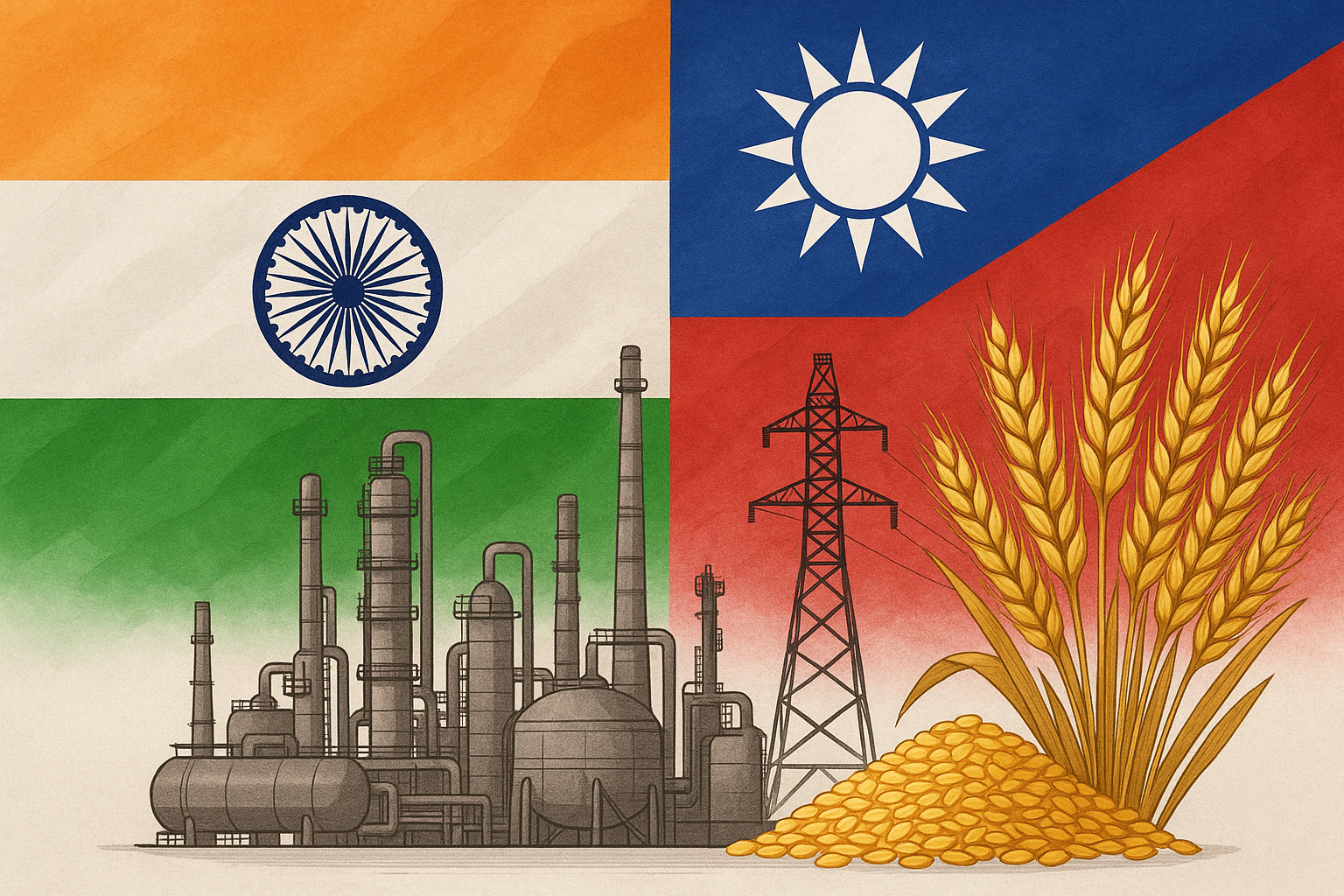
Pic Courtesy- Photo by Perplexity.ai
(The views expressed are those of the author and do not represent the views of CESCUBE.)

Tanveer Malik is a writer and geopolitical analyst with a keen interest in Asia’s emerging strategic partnerships, economic resilience, and global supply chain dynamics. His work often explores the intersection of international relations, trade, and security. Tanveer aims to offer fresh perspectives on India’s global engagements and the broader Indo-Pacific landscape.