LIVE DISPATCH
Loss and Damage Finance: From COP28 Pledges to Policy Architecture Extended Deterrence Under Strain: Credibility, Assurance, and the Stability-Instability Paradox in the Indo-Pacific Beyond Consultation: BIMSTEC's Emerging Role in Regional Intelligence and Security Cooperation Maritime India: Security, Trade, and Great Power Competition Between the Desert and the Savannah: Conflict and the Political Economy of Instability in the Sahel Beyond Ukraine: Understanding Putin's Vision of Russian Power The Politics of Ali Khamenei's Funeral Silicon Sovereignty: How Semiconductors Are Redrawing Global Power Hierarchies Operation Sindoor and the Changing Dynamics of India–Pakistan Security The Negative Impact of US–Iran War on the Pacific Region Generative AI, Labour Sovereignty, and the Geoeconomics of India's Service Economy BRICS Expansion and the Multipolar Moment: Opportunity or Strategic Contradiction? India's AI Diplomacy and the Future of Strategic Technologies Foot-Dragging as Feminism: Iran, South Korea, and the Ungovernable Body Lethal Autonomous Weapons Systems and the Governance Deficit: Challenges to International Humanitarian Law and Accountability Beyond Proximity: Why the UAE Occupies a Growing Place in Iran’s Strategic Calculus Great Power Rivalry and the Crisis of the United Nations Why Fiji Matters: The New Geopolitics of the Indo-Pacific Islands Ten Years After Brexit: Regret, Reform, or Reversal? The Long Shadow of 1953: Understanding the Iran–US Conflict Sports, Strategy and Statecraft of Mega Sporting Events as Geoeconomic Instruments: Qatar 2022 to Saudi Arabia 2034 Border Fencing and National security: India’s Strategy along the Bangladesh Border Hardening the Quad: From Strategic Dialogue to Operational Cooperation Lingering Effects of the Bush Doctrine on Contemporary US Foreign Policy The Maghreb of States: Identity, Sovereignty, and the Limits of Non-Interference India’s BRICS 2026 Chairmanship Navigating a tightrope Amidst the Chinese Geopolitical Rise Beyond the Battlefield: Understanding Unconventional Security Challenges in Contemporary Geopolitics The Control Paradox: How Proxy Warfare Enables Strategic Deniability While Constraining Strategic Control Trapped in Deterrence: Nuclear Stability and the Persistence of Conflict in South Asia The Return of Unipolarity? U.S Strategic Primacy and the Future of the Global Order Supply Chains and Complicity: The Role of Global Corporations in Forced Labour in Xinjiang The Distant Threat: Is Israel Constructing a Strategic Rival in Pakistan Island Militarisation and Techno-Diplomacy: Turkey’s Eastern Mediterranean Fault Lines Amid India-Greece Alignment India’s Security Scenario: An Assessment of its Continental and Maritime Challenges The Geopolitical Architecture of European Defence: Navigating NATO Synergies, Transatlantic Retrenchment, and the Hybrid Threat Landscape The Artemis Accords and the Future of Global Space Governance AI and the Securitization of Critical Infrastructure: Implications of India's AI Summit Beyond Rhetoric: Evaluating the Effectiveness of International Sanctions on China’s Treatment of Uyghur Muslims The Emerging Maritime Rivalry in the Western Indian Ocean: India’s Response to Extra-Regional Powers India's Maritime Grand Strategy on Trial : The IRIS Dena Incident and the Indian Ocean Question Loss and Damage Finance: From COP28 Pledges to Policy Architecture Extended Deterrence Under Strain: Credibility, Assurance, and the Stability-Instability Paradox in the Indo-Pacific Beyond Consultation: BIMSTEC's Emerging Role in Regional Intelligence and Security Cooperation Maritime India: Security, Trade, and Great Power Competition Between the Desert and the Savannah: Conflict and the Political Economy of Instability in the Sahel Beyond Ukraine: Understanding Putin's Vision of Russian Power The Politics of Ali Khamenei's Funeral Silicon Sovereignty: How Semiconductors Are Redrawing Global Power Hierarchies Operation Sindoor and the Changing Dynamics of India–Pakistan Security The Negative Impact of US–Iran War on the Pacific Region Generative AI, Labour Sovereignty, and the Geoeconomics of India's Service Economy BRICS Expansion and the Multipolar Moment: Opportunity or Strategic Contradiction? India's AI Diplomacy and the Future of Strategic Technologies Foot-Dragging as Feminism: Iran, South Korea, and the Ungovernable Body Lethal Autonomous Weapons Systems and the Governance Deficit: Challenges to International Humanitarian Law and Accountability Beyond Proximity: Why the UAE Occupies a Growing Place in Iran’s Strategic Calculus Great Power Rivalry and the Crisis of the United Nations Why Fiji Matters: The New Geopolitics of the Indo-Pacific Islands Ten Years After Brexit: Regret, Reform, or Reversal? The Long Shadow of 1953: Understanding the Iran–US Conflict Sports, Strategy and Statecraft of Mega Sporting Events as Geoeconomic Instruments: Qatar 2022 to Saudi Arabia 2034 Border Fencing and National security: India’s Strategy along the Bangladesh Border Hardening the Quad: From Strategic Dialogue to Operational Cooperation Lingering Effects of the Bush Doctrine on Contemporary US Foreign Policy The Maghreb of States: Identity, Sovereignty, and the Limits of Non-Interference India’s BRICS 2026 Chairmanship Navigating a tightrope Amidst the Chinese Geopolitical Rise Beyond the Battlefield: Understanding Unconventional Security Challenges in Contemporary Geopolitics The Control Paradox: How Proxy Warfare Enables Strategic Deniability While Constraining Strategic Control Trapped in Deterrence: Nuclear Stability and the Persistence of Conflict in South Asia The Return of Unipolarity? U.S Strategic Primacy and the Future of the Global Order Supply Chains and Complicity: The Role of Global Corporations in Forced Labour in Xinjiang The Distant Threat: Is Israel Constructing a Strategic Rival in Pakistan Island Militarisation and Techno-Diplomacy: Turkey’s Eastern Mediterranean Fault Lines Amid India-Greece Alignment India’s Security Scenario: An Assessment of its Continental and Maritime Challenges The Geopolitical Architecture of European Defence: Navigating NATO Synergies, Transatlantic Retrenchment, and the Hybrid Threat Landscape The Artemis Accords and the Future of Global Space Governance AI and the Securitization of Critical Infrastructure: Implications of India's AI Summit Beyond Rhetoric: Evaluating the Effectiveness of International Sanctions on China’s Treatment of Uyghur Muslims The Emerging Maritime Rivalry in the Western Indian Ocean: India’s Response to Extra-Regional Powers India's Maritime Grand Strategy on Trial : The IRIS Dena Incident and the Indian Ocean Question
ADVERTISEMENT
Security October 24, 2021 17646 Reads

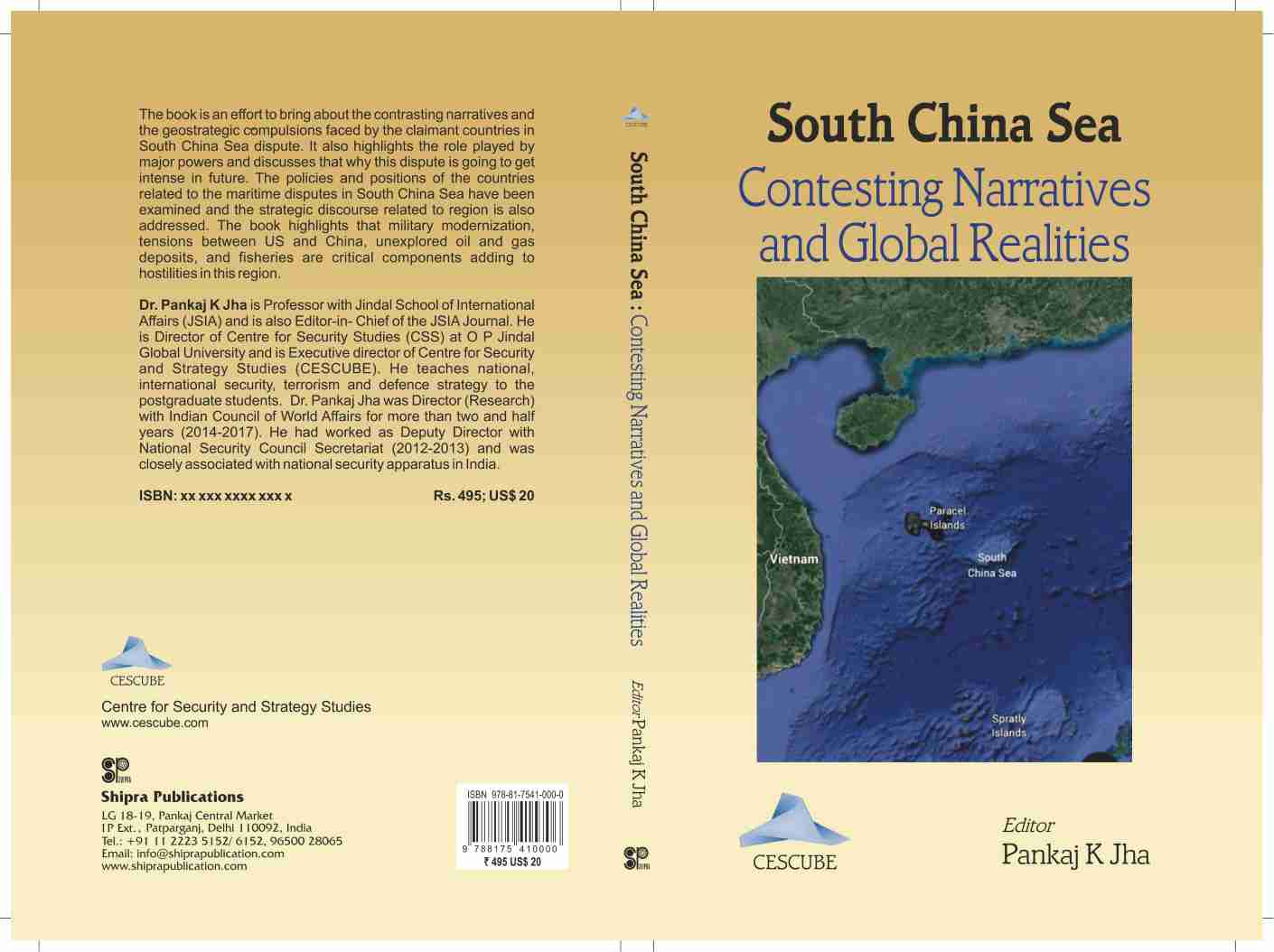
South China Sea : Contesting Narratives and Global realities
P
By Pankaj Jha
Author • Centre for Security & Strategic Studies
South China Sea : Contesting Narratives and Global realities
Share Analysis:
EXECUTIVE SUMMARY & STRATEGIC TAKEAWAYS

The developments in the last five years in South China Sea has gained international attention following the Permanent Court of Arbitration (PCA) ruling in favour of the Philippines. The ruling clearly stated that the China’s claim of nine d...

ADVERTISEMENT

Meanwhile, US started group sails and undertaking surveillance and reconnaissance mission in South China Sea closer to the Chinese controlled islands leading to tensions between the two powers. Vietnam as well as Malaysia and other ASEAN claimants submitted their representation regarding extended continental self which as supported by the European powers and the US. The diplomatic statements and the need for accepting maritime security as a critical issue sled to frictions between US and China in different forums including Shangri la Dialogue, ADMM plus and East Asian Summit meetings too. The role that ASEAN played was subdued and tried to bring more sanity between various contesting parties. The statement became more focussed, however, desisting from naming China in the joint communiques.

The institutions in Southeast Asia reflect the concerns of the major claimants. The Chinese fishermen militia and increased Chinese military modernisation led other claimant countries to upgrade their navies and coast guards. There was a surge in submarines procurements and developing fighter aircrafts fleet among countries such as Vietnam and Indonesia. The maritime survey ships of China, at multiple time infringed the EEZ of the littoral countries, and intimidated the patrol ships through water cannons, and at time even destroying the fishing boats of other countries. This was followed up with unilateral fishing ban of three months in the contested region.

Increased military tensions in SCS was followed up with European powers dispatching their ships in the South China Sea in the year 2021. The tensions between the two powers - China and US, and the Philippines government accepting the fact that cajoling China would be of no help accepted the fact that US Visiting Forces Agreement (VFA) need to be maintained for maritime security of the country. ASEAN also adopted its outlook towards Indo-Pacific construct and one of the important salient points has been maritime security which would help the countries to engage the major powers in a constructive way while securing the maritime trade and commerce, and unimpeded flow of energy, and other critical resources in the region.

The US along with other Quad countries started working on maritime security architecture and created the Quad forum at the highest level to address issues related to Chinese aggressive posture and intimidating tactics. The effort was to counter Chinese BRI initiative and providing the alternative configuration and plan which is now better known as Build Back a Better World(B3W)-an initiative undertaken by the G-7 countries.

During the chairmanship of India in the UNSC special discussion and dialogue was held highlighting maritime security which addressed concerns of major powers and the Vietnamese Prime Minister made a fervent call for UN institutionalized support structures in the regional context to frame the rules of engagement and protect the interests of smaller countries in South China Sea.

This book aims to highlight the narratives which are germinating from China, ASEAN countries, Japan, and other relevant stakeholders. The book also highlights the fact that China’s newfound interest in South China Sea does not have major historical backing (as illustrated in the maps in the book) and therefore South China Sea, the third largest fishing grounds in the world and has immense energy resources, should be seen as a major flashpoint and the theatre of international power politics in future.  


P
About Pankaj Jha →

Senior Research Fellow at Centre for Security & Strategic Studies.
ADVERTISEMENT

Related Strategic Analysis