Climate Change: India’s Silent Security Threat
India’s political and strategic debates continue to revolve around identity and ideology, yet an increasingly destabilising force remains under-addressed: climate change. This commentary examines how climate stress is no longer a peripheral...
The quandaries long governing Indian politics have become outdated or overplayed, caste has become a question of controversy than upliftment, religion is used to polarize vote-banks and gender becomes a topic for intermittent uproar. In India, identity has been the root cause of conflict, often scapegoated by every ruling apparatus. Beyond the usual hocus-pocus, the country must today shift its focus to an overarching, omnipresent issue that cuts across and beyond the borders of petty politics towards the silent threat of climate change.
As per research done by the Germanwatch, India ranks 9th in the Climate Risk Index, having suffered civilian deaths of over 8 lakh and economic losses totalling around $4.5 trillion between 1995 to 2024. While policies such as PM-E Drive (subsidizing electric vehicles) and the National Action Plan on Climate Change (aggregates eight missions on environmental sustainability) are in place, they remain stagnant or underperforming due to lack of political will and public interest. Perhaps if policy makers and law-givers were to realise the security implications of climate change, the scenario would be different.
Resource Scarcity:
Transboundary rivers have always been a point of bilateral contention for India, especially in the context of the Indus Rivers it shares with the hostile neighbour Pakistan. It is well known that trust deficit fuels Indo-Pak politics, which is why the Indus Water Treaty, once hailed as an emblem of resource diplomacy, has also become the source of skirmishes.
For instance, when India inaugurated the Kishanganga Hydroelectric Power Project in 2018 to improve water availability in the J&K region, it did not sit well with Pakistan, which moved the World Bank on the same, demanding consideration of the latter’s interests who stand disadvantaged as a lower riparian state. The first half of 2025 saw the tussle deepen, with the Pahalgam terror attacks resulting in Operation Sindoor which also led to the termination of the Indus Water Treaty.
Climate change only stands to compound tensions in this context, as between 50-80% of the Indus waters are fed by glacial snow melt of the Himalayans or driven by monsoon making it rather climate sensitive. In the coming years, with rising temperatures there will be a surge in droughts and slow drying up of these rivers limiting water inflow. Despite it being an environmental phenomenon, resource scarcity will only further feed geopolitical mistrust between the two nations; perhaps resulting in a blockchain of violence around the border areas in a fight over the supply of Indus.
Realist scholars of international relations would use the lens of John Von Neumann’s Game Theory and deem Indo-Pak conflict inevitable with regard to water politics, as the most convenient and mutually beneficial option would be sharing of hydrological data but the scars of history would prevent cooperation; thereby facilitating a dual crisis of environment and politics. The same logic can be applied to Indo-China and the Brahmaputra question.
Weakening Defence:
The climate-security nexus remains understudied and unacknowledged not only in India, but across the world. However, given India’s vast geographic expanse, it is important to identify and locate how environment can weaken even the world’s fourth most powerful army.
Climate induced stress is not simply limited to heat strokes or air pollution that envelopes New Delhi every winter. Rather, it restricts troop mobility and has even the potential to wreck critical defence infrastructure. The unfortunate 2025 Uttarakhand flash floods were an attestation to this where the army camp near Dharali was damaged. It has been reported that even nine army personnel have been missing since the cloudbursts took place in August.
The Dharali episode must serve as a learning ground for the Government of India, especially in the light of the ambitions they have surrounding the Andaman and Nicobar Islands. The Great Nicobar Project when announced, caused an uproar among environmentalists due to the deforestation and biodiversity loss it entails. Yet, the government wishes to proceed with it to further India’s interests in the Strait of Malacca region, a global trade hub.
The Andaman and Nicobar Command (ANC), a tri-service defence force, patrol and safeguard the region in terms of maritime security. If the Great Nicobar Project takes off, the force deployment will only double as India needs to counter China’s string of pearls strategy.
Development, if divorced from ecology, spells a recipe for disaster. The troops stationed and critical infrastructure present in the Islands are at an heightened risk, with rising sea levels (estimated 3.3 milliliters per year) and frequent cyclones both of which can rupture the security systems. These climate-based itches will only exacerbate with projects such as Great Nicobar as they go onto reduce natural barriers such as corals and mangroves, as well as weaken the fragile topography eventually knocking down the security ambitions once imagined.
Compromised Diplomatic Leverage:
In the past decade, natural disasters have become more common across the globe, including the Indian ocean. This has made disaster response not only an act of humanitarian consideration, but also a means to strengthen a country’s diplomatic outreach and geopolitical influence.
Funds released even as relief are ultimately a mechanism that guarantees political obedience to the country receiving it, which is precisely why India has positioned itself as ‘friend in need’. This pattern can be sketched out in how India was among the first countries to send aid to Turkey in the form of ‘Operation Dost’ post the 2023 earthquake, despite President Erdogan’s negative remarks on the Kashmir issue. Similarly, there has been relentless pouring of assistance to countries ranging from neighbours such as Sri Lanka (Operation Sagar Bandhu) all the way to that of Vietnam (Operation Sadbhav).
Such operations have presented India as a more friendly face and an alternative to a belligerent China that functions through a paradigm of cheque-book diplomacy. It also increases India’s credibility in associations such as QUAD and Indian Ocean Rim Association (IORA) as moral credentials in multilateral activities only go onto legitimize strategic visions, especially that of India vying for a permanent seat in the United Nation’s Security Council. However, what India suffers from is the plague of paradox. International branding is not cemented solely by granting of aid and deploying task forces, it is equally built upon domestic credibility and action which is where India falters.
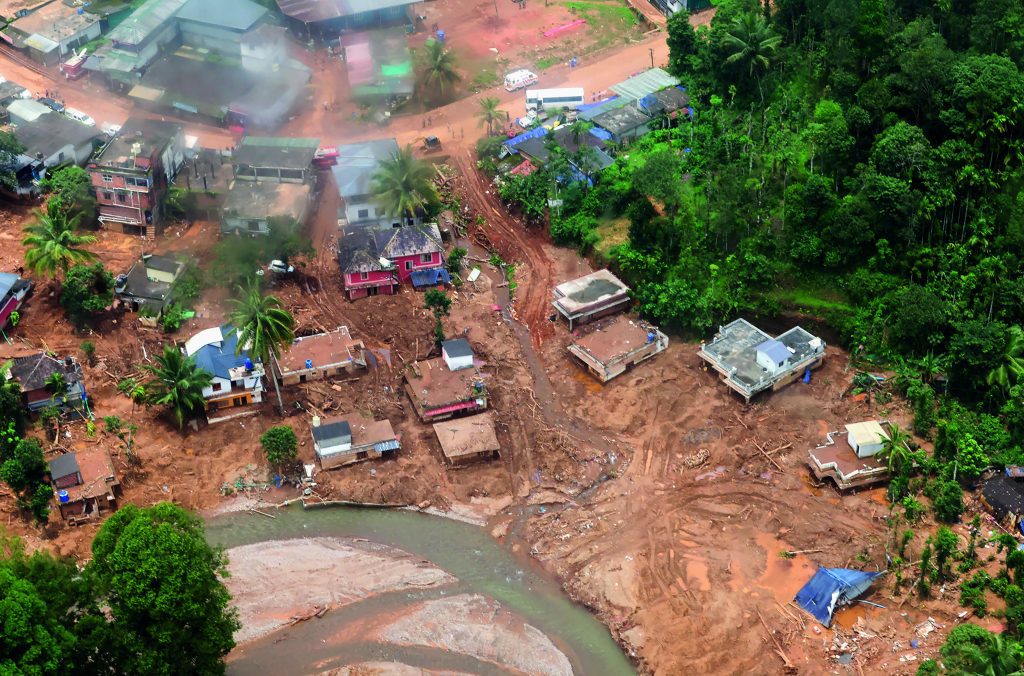
Despite having early warning systems in place, India finds itself unprepared to handle local disasters as seen in West Bengal during Cyclone Amphan and Assam during Cyclone Remal. Moreover, the 2024 Wayanad landslides that gained global traction - thereby reflecting poorly on India’s domestic capacities, especially in terms of risk assessment monitors and not doing infrastructural updates of outdated structures like the Mulaperiyar Dam.
How does this become a geopolitical risk? Firstly, it creates a credibility crisis for India in terms of its disaster response technology and raises questions on the utilization of domestic funds in this regard. Secondly, repetitive disaster occurrences with little to no tending create loops of increased migration and political stability notwithstanding financial drain. Climate led bankruptcy is something that must inform the bigger picture.
Final Reflection:
India has its ambitions set for the future, with the goal of Viksit Bharat @ 2047. However, the road to becoming a completely developed nation and a regional behemoth can’t be accomplished without giving due attention to the elephant in the room – aka climate action. The immediate necessity is to have a ‘climate in all sectors’ (CIAS) approach, including that of defence, diplomacy and security. The politics of climate change in India must undergo a Kuhnian shift to recognize the nexus between environment and security, better late than never.
(The views expressed are those of the author and do not represent the views of CESCUBE)
Image Source: Science India Magazine https://scienceindiamag.in/wayanad-landslides-spotlight-on-critical-relationship-between-nature-and-humans/

Ria Pillai is a Master’s student of Public Policy at Mount Carmel College, Bangalore. She is a political science gold medalist, and has been a Participatory Democracy Fellow with the Bangalore Political Action Committee - heading the pedestrian infrastructure development project. She currently works as an Information Officer at the Global Academy for Future Governance and is also a Climate City Pulse Fellow with Young Leaders for Active Citizenship. Ria’s interests lie at the intersection of geopolitics, sustainable development and artificial intelligence.