From Prototype to Patrol: Assessing the Impact of iDEX on Indian Defence Modernisation

This article examines how India’s Innovations for Defence Excellence (iDEX) initiative is transforming defence modernisation by bridging the gap between innovation and operational use. It evaluates iDEX’s progress across AI, UAVs, autonomy,...
Introduction
Technological innovation has emerged as the key factor determining superiority on the contemporary battlefield. India’s objective of defence self-reliance, which is within the broader vision of ‘Aatmanirbhar Bharat,’ is greatly reliant on the systemic adoption of disruptive technologies. In recognition of the “valley of death” in transitioning from the development of a prototype to operational use, the Ministry of Defence (MoD) established the Innovations for Defence Excellence (iDEX) programme in 2018 and expanded it through the launch of iDEX-Prime in 2022, which offered grants of up to Rs. 10 crores, and subsequently with ADITI (Acing Development of Innovative Technologies with iDEX) in 2024, which funds projects at higher Technology Readiness Levels and grants up to Rs. 25 crores.¹ In addition to these two schemes, the Defence Acquisition Procedure (DAP) 2020 also established a new category for the “Innovative Solutions” to offer pathways for start-ups and MSMEs to procure their developed technologies, within the procurement framework of the Armed Forces.² While iDEX has energised the defence innovation ecosystem of India, there are still several critical challenges that we endure, which inhibit the overall impact on the battlefield: follow-on capital is often very limited; there is often significant delays in absorption in procurement pathways; and doctrinal inertia is observed to not fully integrate new technologies developed via the iDEX programme into the armed forces.
Policy Architecture
Academia and policy literature emphasises the accelerating importance of disruptive technology in contemporary defence planning. Most prominently, India's vulnerability to uncrewed aerial systems (UAS)/drones and swarm technology has been articulated, with scholars advocating for counter-UAS capabilities to counter operational risks.³ Innovation ecosystems are beginning to be studied comparatively, but are often discussed without consideration of institutional bottlenecks in an Indian setting.4 The Manohar Parrikar Institute for Defence Studies and Analyses (IDSA) produced short policy briefs that consistently frame Innovation for Defence Excellence (iDEX) as a foundation of India's self-reliant defence strategy while also noting delays in absorption of the fund. 5 Official documents like the iDEX guideline, Press Information Bureau (PIB) press releases, and provisions of the Defence Acquisition Procedure 2020 (DAP) serve as institutional texts that outline thematic priority areas, challenge-based funding, and appropriate procurement pathways.6 These items form a body of knowledge that situates iDEX into the broader framework of defence industrial transformation in India and articulates continuing inertia of defence procurement in India.
Technology Pipelines: AI, UAVs, Autonomy, and Electronic Warfare
In 2024, iDEX has supported over 300 start-ups and MSMEs.7 AI challenges related to ADITI have resulted in prototypes demonstrating ISR analytics, automated target recognition, and decision-support systems. In the UAV space, India has developed swarming drones, loitering munitions, and BVLOS logistics platforms designed to address incursions along the western border.8 In autonomy, projects can be seen in the development of de-mining robots and perimeter security systems. Electronic warfare innovation has developed prototypes for a resilient mesh network and jamming-resistant radios. However, most of these projects remain prototypes, and the lack of scaled induction and continued divide between early-stage innovation and operationalisation persists.
The impacts of iDEX can be traced through a few vectors:
Size of investments: iDEX's funding increased from about Rs. 1.5 crore in seed grants to larger amounts of Rs.10 crore for iDEX-Prime and up to Rs. 25 crore for ADITI.9 Eco-system creation: The engagement of hundreds of innovators and MSMEs helped to grow the national defence-tech talent pool. Procurement results: By December 2024, iDEX had issued orders for procurement with respect to the iDEX winners of Rs. 1000 crores. International collaborations: Under the INDUS-X programme, select Indian start-ups have collaborated with U.S. partners on joint ISR and autonomy projects.10 These outcomes indicate that there is a reasonable argument to be made that iDEX has been a catalyst for change in India's defence innovation space.
Ongoing Issues
However, there are still several challenges continuing one of them is Funding Constraints despite the increased ceilings of ADITI, India is still missing patient capital structures that can be mustered in countries like the U.S. and Israel, which are the prime structures for long cycle defence start-ups.¹¹ Secondly Procurement Induction: Induction of new capabilities continues to be delayed due to Service Qualitative Requirements (SQR), long testing cycles and limited testing facilities. DAP-2020 has introduced some flexibility in testing, but inertia within the service level remains.¹² third can be consider as Doctrinal Adjustment: Introduction of new technologies such as swarm drones and AI-enabled ISR implies required acquisition of doctrinal adjustment and infrastructure for training and sustainment. If these new technologies are not incorporated into doctrine, then there is the risk all these new technologies become siloed.¹³
Comparative Learning: The U.S. and Israel
The U.S. Defense Innovation Unit (DIU) provides an example of rapid procurement with “commercial solutions openings” and an ongoing approach to funding. In contrast, Israel takes a different tack and makes start-ups part of experimentation battalions to guarantee quick operational feedback from frontend experiment development.14 India’s iDEX has not been able to sustain the transition of prototypes to force-wide adoption. The INDUS-X action can potentially grant pathways to adopt DIU-like principles and frameworks for joint experimentation and export-readiness.15
Policy Recommendations
iDEX-Scale Fund: Establish a fund for post-ADITI performance of Rs. 1,000 crores to follow-on performance tied to milestone-based payments and disbursements and procurement-linked commitments. Operational Experimentation Units (OEUs): Establish dedicated, permanent units in every service that are linked and dedicated to experimentation with proper coordination to shorten feedback loops. Fast-Track Procurement Templates: Institutionalise standard sets of contracts at the departments lead level for AI, C-UAS, and autonomy. Doctrinal & Interoperability Frameworks: Develop a definitive authority to manage an enterprise modelling of tactics, training, and manuals. Export Expansion via INDUS-X: Continue joint projects in defence which would accomplish drafting, validation, certification, and the employment of Indian defence start-ups' exports through experimentation.
Conclusion
iDEX has begun to stimulate a national defence innovation ecosystem, triggering forward momentum across AI, UAVs, autonomy, and EW systems. To cross the critical valley of death, India needs to broaden patient capital, expedite procurement, and incorporate prototypes into doctrine and unit operations. By making these foundational reforms, India can develop start-up genius into long-term combat advantage.
Endnotes
1. Department of Defence Production (DDP), iDEX Scheme Details, Ministry of Defence, Government of India, accessed September 21, 2025, Idex Details | Department of Defence Production https://share.google/fadKXNoHbJI73OWEo
2. Ministry of Defence, Defence Acquisition Procedure (DAP) 2020 (New Delhi: Government of India, 2020), DAP2030new.pdf https://share.google/EtxWApzbE74MBhZ0k
3. Kweera, Rakshit. 2023. “Drones in Modern Warfare: Utilization in India-Pakistan Cross-Border Terrorism and Security Implications.” Strategic Analysis 47 (4): 376–88. https://share.google/58zgONhOUKn6F3yUG
4. Mukherjee, Puja, and Soumyanetra Munshi. 2022. “Conflict with Third-Party Intervention and Revenge: A Game-Theoretic Exploration.” Defence and Peace Economics 34 (6): 767–90. doi:10.1080/10242694.2022.2065187. https://share.google/22nIiXJeWkTMMBupe
5. MP-IDSA, “India’s Path to Defence Self-Reliance: Challenges and Prospects,” Issue Brief, July 2024. https://share.google/RTT8w4unvEzHH3rAb
6. Press Information Bureau (PIB), “DefConnect 2024: Raksha Mantri launches ADITI scheme to promote innovations in critical & strategic defence technologies,” Government of India. https://share.google/EyYpGNO4fqyTbgLqT
7. Department of Defence Production (DDP), iDEX Scheme Details. https://share.google/F2cgyKK2FCXZlahoW
8. Kweera, Rakshit. 2023. “Drones in Modern Warfare: Utilization in India-Pakistan Cross-Border Terrorism and Security Implications.” Strategic Analysis 47 (4): 376–88. https://share.google/58zgONhOUKn6F3yUG
9. PIB, “Year-End Review 2024 - DDP/iDEX.” https://share.google/9y7unYi0xGJjFSeRg
10. U.S. Department of War , “Fact Sheet: India-U.S. Defense Acceleration Ecosystem (INDUS-X) Feb. 21, 2024 ; https://www.war.gov/News/Releases/Release/Article/3682879/fact-sheet-india-us-defense-acceleration-ecosystem-indus-x/
11. Reuters, “First Indian Startups Picked for Indo-U.S. Defence Programme,” January 17, 2025. https://share.google/RnhJVX9FLUjTJIjIJ
12. Mukherjee, Puja, and Soumyanetra Munshi. 2022. “Conflict with Third-Party Intervention and Revenge: A Game-Theoretic Exploration.” Defence and Peace Economics 34 (6): 767–90. doi:10.1080/10242694.2022.2065187. https://share.google/22nIiXJeWkTMMBupe
13. Ministry of Defence, Defence Acquisition Procedure (DAP) 2020 (New Delhi: Government of India, 2020), DAP2030new.pdf https://share.google/EtxWApzbE74MBhZ0k
14.. Kweera, Rakshit. 2023. “Drones in Modern Warfare: Utilization in India-Pakistan Cross-Border Terrorism and Security Implications.” Strategic Analysis 47 (4): 376–88. https://share.google/58zgONhOUKn6F3yUG
15. Defense Innovation Unit (DIU), Annual Report 2023 , https://share.google/B9TBlwUjlgbMktEaX ; Y.2023. “From the Editors.” Journal of Strategic Studies 46 (2): 221–26. doi:10.1080/01402390.2023.2198853. https://share.google/hGFSC1KlM8OCol42J
16. U.S. Department of War , “Fact Sheet: India-U.S. Defense Acceleration Ecosystem (INDUS-X) Feb. 21, 2024 ; https://www.war.gov/News/Releases/Release/Article/3682879/fact-sheet-india-us-defense-acceleration-ecosystem-indus-x/
(The views expressed are those of the author and do not represent the views of CESCUBE)
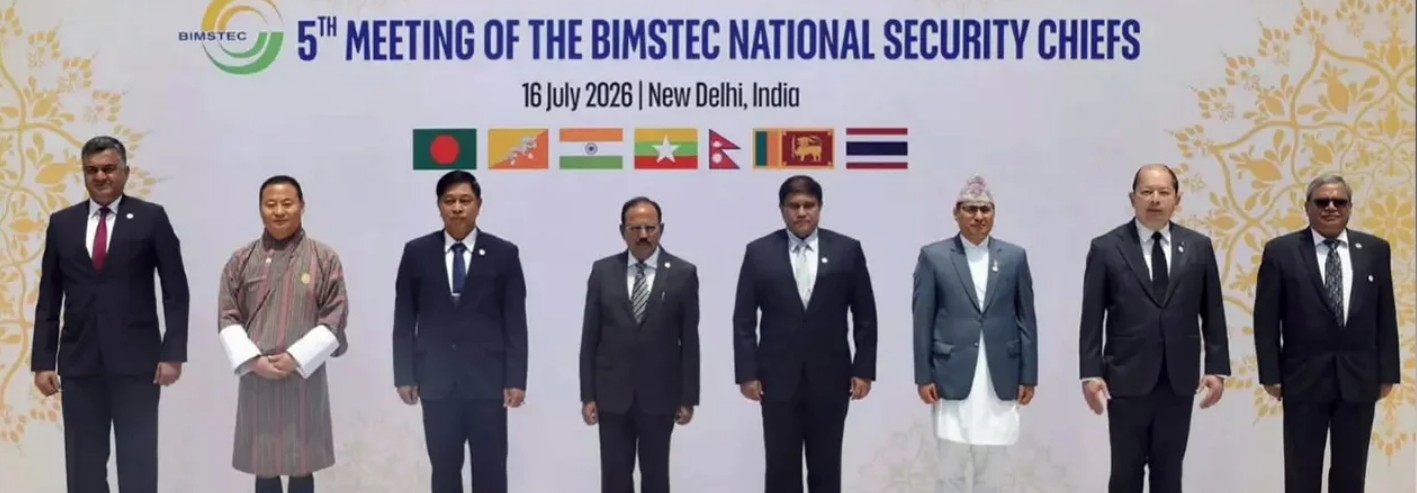
Image Source: Press Information Bureau (PIB)

Soumyadip Mondal is an international relations scholar whose research focuses on South Asian geopolitics, strategic studies, and foreign policy. He publishes analytical work on regional security and conducts rigorous research on conflict, constitutional change, and multilateral engagement through affiliations with leading academic institutes and think tanks.