India's AI Diplomacy and the Future of Strategic Technologies
The convergence of space, cyberspace, and artificial intelligence is redefining the foundations of national power and strategic competition. This article examines how India is integrating these domains through its evolving AI diplomacy, highlighting initiatives such as the AI Impact Summit, the India–U.S. TRUST initiative, and Pax Silica. It argues that while India has emerged as a key norm entrepreneur in global technology governance, sustaining this role will require stronger domestic capabilities in cybersecurity, semiconductor resilience, and indigenous innovation.
The fusion of space capabilities and cyberspace operations is reshaping global security. For India, the journey from a civilian space program focused on affordable satellite launches to a direct medium for civil-military-digital enterprise has accelerated with the rise of artificial intelligence. This essay explores how India’s AI diplomacy, through the AI Impact Summit, the TRUST initiative with the United States, and its accession to the Pax Silica framework is forming a strategic doctrine that treats space, cyberspace, and AI infrastructure as interconnected pillars of national power. This modern transition is not just theoretical. India’s space-based surveillance systems now rely predominantly on AI for data processing, and these assets face growing cyber threats. The integration of space and cyberspace is evident in India’s strategic planning. At the same time, India’s diplomatic posture at the AI Impact Summit, presenting itself as a bridge between the Global North and the Global South, reflects a strategy that leverages its space capabilities, software talent, digital infrastructure, and democratic governance to shape global technology norms.
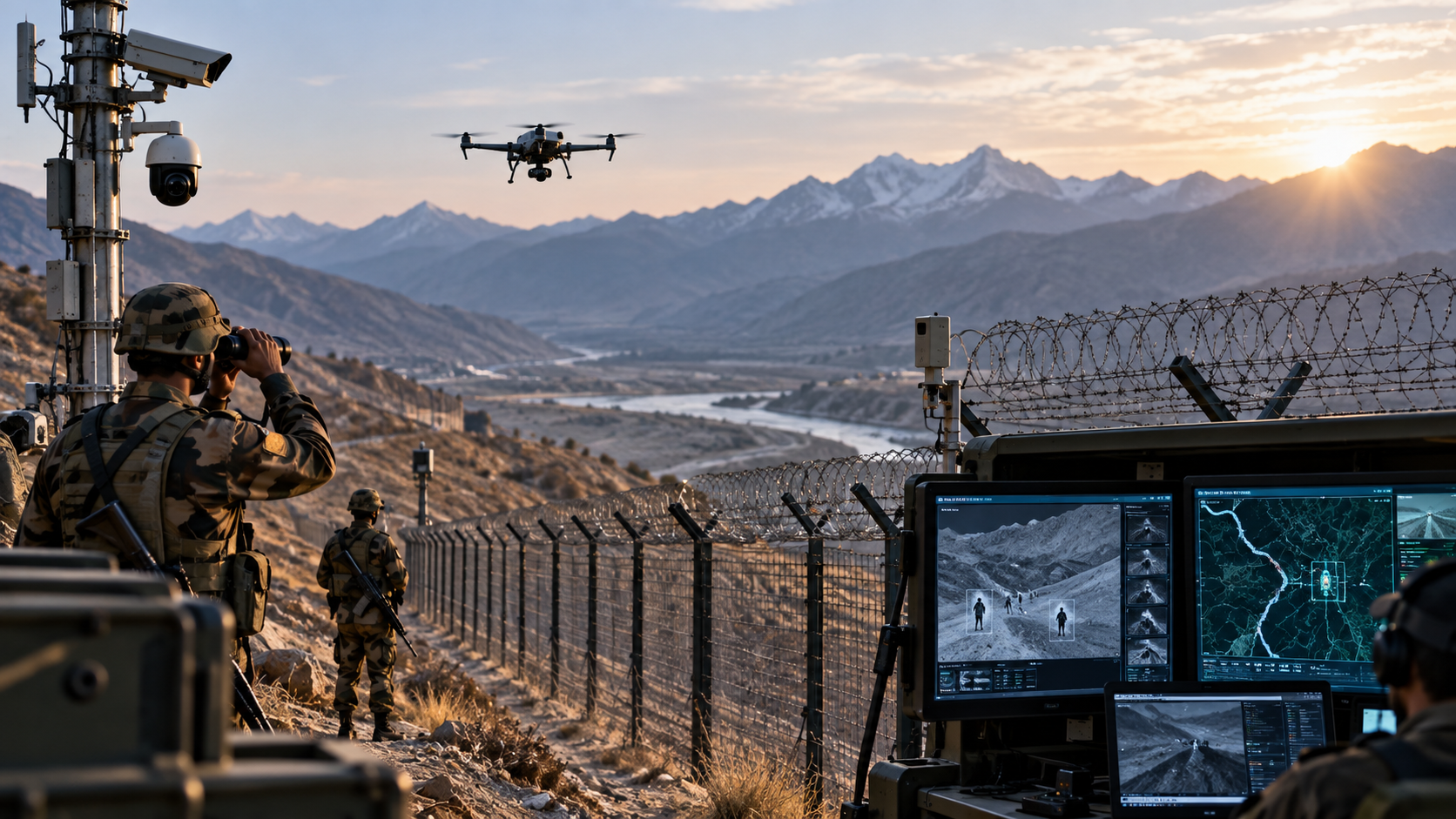
India’s space programme underwent a major shift in 2025. The SpaDeX mission, launched aboard PSLV-C60, demonstrated autonomous docking capabilities essential for future space stations and satellite servicing. Similarly, the NASA-ISRO Synthetic Aperture Radar (NISAR) mission, a joint Earth observation project, positioned India among the leaders in dual-frequency radar technology for tracking environmental changes. A pivotal moment came when ISRO acknowledged its role in Operation Sindoor, a precision-strike campaign targeting terrorist installations in Pakistan. This marked a departure from ISRO’s traditionally civilian stance and confirmed the operational use of satellite-based intelligence. The 52-satellite Space-Based Surveillance phase III programme (SBS-III) institutionalizes this civil-military fusion, aiming to reduce India’s reliance on foreign intelligence assets.
Furthermore, artificial intelligence is now embedded across India’s space missions. Chandrayaan-3 used AI for hazard detection during its lunar landing, showcasing autonomous navigation. The POEM-4 platform hosted twenty-four payloads, including AI experiments in robotics and propulsion. In 2026, ISRO is expected to demonstrate quantum key distribution for secure communications and high-thrust electric propulsion for agile satellites, technologies with both civilian and military applications.
The Ministry of External Affairs created the NEST division to manage strategic technologies, including AI and space. NEST coordinates partnerships like the India-U.S. joint statement of February 2025, ensuring India engages with advanced space powers while also supporting Global South nations. This dual role, technology contributor and beneficiary, defines India’s diplomatic approach and its security contributions.
India’s space assets are vital to both civilian and military operations. They support communications, navigation, broadcasting, and emergency response. As aerospace engineering merges with software systems, vulnerabilities have increased. Cyber incidents targeting satellites and ground stations have prompted action. In February 2026, CERT-In and SIA-India released India’s first Space Cyber Security Guidelines at the DefSat Conference in New Delhi.
These guidelines recommend layered security, accountability, risk protocols, and structured reporting. They also address the growing private space sector, which has introduced more digital interfaces and software dependencies. The liberalization of space policy has enabled private firms to build and launch satellites, increasing exposure to cyber threats.
Despite progress, India faces institutional gaps in space cybersecurity. There is no independent Space Cybersecurity Command to counter satellite hacking or GPS spoofing. ISRO lacks a dedicated cybersecurity division, creating vulnerabilities at the intersection of its civilian and military roles. China, with over 300 military satellites, has invested heavily in both offensive and defensive cyber capabilities. India’s SBS-III programme aims to address this asymmetry. India’s dependence on foreign hardware was highlighted by the U.S. AI Diffusion Rule of January 2025, which placed India in a Tier 2 category requiring licenses for advanced chip imports. Although rescinded in May 2025, the rule underscored India’s strategic anxiety about technological dependency. This concern has driven efforts to develop indigenous AI models and secure supply chains through the Pax Silica framework.
The AI Impact Summit in February 2026 showcased India’s diplomatic leadership. As the first Global South host of the summit series, India positioned itself as a broker between advanced economies and developing nations. The summit’s structure, organized around three Sutras (People, Planet, Progress) and seven Chakras (working groups), emphasized development priorities over regulatory caution.
The Leaders’ Declaration, signed by ninety-one countries including China, Russia, the United States, and the European Union, endorsed equitable AI diffusion, trusted frameworks, scientific collaboration, and workforce reskilling. It supported widespread AI adoption for economic and social benefit, moving away from the precautionary tone of earlier summits. Brookings Institution analysis noted that sovereignty debates are becoming pragmatic, AI diffusion is reshaping global priorities, and safety remains a challenge for implementation.
The U.S.-India TRUST initiative, announced during Prime Minister Modi’s visit in February 2025, provides a framework for operationalizing space-cyberspace-AI convergence. Under TRUST, civil space cooperation includes the ISRO-NASA-Axiom mission that placed astronaut Shubhanshu Shukla on the International Space Station, and the NISAR mission. Carnegie Endowment analysis highlights a strategic framework for human spaceflight signed in 2024, enabling advanced training for ISRO astronauts at NASA. The AI and Technology Cooperation Dialogue held in New Delhi in November 2025 complemented TRUST by focusing on AI infrastructure and talent development. It produced commitments aligned with India’s Governance Guidelines and reinforced the concept of a trusted AI corridor combining India’s digital infrastructure with U.S. capabilities. Together with Pax Silica, these initiatives form a layered diplomacy: TRUST provides bilateral depth, Pax Silica ensures multilateral supply chain alignment, and the AI Impact Summit offers convening legitimacy.
India’s AI diplomacy faces internal tensions. The push for technological sovereignty through indigenous models and infrastructure contrasts with reliance on U.S. semiconductors. The Print notes that India’s assets, software talent, digital infrastructure, electronics market, and defence modernization, make it a valuable partner. However, it lacks the chip fabrication capacity of Taiwan, South Korea, or Japan, limiting its role in the Pax Silica supply chain. India’s initial exclusion from Pax Silica’s founding membership in December 2025 reflected this limitation. Asia Times reported that India was seen as a consumer rather than a co-producer of the technology stack. Its admission in February 2026 followed diplomatic engagement and a strategic recalibration by the Trump administration, recognizing India’s scale, democratic credentials, and infrastructure as essential to countering Chinese dominance.
India’s AI diplomacy in 2025 and 2026 reveals a strategic doctrine that integrates space, cyberspace, and AI infrastructure. The civil-military fusion of the space programme, the SBS-III constellation, and cybersecurity guidelines establish space as a critical node in India’s AI ecosystem. The AI Impact Summit, TRUST initiative, and Pax Silica accession form a multi-vector diplomacy that leverages India’s unique assets to shape the global AI order. The key insight is that space and cyberspace are now inseparable in India’s strategic thinking. Securing space assets requires cyber defence. AI-enabled surveillance depends on semiconductor supply chains. India’s credibility as a Global South bridge-builder hinges on its ability to develop indigenous capabilities. The next decade will test whether India’s diplomatic architecture can be matched by the industrial and scientific investments needed to close the gap between aspiration and dependency. Success will depend not only on policy coherence and diplomatic agility but also on sustained funding, institutional reform, and the cultivation of a robust innovation ecosystem that can translate strategic vision into operational capability.
Endnotes:
1. Observer Research Foundation. 2026, A Turning Point for the Indian Space Programme. January 2026. https://www.orfonline.org/research/2026-a-turning-point-for-the-indian-space-programme
2. The Diplomat. India's New Space-Based Spy Network. January 2025. https://thediplomat.com/2025/01/indias-new-space-based-spy-network/
3. Carnegie Endowment for International Peace. The India-U.S. TRUST Initiative: In Space We TRUST. April 2025. https://carnegieendowment.org/posts/2025/04/the-india-us-trust-initiative-in-space-we-trust-new-horizons
4. CERT-In and SIA-India. India Space Cyber Security Guidelines 2026. Released at DefSat Conference and Expo, New Delhi, February 26, 2026. https://edunovations.com/currentaffairs/national/india-space-cyber-security-guidelines/
5. DD News. Year-Ender 2025: India's Space Programme in 2025 — Technology, Diplomacy, and the Road to Space Vision 2047. December 2025. https://ddnews.gov.in/en/year-ender-2025-indias-space-programme-in-2025-technology-diplomacy-and-the-road-to-space-vision-2047/
6. Brookings Institution. Sovereignty, Safety, and Scale: Takeaways from the India AI Impact Summit. March 2026. https://www.brookings.edu/articles/takeaways-from-the-india-ai-impact-summit/
7. Carnegie Endowment for International Peace. India Signs the Pax Silica — A Counter to Pax Sinica? March 2026. https://carnegieendowment.org/china/posts/2026/03/india-signs-the-pax-silicaa-counter-to-pax-sinica
8. The Print. Joining Pax Silica Is Not All Positives for India. We Must Guard Strategic Autonomy. February 2026. https://theprint.in/opinion/joining-pax-silica-is-not-all-positives-for-india-we-must-guard-strategic-autonomy/2863388/
9. Asia Times. Why the US-Led Pax Silica Tech Alliance Snubbed India. December 2025. https://asiatimes.com/2025/12/why-the-us-led-pax-silica-tech-alliance-snubbed-india/
10. Observer Research Foundation. Emerging Technologies and India's Defence Preparedness. https://www.orfonline.org/research/emerging-technologies-and-india-s-defence-preparedness
11. United States Department of State. "Pax Silica." https://www.state.gov/pax-silica
(The views expressed are those of the author and do not represent the views of CESCUBE)

Vivetha Jayaseelan is an International Relations researcher specializing in the securitization of critical infrastructure and Indo-Pacific security architecture. Her research investigates the intersection of sub-sea strategic autonomy, AI space diplomacy, and non-traditional regional security threats using OSINT and quantitative analysis.