Indo-Pakistan Relations post Op-Sindoor: Dissecting Third Party Intervention Amidst Tumultuous Bilateral Ties
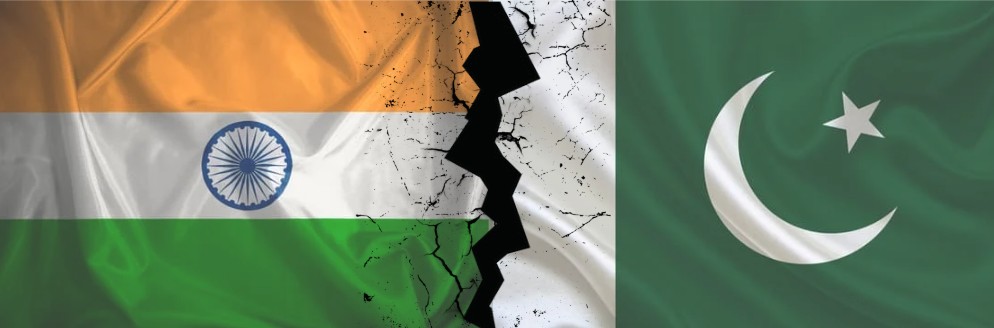
This article critically examines the geopolitical ramifications of Operation Sindoor, India’s retaliatory action against Pakistan following the Pahalgam terror attack in April 2025. Rooted in India's long-standing commitment to principles o...
“Yesterday’s weapons cannot win today’s wars, tomorrow’s technology is needed to fight today’s battles.[i]”
-CDS General Anil Chauhan
I. Operation Sindoor: The Aftermath
India, as a principled nation has always walked on the path of principles imbibing the essence of natural justice[ii], rule of law[iii], democratic constitutionalism[iv], nomocracy, tenets of principled governance, constitutional procedural apparatus, and summing them all- has always tread the path of- Vasudhaiva Kutumbhakam. India’s vision of the world is not exclusionary, but includes all, and highlights the basic foundational value of- “One Earth, One World, One Family”. Here lies the completeness of the whole Indian thought; and herein lie the basic national security and foreign policy doctrines of India, which succinctly state that India shall in no way, transgress or target any other nation, its national sovereignty, its territorial integrity, and broader border security.
India, thus far has always abided by her core principles of independence, and has all the intentions to continue to do the same. However, in any case, if any other nation tries to act on the contrary or disturb the status quo, India, for reasons obvious, will not be taking it sitting quiet. This has been showcased and upheld by India, in all the bilateral skirmishes, limited wars, or all-out wars that she has seen in her nascent stages of Independence, up until now. This is exactly what happened when India struck back and retaliated against Pakistan on the intervening night of 6-7th May 2025[v], in response to the dastardly beastly attack on innocent civilians at the Pahalgam Valley, on 22nd April, 2025. The bilateral relationship between India and Pakistan has been patchy[vi], at its best, since the brutal, blood-wrenching partition that both sides faced as a result of British misgivings under the garb of calculated governance.
While certain unintended actions did take place, and none of that was in anybody’s control to handle or change, a wise national consciousness would certainly look ahead and work for the future; instead of pondering over the past. But Pakistan was not to do so, at any cost. It is often said that good neighbours can make your life a transcendental bliss. But, India did not get any instance whereby the same could have been enjoyed, even for a brief moment. With China[vii] always knifing down India’s neck (Siliguri Corridor) with nefarious partnerships formulated across Pakistan, Bangladesh, et al; Pakistan[viii] constantly on the lookout for a chance to kill Indian interests geo-politically, economically, historically, diplomatically, maritime-wise, etc; with internal tensions and internal conflicts rising in Bangladesh[ix], Sri Lanka, amongst others; and extremism, intolerance, state-sponsored terrorism, societal disintegration on the rise- India has her hands full.
To harmoniously balance all these conflicting viewpoints, and interests in her neighbourhood, India surely does play her part well, by endorsing what is internationally justifiable and right; with positively retaliating against what all is wrong. And recently, the world also saw how India does react and limits herself to teaching much needed lessons to erring parties; in this case- Pakistan. Even though India performed her part in “Op. Sindoor” and showed her technological, cyber, technical, economic, and diplomatic prowess, what was interesting to watch was the number of nations that sided with Pakistan, for all the wrong reasons in this bilateral transaction.
II. Third-Party Interventions and Dwindling Bilateral Channels: A Death-knell for Pakistan’s Disoriented State
India per se, has always striven to maintain cordial relations with all her partners, including Pakistan. But the same cannot be said for Pakistan, for reasons best understood in silentio.A number of countries which have time and again supported Pakistan, have yet again showcased their support for the rogue nation. Be it Turkiye, Azerbaijan, or China, covertly or overtly, the support that has been shown by these nations for Pakistan was not only an eye-opener, but a constant reminder of how backstabbing by nations in the international world order is not new.
India was the first respondent to Turkiye’s call for help in the wake of devastating earthquakes that hit Turkiye and Syria in February 2023. And yet, forgetting all such support and assistance of the past in the form of Humanitarian Assistance and Disaster Relief (HADR), Turkiye was the first nation to back Pakistan in its dastardly unprovoked attack on Indian sovereignty in the wake of the Pahalgam attack. If nothing else, it certainly does prove the point that in international relations, friends and enemies are transitory temporary, it is only the national interests which supersede all. Same is true for Turkiye siding with Pakistan on the issue of Kashmir, which India has innumerably stated as a “strictly bilateral issue”, not open for mediation by third parties. Turkiye aids Pakistan via military training programmes[x], economic support, and diplomatic overtures. Not only this, but defense deals have increased, and so is the trilateral partnership between Turkiye-China-Pakistan, which has taken the shape of an unbreakable bonhomie and certainly will add to India’s issues with these nations, either diplomatically, or militarily.
The Chinese aid that is being consistently provided to the Pakistani establishment is something to ponder upon. Not only does it have the force to change the whole geopolitical scenario of the world, but it can also destabilise the fragile and peaceful status quo of the Indian subcontinent. The Belt and Road Initiative of China (BRI)[xi] and the China-Pakistan Economic Corridor (CPEC) are two of the most startling examples of the same. China is engaging with Pakistan in furtherance of its military modernisation, territorial expansion, foreign population exploitation, promotion of new international order in defiance of established rules and regulations, successful propagation of carrot and stick policy, et al. These tactical deployments, even after being overtly visible to international players, are surprisingly ignored by the Pakistani establishment, because of the benefit that these accrue in shorter term for the insubordinate nation (in this case, Pakistan).
However, these policies are curated to create a brittle and flimsy ground of bilateral cooperation, often resulting in huge losses to the insubordinate nation. China has not only practiced this in Pakistan (whereby, the BRI is being heavily protested by the local Balochistanis, in specific relation to the lopsided foreign-induced development of Gwadar port and exploitation of natural resources), but has also made specifically designed inroads into the African continent (technological investment, military base development, exhaustion of natural mineral resources, rare-earth minerals), the Arctic Sea (infrastructure development, partnerships with Arctic region countries, settlement of Chinese inhabitants to increase influence), alongwith repeated clashes being orchestrated by the Chinese side in the South China Sea, Indo- China border, and the Indo-Pacific Region. This is not at all new, but if Chinese inroads and specific military aid to Pakistan increases (as has been seen after Op. Sindoor), this could unwantedly change the whole Indo-Pakistan dynamic -from strictly bilateral to battleground of proxy players-with vested interests of China, Australia, Bangladesh, Russia, North Korea, Turkiye, growing beyond diplomatic Indian control. This, of course, will be quintessentially unacceptable by India, by all means.
Coming to another major partner and “crisis-friend” of Pakistan, Azerbaijan is a glaring example of how friendships grow and sustain in the international world order. Azerbaijan and Pakistan share cohesive bilateral relationship which encompasses sectors such as defense, energy, infrastructure, social bonhomie, etc. However, the quid pro quo between both the nations lies in the fact that Pakistan supports Azerbaijan’s diplomatic control/ support in the Nagorno-Karabakh conflict, whereas Azerbaijan supports Pakistan in its Kashmir standing. Not only that, but Azerbaijan has constantly engaged in defense procuration from Pakistan, which has resulted in joint defense manufacturing by both the nations, military-technical and active cyber cooperation across timelines. Both the nations regularly invest in each other’s economies[xii], with Pakistan securing the right to procure LNG cargoes on demand, and the development of Machike-Thallian-Tarujabba White Oil pipeline project, upping the ante of the bilateral relationships. Azerbaijan-Turkiye-Pakistan engage in a number of trilateral meetings with the recent outing being right after the successful conduct of Op. Sindoor by India. Nobody can forget the praises that the Pakistani Army Chief received from the Azerbaijani and the Turkish side at the trilateral meeting, which of course, was specifically derided by the Indian side, in all her rights.
Even though Pakistan receives overt and explicit support from Turkiye, Azerbaijan, and China as aforementioned at all occasions, there are still many more international players that do so covertly, and in a much more clandestine manner.
Pakistan, being a Muslim-dominated country, is anyhow supported by Muslim majority nations such as Saudi Arabia, Qatar, Iran (for geo-political reasons, but Shia-Sunni dichotomy still exists between the two), United States (for historical reasons- growth of Mujahideen, Pre-Nuclear India and Post-Nuclear India bonhomie, and Pakistan acting as a strict ante to India’s rise to global super power), and various international organisations such as the Commonwealth of Nations, the Organisation of Islamic Cooperation, as well as the Shanghai Cooperation Organisation (SCO)- as seen recently whereby the Defense Minister of India, Sh. Rajnath Singh refused to sign the joint declaration of SCO, due to specific exclusion of the Pahalgam attack. However, India’s position was soon recovered back in the joint BRICS declaration and the successive meeting of Dr. S. Jaishankar with the Vice-President as well the foreign ministry officials of China, in Beijing after a gap of number of years. The aforementioned issues are just like thorns to roses in a plausible successful India-Pakistan relationship.
III. Parting Note: Kindering Hopes for a Bilateral Bonhomie
Even though India has always striven to avoid any third-party interference in her bilateral relations, Pakistan has consistently tried to add on third parties in the bilateral bond. This, of course, has not gone down well for both the nations, but has been historically impossible to balance Pakistan’s rogue behaviour with India’s interests, for the Indian diplomatic side. The United States of America has been a historical strategic partner of Pakistan and has used the Pakistani soil for many of its ulterior motives as well such as in maintaining the proxy-balance with the USSR in the Cold War Era, in supporting Pakistan when the Kashmir issue was referred to the United Nations, etc.Similarly, China, and other nations as well have used and exploited the Pakistani soil their specific motives.
All of this, even while Pakistan has been consistently struggling with its own domestic issues of unemployment, economic distress, amongst others. Third party interventions in the bilateral issue of India and Pakistan have constantly increased from the Pakistani side; whereas India has engaged with other countries after Op. Sindoor, not for military interventions or third-party interference between India and Pakistan. The objective furthering which India engages with third parties thus, is drastically opposite to Pakistan’s. Conclusively, the heavy interference of other nations in the bilateral relations of India and Pakistan, is neither in favour of India, and nor is it in favour of Pakistan. If avoided, the diplomatic back track channels of India and Pakistan can rejuvenate themselves with collective efforts from both the sides. Nevertheless, Pakistan has been historically untrustworthy, in all areas of bilateral cooperation, whatsoever. Therefore, yet again, India has an insurmountable mountain to cross in the form of Pakistan’s consistent efforts to engage as many proxies in its bilateral relationship with India. Much to the chagrin of the Indian side, this is the truth, and hereby will be tested the diplomatic prowess of India, already exhibited in the aftermath of Op. Sindoor, when India reached out to strategically important partners across continents. The future cannot be seen but can be worked upon, and thence, India must always be on her guard to act strategically and actively, as and how, whichever and whatever situation arises.
Jai Hind.
[i] “Operation Sindoor: CDS Chauhan says ‘yesterday’s weapons can’t win today’s wars’: bats for indigenous tech”, Times of India, July 22, 2025, https://timesofindia.indiatimes.com/india/neutralised-pakistani-drones-through-cds-anil-chauhan-shares-new-details-on-operation-sindoor-pitches-for-local-tech/articleshow/122554205.cms.
[ii] “6 Principles of Natural Justuce”, National Institute of Open Schooling, July 22, 2025, https://www.nios.ac.in/media/documents/SrSec338New/338_Introduction_To_Law_Eng/338_Introduction_To_Law_Eng_L6.pdf; Kenneth Binmore, Natural Justice (2005); Paul Jackson, Natural Justice (1973).
[iii]Justice A.K. Sikri, Constitutionalism and the Rule of Law: In the Theatre of Democracy (2025).
[iv] Robert C. Post & Reva B. Seigel, “Democratic Constitutionalism”, Yale Law School, https://law.yale.edu/sites/default/files/documents/faculty/papers/post_and_siegel_democratic_constitutionalism.pdf; ; Mathew John, Democratic Constitutionalism in India and the Blandishments of Grand Narratives, IACL-AIDC Blog, February 26, 2025, https://blog-iacl-aidc.org/2025-posts/2025/2/26/democratic-constitutionalism-in-india-and-the-blandishments-of-grand-narratives;
[v] “Operation Sindoor: CDS Chauhan says ‘yesterday’s weapons can’t win today’s wars’: bats for indigenous tech”, Times of India, July 22, 2025, https://timesofindia.indiatimes.com/india/neutralised-pakistani-drones-through-cds-anil-chauhan-shares-new-details-on-operation-sindoor-pitches-for-local-tech/articleshow/122554205.cms.
[vi] Ajay Bisaria, Anger Management: The Troubled Diplomatic Relationship between India and Pakistan (2024).
[vii] Zorawar Daulet Singh, Powershift: India-China Relations in a Multipolar World (2025); “Prospects for Indo-China Relations”, The International Institute for Strategic Studies, May 16, 2025, https://www.iiss.org/online-analysis/online-analysis/2025/05/prospects-for-indiachina-relations/.
[viii] Christophe Jafferlot, The Pakistan Paradox: Instability and Resilience (2015).
[ix] Chandrika Gulati, Bangladesh: Liberation to Fundamentalism- A Study of Volatile Indo-Bangladesh Relations (1988).
[x] “Turkey and Pakistan: A Special Relationship?”, The International Institute for Strategic Studies, July 22, 2025, https://www.iiss.org/online-analysis/online-analysis/2020/04/dmap-turkey-and-pakistan-a-special-relationship/.
[xi] “India’s Strategic Leverage Amidst US-China Rivalry over Pakistan”, ORFOnline, July 22, 2025, https://www-orfonline-org.webpkgcache.com/doc/-/s/www.orfonline.org/expert-speak/india-s-strategic-leverage-amidst-us-china-rivalry-over-pakistan.
[xii] “What is Behind the Azerbaijan-Pakistan Love Affair”, India Blooms, July 16, 2024, https://www.indiablooms.com/news/what-is-behind-the-azerbaijan-pakistan-love-affair/details.
(The views expressed are those of the author and do not represent the views of CESCUBE.)

Ms. Sanighdha is currently a Doctorate Junior Research Fellow (UGC-JRF), pursuing her Ph.D. in A.I. and National Security Laws at the Department of Laws, Panjab University, Chandigarh. Having pursued her graduation in the field of law, she is an enrolled advocate, and has her Masters in the field of constitutional and administrative laws. She is a published poet with her two publications "The Musings of My Heart" and "My Reflective Contemplations", with the Bookleaf Publishing Agency, and additionally a published legal author with the Allahabad Law Agency, of a book titled "Indian Constitutionalism: Originalism, Living Constitutionalism and Transformative Theories", co-authored with Prof. Rattan Singh (VC, Punjab State Open University, Patiala). Additionally, she is a regular fortnightly contributing columnist to a premier defense magazine, "Life of Soldiers", and contributes to ETLegal World as well. Apart from this, she has numerous research paper publications to her credit and has presented her research papers touching socio-legal issues across international/national conferences/seminars in India. She has immense interest in issues touching upon India's defense sector and national security issues.