Operation Sindoor: A Critical Analysis
The April 2025 Pahalgam terror attack, which killed 26 civilians, marked a turning point in India’s internal security and triggered Operation Sindoor against Pakistan-based terror infrastructure. While militarily effective, the operation ex...
Introduction:
The tragic terrorist attack in Pahalgam on April 22, 2025, which killed 26 innocent civilians, mostly Hindu tourists, sparked nationwide outrage and prompted a strong response from India. In a decisive reaction to the gruesome terrorist attack in Pahalgam, the Cabinet Committee on Security (CCS) approved a series of stringent measures targeting Pakistan’s continued support for cross-border terrorism.[i] Yet another clear attempt to incite communal violence in an already heavily militarised region, this marked a shift from cross-border attacks to dividing India from within. In response, along with diplomatic and economic measures, India launched Operation SINDOOR to destroy the terror bases behind the attack. This act was considered an act of provocation by Islamabad and was responded to with escalatory force. Over the next week, it used drones and shelling to target religious sites. The Shambhu Temple in Jammu, the Gurdwara in Poonch, and Christian convents were attacked.[ii] This report attempts to bring out the civilian perspective to these events, i.e. focusing not on military effectiveness and capabilities but on transparency, media communication, public sentiment, international law and narrative control. This aim will be supported by a comparative analysis of the above criteria between OP SINDOOR, OP Rising Lion and ISPR’s coverage of the same.
Media Strategy and Civil Perception:
The trigger factor to this conflict: the Pahalgam terror attack was an intentional attempt by Pakistan to capitalise on India’s religious fractures by targeting a specific religious group. This act aimed to compromise national unity, especially in a region already under prolonged militarisation and prominent anti-government sentiments[iii]. This implies the existence of a deeper narrative war hidden in the traditional proxy war. Hence, the media’s role in maintaining societal unity and preventing anti-government sentiment is paramount. Even though India’s outreach domestically and internationally has improved from the previous conflicts, operations and surgical strikes, it is yet to be comparable with other global or regional powers.
a) Ambiguous stance: India's ambiguous stance towards the OP and the subsequent retaliation was an intentional power move to deny the adversary any credibility to their attempt to damage Indian military and civil infrastructure and life, while maintaining an “unshaken” or “indifferent” image to the global eye. Whilst being highly effective internationally, it caused anxiety domestically, as there were limited live and credible updates regarding the breadth and depth of the conflict, along with a plethora of digital misinformation in the mix.
b) Tackling Misinformation: The Indian government’s fact-check unit (FCU), under the Press Information Bureau (PIB), had ramped up its efforts to debunk false narratives being circulated online.[iv] Along with the Indian Armed Forces, dedicating 15% of their time and effort to debunking disinformation.[v] Although majorly effective, the natural delay in seeking out false information, fact-checking it, and then publishing it to be false could not keep up with the volatility of digital disinformation, propaganda and media. This delay was even acknowledged by the Chief of Defence Staff (CDS) General Anil Chauhan.[vi]
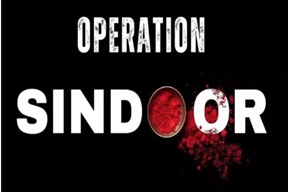
c) Disseminating Information: The primary sources for credible information during the conflict were the PIB's press releases, available through their website and social media handles. Additionally, the Indian armed forces utilised their social media handle “ADG PI,” which over a period of time put out 11 posts regarding OP SINDOOR, which yet provided no facts or figures regarding the conflict, with the primary media being the OP SINDOOR poster. On the other hand, this social media handle covered Yoga Day more extensively (22 posts), backing up the Indian “indifferent” image.[vii]
Based on the above inferences, it can be established that India's strategy towards narrative building and tackling misinformation has been reactionary rather than proactive. More effort was poured into debunking false information instead of constantly providing credible information. A case worth studying and absorbing for India would be the Israel Defence Forces' strategy and measures for propagating a narrative, along with minimising civil unrest by keeping them informed.
Comparative Case Study: Operation Rising Lion:
While discussing the military’s media engagement, transparency and narrative-building capabilities, one cannot ignore the framework set up by the Israeli Defence Forces to maintain not only domestic but international perception in their favour. Apart from being a tool of statecraft or propaganda, it helps prevent chaos and anxiety among the citizenry during times of crisis. This framework was established under the term “Hasbara” (the Hebrew word for “propaganda”), and has been extensively employed, especially during the recent military operation by the IDF: Operation Rising Lion.
Commonalities with OP SINDOOR:
(i) Nomenclature: Both these Operations were carried out against an adversary with an opposing ideology threatening the existence and national security of the other. The reasoning behind the code name “OP SINDOOR” was drawn from a religious context and importance, since the triggering factor was targeted violence against Hindus.[ix] Similarly, Israel has named its military operation against Iran "Rising Lion" as it took the name from a biblical verse 23:24 that vows for a victorious future for a powerful Israel.[x] Both these codenames aim to expand the scope of sympathisers for the state’s cause but also tap into the religious unity of the majority.
(ii) Means:

Table 1: Comparison of IAF and IDF capabilities and means for respective Ops.[xi] [xii] [xiii]
(iii) Nature: Both Operation Sindoor and Operation Rising Lion were precision-strike missions aimed at dismantling the adversary’s ability to retaliate: India targeting Pakistan’s terror infrastructure and military nodes, and Israel pre-emptively striking Iran’s missile and nuclear assets. While both countries succeeded in achieving their goals and limiting escalation through measured force, the way they handled retaliation differed starkly.
(iv) Retaliation:
Following Operation Sindoor, Pakistan retaliated with drone and missile strikes directed at Indian military installations between May 8–9, 2025. These attacks included multiple UAVs and short-range missiles targeting airbases, border command posts and religious sites in Punjab and Jammu & Kashmir. According to PIB, all attempted strikes were successfully intercepted using India’s Akash and SPYDER surface-to-air missile systems.[xiv] However, Pakistan’s simultaneous escalation along the Line of Control (LoC) led to 12 Indian civilian casualties and over 40 injuries, triggering panic in border districts.[xv]
Israel’s Operation Rising Lion faced a coordinated retaliatory campaign by Iran. On April 15–16, Iran launched over 170 drones, 30 cruise missiles, and 120 ballistic missiles targeting critical Israeli infrastructure, including military airfields in the Negev and command centres in northern Israel. Thanks to the Iron Dome, David’s Sling, and Arrow-3 systems, Israel intercepted nearly 99% of these projectiles, as confirmed by Reuters and the US Department of Defense’s European Command. The response was one of the largest integrated missile defence efforts in Israeli history and was supported by coordinated air patrols with U.S. aircraft.[xvi]
(v) Countermeasures:
India’s response to Pakistan’s counter-strike was predominantly kinetic:
- On May 9, Indian Air Force aircraft struck deeper military installations in Sargodha, Murid, and Rafiqui in retaliation.
- While also intercepting the majority of the projectiles from Pakistan, including kamikaze drones and missiles, using indigenous and effectively integrated defence systems.
- However, communication from the Indian public remained minimal. Aside from selective updates by the Defence PRO and PIB’s disinformation clarifications, the Indian government did not disclose loss figures or operational outcomes.
- This led to significant civilian confusion and media speculation, given that there was no real-time information being disclosed by the state regarding the depth and breadth of the conflict.
- Hence, there was a more extensive requirement for fact-checking and fake news debunking.
- Across the borders, Inter-Services Public Relations (ISPR) covered the events in more detail (accuracy and credibility under speculation), but also mostly propaganda-heavy.

Fig 1: ISPR Press Release covering details of OP Sindoor
On the other hand, Israeli countermeasures were different:
- In addition to its missile interceptions, Israel conducted follow-up
- Airstrikes on IRGC command nodes and missile storage facilities in Syria and western Iran.
- These retaliatory strikes were executed within hours and were accompanied by immediate media briefings by the IDF, including satellite images and airstrike footage.
- The Israeli government also engaged in global diplomacy, hosting press briefings for international correspondents, briefing the UN Security Council, and deploying foreign ministry spokespersons to major media networks such as CNN, BBC, and Al Jazeera.
- The IDF’s social media platforms were employed far more proactively, publishing media and graphics such as maps with locations being targeted by the adversary, footage of defensive equipment being deployed, accurate statistics, facts and figures to further propagate their cause and invite sympathisers.

Fig 2: The IDF X handle provides daily updates on attempts at striking Israeli targets

Fig 3: Illustrations published by IDF covering the details of OP Rising Lion
Policy Suggestions:
The events surrounding the first of its kind Operation Sindoor revealed that while India has developed substantial military capabilities, including inter-service cooperation and fluidity, self-reliance in terms of defence manufacturing. However, its underdeveloped strategic communication, public diplomacy, and civilian information infrastructure are symptomatic of a lack of experience in the same. To address these gaps, a series of policy recommendations is proposed, drawn from the comparative lessons of Israel’s Operation Rising Lion and credible domestic analysis.
a) India must establish a National Strategic Communication Taskforce (NSCT) under the National Security Council Secretariat to unify the narrative efforts of the Ministry of Defence, the Ministry of External Affairs, PIB, and the armed forces. As demonstrated during Israel’s real-time dissemination of visuals and verified data via the IDF’s official channels and foreign ministry briefings, centralised messaging can decisively shape global perception and public morale.
b) The Ministry of External Affairs should operationalise Pre-Conflict Embassy Preparedness Protocols. The relative diplomatic inertia of Indian embassies during the early phase of Operation Sindoor enabled adversaries like Pakistan’s ISPR to dominate narrative spaces. Embassies must be equipped with “crisis information kits” including legal justifications, satellite imagery, humanitarian briefings, and multilingual press statements. Such an effort will not only bend international perspective but also cause domestic tensions with the adversarial state by denying them absolute credibility.
c) The government should implement a Civilian Alert and Assurance System, akin to Israel’s “Red Colour” mobile app. Civilian panic, especially in Punjab and Jammu & Kashmir during the retaliation phase, was amplified by the lack of real-time official updates. A secure and verified alert mechanism could include map-based alerts (similar to as observed in Fig. 3), official advisories, and basic reassurance messaging, reducing susceptibility to misinformation.
d) To uphold democratic transparency and prevent such future instances, India should implement a Post-Operation Disclosure Protocol, where non-sensitive details such as strategic objectives achieved, civilian protections enforced, and minimal loss figures are released within 14–30 days post-ceasefire, pending security clearance.
Conclusion:
Operation Sindoor marked a critical moment in India's evolving security posture, not only for its kinetic precision and military assertiveness but also for the urgent lessons it revealed in the domains of tactical, civilian communication, strategic narrative-building, and digital information warfare. This Operation, as claimed by the govt. has set forth a new ‘normal’, and hence it is imperative to further perfect such frameworks. While the Indian armed forces successfully neutralised multiple terror and military nodes within Pakistan but lethality alone doesn’t make the military of a democratic state great. The government’s overall public engagement remained reactive, ambiguous, and fragmented, creating confusion, anxiety, and a gap that was quickly filled by adversarial propaganda, especially from Pakistan's ISPR.
The case study of IDF’s OP Rising Lion highlighted that certain improvements are applicable in the real world, and especially in the case of India, given the commonalities between the two OPs. Despite India’s improved outreach compared to past operations, the lack of visual documentation, embassy preparedness, and crisis messaging protocols left civilians largely uninformed about the depth and breadth of the conflict. From a civilian perspective, the state's responsibility extends beyond military deterrence to ensuring psychological stability and public trust. In a hyper-digital world where perception can shape geopolitics as much as performance, India must now prioritise the development of a coherent national information warfare and strategic communication doctrine: one that is democratic, transparent, legally sound, and technologically agile.
The goal is not to imitate another state’s tactics, but to learn from best practices and tailor a uniquely Indian model of strategic communication that reinforces both national security and democratic accountability. Operation Sindoor was a victory in kinetic terms; the next challenge is to ensure it is equally remembered as a turning point in India’s civilian and strategic communication policy.
References:
[i] PIB Delhi. “Press Release: Press Information Bureau.”, 14 May 2025, https://www.pib.gov.in/PressReleasePage.aspx?PRID=2128747. Accessed 30 June 2025.
[ii] Kumar, Santosh, et al. “Press Note Details.” PIB, 12 May 2025, https://www.pib.gov.in/PressNoteDetails.aspx?NoteId=154448&ModuleId=3. Accessed 30 June 2025.
[iii] Kathju, Junaid. “Why are Kashmiris voting in Indian election they've long boycotted?” Al Jazeera, 16 May 2024, https://www.aljazeera.com/news/2024/5/16/kashmir-breaks-with-election-boycotts-protests-indian-policies-by-voting. Accessed 2 July 2025.
[iv] Sharma, Sejal. “Operation Sindoor: Indian govt's fact-check unit debunks fake narratives circulated online.” Hindustan Times, 7 May 2025, https://www.hindustantimes.com/india-news/operation-sindoor-indian-govt-s-fact-check-unit-debunks-fake-narratives-circulated-online-101746611502020.html. Accessed 4 July 2025.
[v] TOI News Desk. “15% of Army's time during Operation Sindoor went into countering fake narratives: CDS General Anil Chauhan | India News.” Times of India, 31 May 2025, https://timesofindia.indiatimes.com/india/15-of-armys-time-during-operation-sindoor-went-into-countering-fake-narratives-cds-general-anil-chauhan/articleshow/121530755.cms. Accessed 4 July 2025.
[vi] Ibid
[vii] https://x.com/adgpi?ref_src=twsrc%5Egoogle%7Ctwcamp%5Eserp%7Ctwgr%5Eauthor
[viii] https://x.com/adgpi/status/1919850036596199492
[ix] Das, Anupreeta. “The Symbolism Behind India's 'Operation Sindoor.'” The New York Times, 7 May 2025, https://www.nytimes.com/2025/05/07/world/asia/india-operation-sindoor-name.html. Accessed 7 July 2025.
[x] HT News Desk. “Why Israel named strikes against Iran 'Operation Rising Lion'? A Bible connection.” Hindustan Times, 13 June 2025, https://www.hindustantimes.com/world-news/why-israel-named-strikes-against-iran-operation-rising-lion-a-bible-connection-101749820441976.html. Accessed 7 July 2025.
[xi] Scarbro, Graham. “Iran-Israel Conflict: A Quicklook Analysis of Operation Rising Lion.” U.S. Naval Institute Proceedings, vol. Vol. 151, no. 6, 2025, p. 1468. US Naval Institute, https://www.usni.org/magazines/proceedings/2025/june/iran-israel-conflict-quicklook-analysis-operation-rising-lion. Accessed 7 July 2025.
[xii] PIB. “Press Information Bureau.” Press Information Bureau, 2025, https://www.pib.gov.in/EventDetail.aspx?ID=1206. Accessed 7 July 2025.
[xiii] Reuters. “What is Israel's multi-layered defence against Iranian missiles?” Reuters, 16 June 2025, https://www.reuters.com/world/middle-east/what-are-israels-iron-dome-arrow-missile-defences-2024-04-14/. Accessed 7 July 2025.
[xiv] PIB. “Press Release:Press Information Bureau.” Press Release:Press Information Bureau, 14 May 2025, https://www.pib.gov.in/PressReleasePage.aspx?PRID=2128746. Accessed 7 July 2025.
[xv] Farooq, Omer. “Operation Sindoor: 11 soldiers, 40 civilians killed in Indian strikes, discloses Pakistan's ISPR - The Times of India.” Times of India, 14 May 2025, https://timesofindia.indiatimes.com/india/operation-sindoor-11-soldiers-40-civilians-killed-in-indian-strikes-discloses-pakistans-ispr/articleshow/121147121.cms. Accessed 7 July 2025.
[xvi] Jensen, Benjamin. “Ungentlemanly Robots: Israel's Operation Rising Lion and the New Way of War.” CSIS, 13 June 2025, https://www.csis.org/analysis/ungentlemanly-robots-israels-operation-rising-lion-and-new-way-war. Accessed 7 July 2025.
Image Source: Press Information Bureau
(The views expressed are those of the author and do not represent the views of CESCUBE.

Alakshendra Singh is currently in his third year of the BA (Global Affairs) program at the Jindal School of International Affairs, O.P. Jindal Global University, Sonipat. His academic interests lie in the fields of defence, security, and strategic studies. He is an aspiring China specialist with A1 level proficiency in the Mandarin language.