BRICS Expansion and the Multipolar Moment: Opportunity or Strategic Contradiction?
The expansion of BRICS marks one of the most significant developments in contemporary global politics, reflecting the growing influence of emerging powers and increasing dissatisfaction with Western-dominated international institutions. With the inclusion of Egypt, Ethiopia, Indonesia, Iran, Saudi Arabia, and the United Arab Emirates, BRICS now represents a larger share of global population, economic output, energy production, and geopolitical influence. The expansion strengthens the bloc's claim to represent the interests of the Global South while enhancing its ability to advocate for reforms in institutions such as the United Nations, IMF, World Bank, and WTO.
However, greater size does not necessarily translate into greater cohesion. The entry of new members has also introduced competing regional interests, divergent foreign policy priorities, and strategic rivalries that complicate consensus-building within the grouping. This article examines whether BRICS expansion represents a genuine step toward a more multipolar international order or whether internal contradictions could limit its effectiveness. It argues that the future relevance of BRICS will depend not only on its ability to challenge existing power structures but also on its capacity to balance diversity, institutional development, and strategic coherence in an increasingly fragmented global landscape.
Introduction
An economist from the Goldman Sachs investment bank came up with the name BRIC in 2001 to acknowledge the rapid economic development of Brazil, Russia, India, and China and with the incorporation of South Africa in 2011, an “S” was added to the original acronym for the group’s first expansion. Traditionally BRICS primarily focuses on three areas: politics and security, economy and finance, and people-to-people cooperation.[1]
The BRICS is currently composed of eleven countries. Egypt, Ethiopia, Indonesia, Iran, Saudi Arabia, and the United Arab Emirates are the six new members admitted in 2024-25. The group seeks to improve the legitimacy, equity in participation, and efficiency of global institutions such as the UN, IMF, World Bank, and WTO. Moreover, it aims to advance social inclusion and sustainable social and economic growth.[2]
According to estimates, BRICS accounts for 37.3 % of world GDP. Since the new members would contribute roughly 4 % to the group’s cumulative GDP, the significance of the expansion should be seen beyond the purely economic effect, in the form of greater influence for the group and for developing countries as a whole within international organisations such as the United Nations, the World Trade Organisation, and the Bretton Woods institutions.[3]
However, the new members could bring potential conflicts into the group, making the reaching of consensus on common political positions more difficult. New divisions test global ambitions as competing regional interests have increased the difficulty of presenting a unified position. Divisions have sharpened further during the growing conflict in the Middle East. Iran and the UAE are BRICS members despite pursuing competing interests in the region.[4]
Ethiopia strengthens BRICS’ presence in Africa beyond South Africa, giving the grouping greater representation across the Global South. However, Ethiopia faces economic vulnerabilities, political instability, debt challenges, and dependence on external financing, raising questions about whether BRICS can provide effective institutional support beyond symbolic representation.[5]
Meanwhile, Indonesia sees BRICS primarily as an avenue for strategic autonomy and Global South cooperation rather than as an anti-Western alliance. BRICS expansion reflects the growing dissatisfaction with Western-dominated institutions, but its long-term coherence depends on whether it can balance strategic diversity with institutional unity.[6]
BRICS Expansion as a Symbol of the Emerging Multipolar Order
The BRICS group has emerged as a significant political force over the last two decades, building on its aim to establish a counterbalance to Western influence in global institutions. These ten BRICS countries collectively produce and export almost 40% of the world’s crude oil. They also comprise approximately half of the world’s population, two-fifths of global trade in goods, and one-quarter of the world’s GDP.[7] The group’s share of worldwide GDP would increase to one-third with the addition of another twelve countries that have applied for membership, including dynamic emerging markets such as Thailand, Vietnam, and Bangladesh.
Trade has been a major driver of the economic development of BRICS+. For instance, China’s growing role as a supplier of industrial and consumer goods, as well as an importer of commodities, has been a key force for integration. China has become a major market for Brazilian soybeans and iron ore, and a major exporter of advanced goods such as electric vehicles, solar panels, and heavy machinery.
While the Asian Infrastructure Investment Bank continued to increase investments in transportation, renewable energy, digital connectivity, and urban infrastructure, the New Development Bank (NDB) approved more than $40 billion in more than 120 infrastructure and sustainable development projects by 2025.[8]
The increasing financial aspirations of BRICS+ institutions are reflected in contemporary initiatives, such as the Asian Infrastructure & Investment Bank (AIIB) strategic investment agreement with Saudi Arabia and BRICS talks on a new multilateral guarantee mechanism. It is anticipated that the bloc’s capital base will be increasingly diversified and its ability to fund infrastructure, energy transition, and Global South development projects will be strengthened by the inclusion of resource-rich economies like Saudi Arabia, Iran, and the United Arab Emirates.[9]
Egypt controls access to the Suez Canal, one of the world’s most significant maritime trade corridors connecting Europe and Asia. Ethiopia, meanwhile, strengthens BRICS’ presence in Africa, a region that is becoming more significant because of maritime trade routes, Red Sea security, and geopolitical rivalry between China, the US, Gulf nations, and regional powers.[10]
Nevertheless, BRICS members continue to maintain strong economic and diplomatic ties with Western countries even while advocating reforms in global governance. Instead of concentrating power in the United States and its Western allies, BRICS represents an attempt to establish a more multipolar international order
Economic Opportunities and South-South Cooperation
BRICS-led de-dollarization aims at the gradual construction of alternative financial and payment infrastructures. Russia was a major catalyst for this shift after its exclusion from the SWIFT financial messaging network post-Ukraine conflict. It has developed its own payment network known as SPFS. Since global oil trade has historically been conducted through the “petrodollar” system the inclusion of Saudi Arabia, the UAE, and Iran creates opportunities for alternative currency arrangements in energy transactions.[11]
Beijing has urged nations that export oil, particularly those in West Asia, to use the yuan instead of dollars for some transactions. China’s Cross-Border Interbank Payment System (CIPS) is intended as an alternate international payment method, whereas India has increasingly positioned UPI as a model for cross-border digital payments, especially in the Global South.
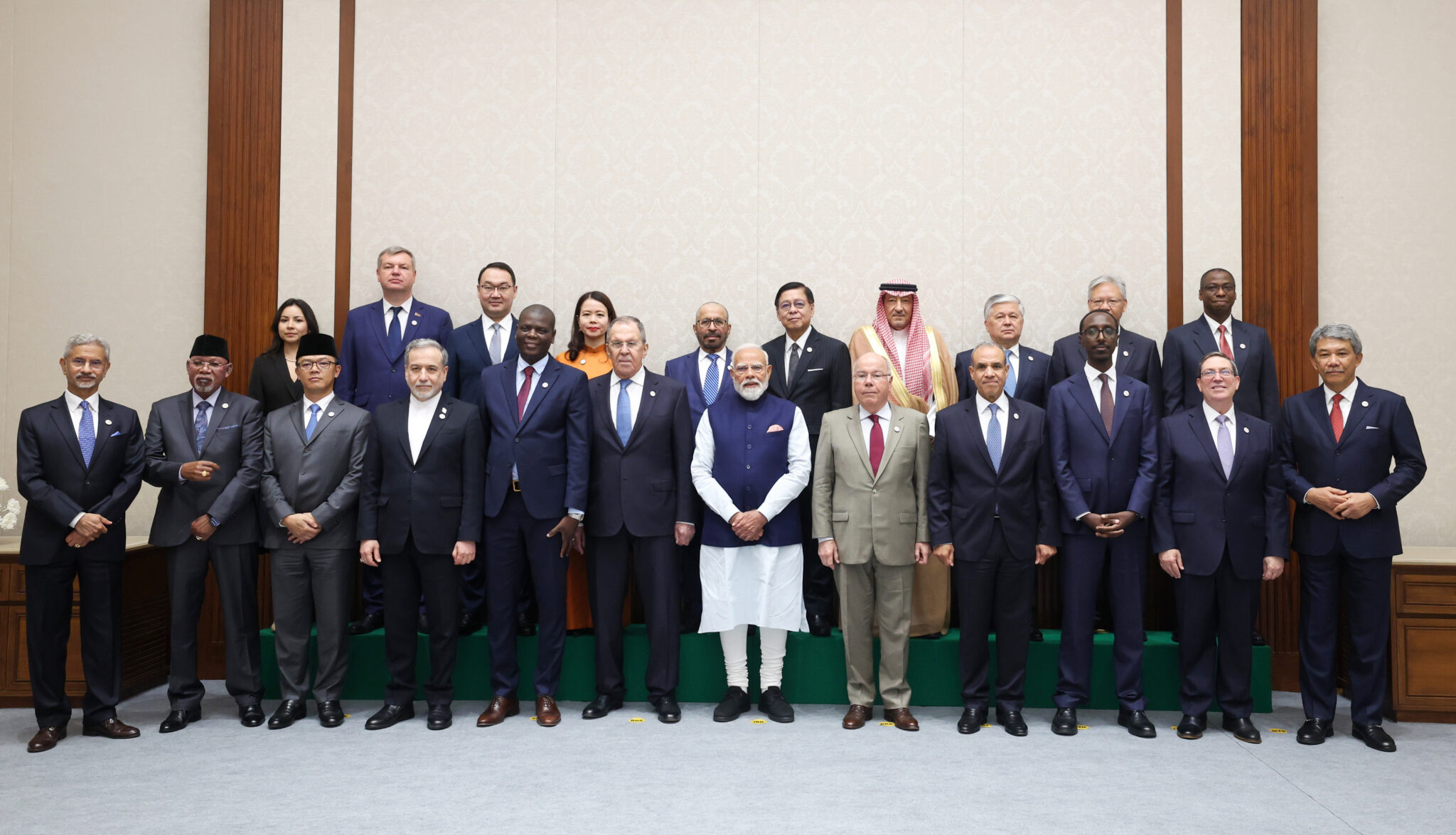
During the BRICS Foreign Ministers Meeting held in New Delhi in May 2026 under India’s chairmanship, member states reaffirmed cooperation on secure digital infrastructure, including progress toward a proposed submarine cable network and digital connectivity initiatives.[12]
The BRICS Start-up Knowledge Hub, launched in January 2025, aims to strengthen collaboration among start-ups, investors, and MSMEs across BRICS countries through innovation and knowledge-sharing platforms. [13] BRICS is advancing scientific and technological cooperation in the ocean and polar sectors through joint initiatives involving governments, universities, research institutions, and industries.[14]
The 6th Meeting of the BRICS Working Group on Ocean and Polar Science and Technology, hosted by Russia in 2024, brought together over 50 scientists to discuss ocean governance and promote joint marine expeditions to strengthen collective capabilities.[15]
The UAE has advanced financial centres such as Dubai International Financial Centre (DIFC) and Abu Dhabi Global Market (ADGM) and world-class logistics infrastructure particularly its global ports, free economic zones, and its strategic trade connectivity linking Asia, Africa, and Europe, bringing economic opportunities for BRICS.[16] Indonesia seeks to utilise BRICS collaboration for green technology, particularly in geothermal and hydrogen energy, aligning with its own sustainability goals.[17]
Strategic Contradictions and Internal Geopolitical Rivalries
BRICS expansion increased the bloc’s geopolitical weight but it also imported regional rivalries and conflicting strategic interests, making consensus-building more difficult. China envisions BRICS as a platform to create a more comprehensive counter-Western and China-influenced global order alongside initiatives like the Belt and Road Initiative (BRI) and the Shanghai Cooperation Organisation (SCO). New Delhi wants BRICS to remain “non-Western” but not explicitly “anti-Western.” India leverages BRICS to bolster Global South cooperation rather than becoming part of a China-led geopolitical bloc.[18]
The sharpest and most visible site of India-China divergence within BRICS has been the question of membership expansion, and specifically the candidacy of Pakistan. Islamabad formally applied for BRICS membership in August 2023, and both China and Russia have signalled support for its accession. [19] but Prime Minister Modi At the Kazan summit in October 2024, explicitly stated that all expansion decisions must be taken by consensus and based on criteria, including the requirement that new members maintain diplomatic and friendly relations with all existing members.
Nonetheless, Pakistan’s membership question is likely to resurface under China’s 2027 chairmanship, when Beijing will have considerable influence over the expansion agenda and the framing of the discussion. [20]
China increasingly frames BRICS as part of a broader geopolitical challenge to the Western-led order. India, however, seeks balance. It maintains close relations with Western countries through platforms like the Quad while simultaneously participating in BRICS and the SCO. India is also cautious about the excessive dominance of renminbi-based lending inside the NDB.[21]
Internal divisions surfaced within BRICS over the West Asia conflict during the 2026 Foreign Ministers’ Meeting. Iran demanded explicit condemnation of the US and Israel for “illegal aggression” against Iran and called for resistance to “Western hegemony.” The UAE opposed Iran’s attack on energy infrastructure and objected to overtly anti-Western rhetoric. India released a chair’s statement as BRICS failed to issue a joint statement due to a lack of consensus.[22]
BRICS members maintain diverse and often contrasting strategic, economic, and diplomatic relations with the US and Europe, limiting the bloc’s ability to function as a unified anti-Western alliance.[23] BRICS increasingly reflects a divide between members seeking to challenge the Western-led order like Russia & China and those using the bloc primarily to expand strategic flexibility without directly confronting the West such as India, Brazil, and the UAE.[24]
Institutional and Governance Challenges within BRICS
BRICS remains a loosely coordinated, issue-based grouping rather than a deeply institutionalised organisation with binding mechanisms. The BRICS functions more as a platform for political dialogue than a deeply institutionalised alliance.
Unlike highly institutionalised organisations such as the European Union or NATO, BRICS does not have a unified legal framework, nor does it possess a permanent secretariat with significant executive authority or binding dispute-resolution mechanisms.[25] Its functioning primarily depends on annual summits, ministerial meetings and diplomatic consultations which limit the grouping’s ability to implement binding decisions or ensure consistent policy coordination.
BRICS follows a consensus-driven decision-making model where all members must broadly agree before major initiatives are adopted. This creates several governance difficulties such as slow policy responses. Diverse political systems, economic interests, and geopolitical priorities often delay decision-making processes because decisions require broad political agreement, BRICS often produces general declarations rather than concrete policy implementation mechanism.[26]
As a symbol of rising powers and the ambitions of the Global South, BRICS has great symbolic significance. However, it is still a challenge for BRICS to convert symbolic solidarity into concerted policy action.
India’s Strategic Position in an expanded BRICS
India approaches the grouping through the lens of strategic autonomy, multipolarity, and issue-based cooperation. For New Delhi, BRICS is not intended to become a rigid ideological alliance or an anti-Western bloc. Rather it aims to shape the evolving international order without compromising its independent foreign policy.[27] India serves as a Bridge Between the Global South and the West because it engages with multiple geopolitical organisations like QUAD, the EU, West Asia etc.
India views BRICS as an important platform to push for reforms in global governance institutions like the United Nations Security Council, greater representation for developing countries in the IMF and World Bank, with more equitable global financial governance, and stronger South-South cooperation.[28]
The inclusion of countries from West Asia, Africa, and potentially Southeast Asia creates new pathways for India to strengthen its connectivity, energy security, trade partnerships, and diplomatic influence. India remains cautious about the possibilities of BRICS gradually evolving into a China-centric platform. India therefore often promotes inclusivity, sovereign equality, consensus-based decision-making, and non-bloc positioning within BRICS diplomacy.
For India, BRICS ultimately functions as a mechanism for strategic flexibility within an emerging multipolar world order. The grouping enables India to diversify diplomatic options, strengthen economic engagement, and reduce overdependence on Western institutions. This reflects an Indian strategic tradition to avoid exclusive bloc politics and maintain decision-making independence.
Conclusion
BRICS expansion signifies an attempt to institutionalise an alternative pole in world politics beyond Western alliances. The expanded BRICS can deepen South-South economic cooperation and reduce dependency on Western financial systems if institutional mechanisms become more coordinated. BRICS risks becoming a fragmented coalition unless it develops a shared strategic vision beyond opposition to Western dominance. Without stronger institutional mechanisms, BRICS may remain a consultative platform rather than an effective geopolitical bloc. For India, BRICS is less an alliance and more a platform for issue-based strategic flexibility within a multipolar world order
References:
[1] https://brics.br/en/about-the-brics
[2] https://www.europarl.europa.eu/thinktank/en/document/EPRS_BRI%282024%29760368?
[3] https://www.bcb.gov.br/en/about/brics-en
[4]https://apnews.com/article/india-brics-iran-war-4fe5c3ff22993f8e24cf917df56d781c
[5]https://www.cfr.org/backgrounder/ethiopia-conflict-tigray-and-implications-region
[6]https://www.lowyinstitute.org/the-interpreter/indonesia-brics-membership-multipolarity
[7] https://www.bcg.com/publications/2024/brics-enlargement-and-shifting-world-order
[11]https://www.orfonline.org/expert-speak/brics-and-de-dollarisation-global-implications
[13]https://www.startupindia.gov.in/sindhi/content/sih/en/BRICS.html.html
[15] https://brics.land-ocean.ru/
[16] https://bricscci.com/brics-countries/uae/
[17]https://eastasiaforum.org/2025/02/04/indonesias-bold-step-into-brics-and-beyond/
[18]https://orcasia.org/article/1634/india-china-and-the-contested-architecture-of-brics
[19]https://www.aljazeera.com/news/2023/11/24/pakistan-seeks-brics-membership-despite-india-roadblock
[21] https://www.ndb.int/about-ndb/shareholding/
[25] https://www.bricsipedia.ch/brics-architecture-1/
[26]https://www.orfonline.org/expert-speak/brics-and-the-challenge-of-institutionalisation
[27]https://www.orfonline.org/research/india-and-brics-a-quest-for-non-western-multilateralism/
[28] https://www.mea.gov.in/error.htm
(The views expressed are those of the author and do not represent the views of CESCUBE)
Image Source: https://www.brics2026.gov.in/ BRICS India 2026

Riddhi Suthar is a final-year undergraduate student of Political Science with academic interests in international relations, internal security, public policy, and governance. Her research engages with contemporary security dynamics, institutional frameworks, and policy processes in the Indian and global context. She has presented a research paper at an academic conference, demonstrating her commitment to scholarly dialogue and analytical research. She is currently interning at the Mahatma Gandhi Labour Institute, Ahmedabad, where she is gaining practical insights into labour policy, governance mechanisms, and socio-economic policy research.