China–Philippines Grey-Zone Confrontations in the South China Sea
Grey zone warfare refers to a form of state coercion that is more aggressive than normal diplomatic activity without causing an outright military conflict. It involves carefully designed tactics that steadily escalate security tensions and ...
The South China Sea has become the primary theatre where grey zone warfare activities demonstrate both its effectiveness and its corrosive impact on international and regional laws. China has initiated a multilayered strategy to push its territorial claims against the Philippines while deliberately staying below the threshold of outright armed conflict. The approach it uses on the Philippines, takes advantage of a key gap in international maritime law, which as of now only recognizes two conditions, peacetime, and armed conflict. Because there is no legal category specifically for the deliberate, ambiguous, and coercive grey zone operations, China is able to advance its strategic objectives without triggering the rules that traditionally govern conventional warfare.
The China-Philippines confrontation has become a major case-study for whether international maritime law can limit great power behaviour in the grey zone. The primary dispute focuses on Scarborough Shoal and Second Thomas Shoal, where China has used coast guard vessels, maritime militia, and fishing fleets to strengthen control over waters that are claimed by the Philippines under the United Nations Convention on the Law of the Sea (UNCLOS). A turning point came in 2016, when an international arbitral ruling rejected China’s broad maritime claims. However, Beijing not only dismissed this legally binding decision but also maximized its activities in these contested areas. By rejecting international arbitration ruling and exerting soft-control over these disputed islands through constant coast guard & militia presence, installation of buoys, and intensified fleet raids, China poses a direct challenge to the rules-based international maritime order.
Grey-Zone Tactics & Patterns in Conflicts
China has created a structured system to carry out its grey zone operations while keeping plausible deniability about its military role. At the center of this system lies the China Coast Guard, which went through major reforms between 2013 and 2018. However, the most important change came in 2018, when the coast guard was moved from the Civilian State Council to the Central Military Commission. This shift put what appears to be a law enforcement agency under direct military command, making it a key tool for China’s strategic objectives in the grey zone. Similarly, another significant structural transformation is the 2021 Coast Guard Law, which gives a legal basis for more aggressive Grey-zone tactics. The law allows coast guard forces to use weapons and carry out enforcement measures under very broader conditions than regular coast guard limits. The 2021 Coast Guard Law gives China’s coast guard the power to act in waters under Chinese jurisdiction, but it never clearly defines where those waters are. This vagueness lets China treat the entire South China Sea, including Philippines’ maritime disputed areas, as if it were under its control. As a result of this subtle amendment, China can present its coast guard actions as legitimate law enforcement, even in places where international law shows China has no jurisdiction.
China’s grey zone operations use a three-tiered structure. At the top, the People’s Liberation Army Navy provides the ultimate threat capability, although it constantly supervises and stays in the background. Next, the China Coast Guard acts as the main operational instrument, carrying out what Beijing calls as enforcement activities to push its territorial claims. Lastly, maritime militia forces maintain a constant presence through civilian fishing vessels that are organised, trained, and directed by the state. Together, this layered system enables the salami slicing strategy:
- Fishing boats and maritime militia - maintain everyday presence in disputed waters, creating an impression of constant vigilance and control.
- Coast guard vessels - enforce China’s greater claims by blocking or escorting ships, acting as a self-proclaimed law enforcement substitute.
- Naval forces - stay in the background but provide military backup if the situation escalates.
The Scarborough Shoal confrontation is the clearest example of how China’s grey zone operations seem to achieve territorial control without firing a shot. The shoal is about 120 nautical miles from the Philippine coast, and has long been used by both Chinese and Filipino fishermen. In April 2012, the Philippines sent its largest warship to detain Chinese fishing boats. China quickly responded by sending coast guard vessels, leading to a tense standoff. Since then, China has maintained effective control of the shoal, despite the Philippines’ claims under UNCLOS international law. After two months, the Philippines withdrew following what Manila understood to be a mutual de-escalation agreement. However, China did not withdraw. Instead, Chinese coast guard vessels remained and began systematically excluding Filipino fishermen, effectively establishing Chinese control.
After the 2012 standoff, Chinese coast guard vessels increased their patrols and carried out systematic enforcement operations against Filipino fishermen. By 2015, the Beijing government described these patrols as its routine law enforcement activities. The tactic reached a new stage in September 2023, when China installed a 300?meter floating barrier at the shoal, physically blocking Filipino fishing boats from entering the area.
Similarly, the Second Thomas Shoal presents a different but equally important case, demonstrating both the persistence of Chinese pressure and the limits of these grey zone tactics. In 1999, the Philippines deliberately stationed the BRP Sierra Madre, an old warship, on Second Thomas Shoal to serve as a permanent military outpost. From February 2023 to August 2024, China carried out a blockade designed to specifically stop the Philippines from sending resupply missions to the Sierra Madre. By December 2023, this blockade escalated, China deployed about 50 coast guard and maritime militia vessels and used aggressive tactics such as ramming boats, firing water cannons that injured crew members, and employed military-grade lasers and acoustic devices to disrupt Philippine operations. These aggressive, non-lethal tactics impose physical costs on the Philippines for maintaining presence, create psychological pressure on Filipino civilians such as sailors and fishermen, and test limits of what actions might trigger United States intervention. However, this campaign also revealed the limits of grey zone coercion. Despite eighteen months of sustained pressure and approximately fifty vessels deployed, every Philippine resupply mission succeeded in reaching the Sierra Madre. Yet, China's de-escalation seemed to be tactical rather than strategic, as China simply shifted pressure to other contested zones.
The 2016 Arbitral Ruling and Attempts of Norm Erosion
The 2016 South China Sea arbitration stands as the most significant international legal ruling on maritime disputes between China and the Philippines. However, its impact was heavily undermined by China’s refusal to comply, revealing the intention behind China’s grey zone tactics that steadily weaken the foundations of international maritime law. The Philippines filed the case in January 2013 under UNCLOS dispute settlement procedures. China immediately rejected the process and declined to participate. Nevertheless, the tribunal moved forward and in July 2016 issued its ruling, rejecting the legal basis of China’s claims. It concluded that China’s assertion of historic rights within the nine-dash line had no grounding within international law.
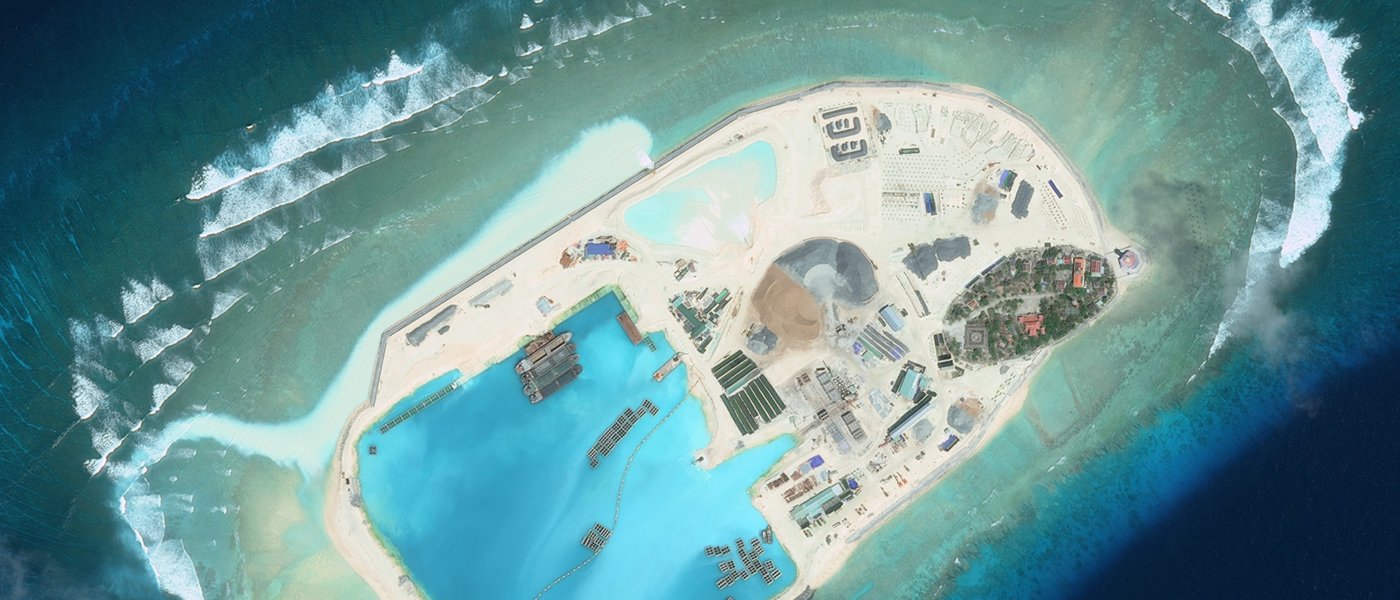
However, China’s reaction was shocking. Instead of accepting the arbitral ruling, Beijing declared it null and void. More importantly, China has undermined the decision through its retaliatory actions, by creating physical structures. After Manila’s legal victory, China rapidly expanded its island building campaign in the Spratly Islands, turning seven reefs into militarized artificial islands through large scale dredging to create about 4,600 acres of new land. These new islands now contain military grade runways, radar systems, missile shelters, and deep water ports. These actions were a direct response to the 2016 arbitral ruling, since the international law refused to validate China’s claims, Beijing decided to impose physical restrictions capable of affecting the legal judgments and keep them ineffective in practice. China’s rejection of the 2016 arbitral ruling reveals the reality on how cautious grey zone tactics could even undermine international authorities like UNCLOS. Although the ruling was legally binding, Beijing dismissed it, escalated the very activities that are deemed to be illegal, and faced no real enforcement consequences, thus setting an unpopular impression that powerful states can defy international law without facing accountability, if planned with patterns.
In addition, the Maritime militia operations also blur the line between civilian and military activity, weakening application of international law among regional powers. While these vessels may look like ordinary fishing boats, evidence shows they could also be state-funded, crewed by trained personnel, and directed by the government, making legal accountability difficult to distinguish. China’s resistance revealed the reality of weak enforcement across regional powers, showing the need for stronger collective action to protect maritime law.
Wider Effects on Marine Economy
The idea of norm erosion attempts by China is not abstract anymore, it has real, measurable effects on Filipino fishing communities. After China took control of Scarborough Shoal, the average amount of fish catches dropped sharply. In the Ilocos region, fishermen went from catching 31,850 tons in 2012 to 25,600 tons in 2021, which is a 16% decline. The impact was even worse in Palawan, where catches fell from 174,898 tons in 2012 to 118,361 tons in 2021, to a 32% drop. These drop rates in fish catches have led to serious economic losses in the Philippines' marine income. In the three hardest-hit Philippine regions, the total value of fish production grew by only 17.5% between 2012 and 2021. This is far below the national average growth of 33.5% for fisheries during the same years, showing how badly these communities have been held back.
Beyond these data figures Filipino fishermen also deal with serious day-to-day challenges. Most of their boats are small wooden or fiberglass vessels, while Chinese coast guard ships are massive, weighing 3,000 to 5,000 tons. To stay safe, fishermen spend much more time trying to avoid these ships, which makes their work less efficient, time-consuming and more expensive because of higher fuel use. In some cases, they have had to stop fishing in entire areas altogether for safety reasons. The ongoing situation reveals two important things. One, China’s pressure has not stopped despite grey zone tactics having limits when met with organised tactics and firm resistance. Since 2021, China has not gained much new territorial control, however, these setbacks have not led to any change in China’s overall strategy. Two, Xi Jinping views control of the South China Sea, including the Philippines as a key part of China’s national revival, so Beijing continues to apply pressure despite repeated failures. When China recognized these limits of grey zone tactics in the Philippines region, it began pushing its fight into cyberspace as well. In early 2024, during peak tensions at Second Thomas Shoal, the Philippines was hit by a 325% surge in cyberattacks. More than half of these targeted law enforcement, government ministries, and universities, those that are directly involved in managing the maritime dispute.
Way Forward
The fundamental problem of China’s Grey zone tactics, is the clash between international legal norms and available physical facts on the ground. China's approach deliberately prioritizes creating irreversible physical structures that could manipulate legal judgments and make international bindings operationally meaningless, in these contested zones. Seized islands cannot be unseized solely through legal rulings, once the Chinese coast guard begins to maintain its permanent presence. Similarly, militarized artificial islands cannot be removed through diplomatic protests. Nearly nine years after the arbitral ruling, China not only continues activities the tribunal ruled illegal but has dramatically expanded them further.
The impact goes far beyond China and the Philippines; it threatens the basic rules of the global maritime system. If China manages to secure control through constant grey zone tactics despite the 2016 ruling, it would further attempt to weaken the authenticity of UNCLOS as a medium to settle disputes. This could push other countries either to give in or to build up their own military power to resist, instead of relying on international law. The China-Philippines confrontation is not just a regional dispute but a decisive test of whether maritime order will rest on rules-based international law or on power differences. It is timely to reaffirm rules and consider necessary amendments fitting the differences of regional maritime zones.
References:
- Chen, Wen-Chung, Chun-Hung Ou, Ming-Hsien Yang, and Yen-Chiang Shih. China’s Gray Zone Actions in the East China Sea, Taiwan Strait, and South China Sea: A Comparative Study and Impact on Fisheries. Marine Policy 167 (2024): 106246. https://doi.org/10.1016/j.marpol.2024.106246
- CYFIRMA. Grey Zone Warfare in China’s Stalled South China Sea Ambitions. August 8, 2025. https://www.cyfirma.com/research/grey-zone-warfare-in-chinas-stalled-south-china-sea-ambitions/
- De Castro, Renato Cruz. The Philippines’ Responses to Chinese Gray Zone Operations Triggered by the 2021 Passage of China’s New Coast Guard Law and the Whitsun Reef Standoff. Asian Affairs: An American Review 49, no. 4 (2022): 193–216. https://doi.org/10.1080/00927678.2022.2121584
- Garlauskas, Markus. Dispatch from Manila: On the Frontlines of the ‘Gray Zone’ Conflict with China. Atlantic Council (blog). May 2024. https://www.atlanticcouncil.org/blogs/new-atlanticist/dispatch-from-manila-on-the-frontlines-of-the-gray-zone-conflict-with-china/
- Lin, Bonny. Understanding and Countering China's Gray Zone Tactics. Santa Monica, CA: RAND Corporation, 2022. https://www.rand.org/content/dam/rand/pubs/research_briefs/RBA500/RBA594-1/RAND_RBA594-1.pdf
- McLaughlin, Rob. The Law of the Sea and Grey Zone Operations in the South China Sea. Singapore: S. Rajaratnam School of International Studies, 2022. https://www.rsis.edu.sg/wp-content/uploads/2022/04/IP22025.pdf
- Ngo, Tu Thuyen. Grey Zone Conflict in the South China Sea and Challenges Facing the Legal Framework for the Use of Force at Sea. Asia-Pacific Journal of International Humanitarian Law (2020): 209–211. https://apjihl.org/wp-content/uploads/2021/10/009-Grey-Zone-Ngo.pdf
(The views expressed are those of the author and do not represent the views of CESCUBE)
Image Source: Center for Strategic and International Studies (CSIS), https://www.csis.org/analysis/ripple-effects-vietnams-island-building-south-china-sea

Vivetha Jayaseelan is an International Relations researcher specializing in the securitization of critical infrastructure and Indo-Pacific security architecture. Her research investigates the intersection of sub-sea strategic autonomy, AI space diplomacy, and non-traditional regional security threats using OSINT and quantitative analysis.