Lawfare and Border Disputes: The Strategic Use of Legal Ambiguity in India’s Security Environment

In the realm of contemporary strategic politics, military engagement is still considered to be more of a last resort for pursuing one’s own geopolitical objectives. Hence, today’s conventional dichotomy of winning and losing involves more n...
The broadly understood definition offered by Bartman points out as Lawfare to be mainly “the strategic usage of the international legal system to achieve political and military objectives,” confining the phenomenon to particular occasions as the policy does not necessarily reject legality, but rather instrumentalises it. Unlike conventional military actors, Lawfare primarily functions in the middle ground between peace and war, allowing states to pursue geopolitical advantage while maintaining a layer of legality and restraint.
Within security studies, Lawfare is specially considered to be a component of grey-zone conflict in which case, alongside other tools such as information warfare or diplomatic signalling, Lawfare enables states to advance strategic claims incrementally. Particularly seen in the context of India’s usage of Lawfare as a tactic to navigate its conflicts, the effectiveness of Lawfare lies primarily in its ambiguity, as legal arguments can be sustained over long periods, which gradually becomes difficult to refute and lead to a strategic paralysis among adversarial players wary of escalation or reputational damage.
In an environment where hard power options are constrained, keeping in mind the high-scale consequences of the usage of such options, legal strategies such as this one offers a means to frame actions as procedurally defensible, allowing states to shift the burden of escalation onto the opposing party.
Legal Ambiguity in Border Disputes and India’s Strategic Interpretation
In many protracted international border disputes, legal ambiguity often more than not acts as a structural feature that shapes state behaviour, mainly when boundaries remain undefined and many a times based on diverse legal interpretations, this uncertainty only stems conflicting claims to persist, creating a space where laws and strategy become imperatively intersected. The India-China border disputes along the Line of Actual Control (LAC) is a clear example of how such legal inconsistencies can underpin strategic conflict while offering diverse avenues for restraint. The LAC stretching across 3,488 km in the Himalayas continues to remain un-demarcated and subjected to different perceptions by New Delhi and Beijing. Over the decades following the growing crisis between the two nations over the boundary status, India and China have adopted various approaches to dealing with the boundary question. On one hand while China refuses to acknowledge the historic McMahon Line as the Line of Actual Control, claiming it to be a perceived violation of “historic rights” caused by the British imperialism, based off which since the late-1950s, China has continued to advance its own portrayal of the LAC as a de jure legal boundary, which also claims Aksai Chin in the Ladakh district within the Chinese territories. On the other hand, upholding the McMohan Line’s relevance, India does not grant legal recognition to the Chinese version of the LAC, nor does it recognise China’s claims over Aksai Chin. Under the general principles of International Law, China’s “conditional sovereignty” over the un-demarcated regions of the LAC also has limited legal consequences without the clear idea whether the constitutive elements of the Chinese state also extend to the regions it claims.
Thus, as neither side recognizes the other’s strategic interpretation of the LAC’s alignment in many sectors, it leads to the creation of these “grey zones” where military patrols and diplomatic tensions intersect. This absence of legal coordination has been identified by many analysts as the structural source of recurring tensions, as well as a pressure point in strategic signalling. Moreover this structural ambiguity has significant strategic implications as it rather permits contestation of regional or other such claims without escalating into full-scale conflict. Both sides are automatically forced into engaging in transgressions that are diplomatically structured in ways that avoid explicit violation of established agreements. Mechanisms such as bilateral Confidence Building Measures (CBMs) and patrolling protocols reflect the efforts on both sides to manage the conflict below the threshold of full-scale warfare, rooted in the policy of strategic restraint even as legal uncertainties continue to exist. However, ambiguity in this case, can be instrumentalised when contested perceptions of the LAC allow each side to signal resolve while maintaining the control over disputed high ground, negotiating from positions directed towards formal settlement, which reflects broader discussions of Lawfare policies. The strategic restraint adopted by India in avoiding aggressive militarisation and pursuit of legal adjudication favouring scaled diplomacy and crisis de-escalation, shows how states may deliberately make use of such legal ambiguity in their favour, not only to avoid further escalation of crisis, but also preserving long-term claims. The 1993 Border Peace and Tranquility Agreement demonstrated this dual logic clearly. It did recognize the de facto status of LAC for the purpose of peace, while also leaving its final legal status unresolved.
Risk and Limitations of Lawfare in Border Disputes
Even though there is a rising use of Lawfare as a strategic legal framework in the current geopolitical scenario, it carries significant risks as well. The merging of law and politics in Lawfare more often than not blurs the traditional boundaries, turning legal systems into conflict zones for broader societal frictions. This fusion of legal and political tactics can even raise significant concerns about the integrity of the legal system, affecting the credibility of international law and national security policies. While legal strategies may offer alternatives to high-scale confrontation, their overreliance or misuse can produce unintended strategic costs. Modern geopolitical conflicts are increasingly becoming greater subjects in courtrooms over battlefields as states anticipate legal scrutiny. They often litigate reactively to justify military, diplomatic or economic decisions in conflict contexts, as legal scholar Rosa Brooks argues how this has created a ‘paradox of Lawfare’ where proliferation of legal norms consecutively expands accountability mechanisms, providing new avenues for strategic manipulation. This further leads to fragmentation of the international legal order as different states attempt to assert their own interpretations of international norms to further their claims and legal frameworks risk becoming politicised. This inconsistent dynamic complicates coordination and weakens universality, where powerful states can influence norms to their advantage while marginal states struggle to assert their rights within the same legal architecture.
Moreover, in the context of territorial disputes, such legal ambiguities can prolong conflicts rather than resolve them. States often end up using this mechanism to maintain maximalist positions on a global level, without any conceding ground. While this is often considered to be a form of strategic restraint, in practice, it has much diverse applicability. Research on the India-China border disputes, for example, highlight how such prolonged uncertainty over the legal alignment of the Line of Actual Control (LAC) has contributed to repeated military stand-offs and restricted the effectiveness of dispute management mechanisms. Analysts have observed that in absence of clear legal demarcations and alignment, CBMs can only partially mitigate historic mistrust, leaving the friction unaddressed.
For states like India, the implications of these risks are substantial. While pursuing a calibrated strategy of legal diplomacy and strategic restraint in disputes, such as the one with China, crafting a coherent legal strategy becomes imperative for broader security policy. Over merely invoking legal arguments, effective policy must combine legal clarity with diplomatic engagement and institutional capacity to manage ambiguity. As observed by scholars, this includes investing in technical delimitation efforts, sharing legal cartographic data wherever possible and enhancing bilateral agreements to avoid crisis escalation. Ultimately, this intersection of legal ambiguity, Lawfare and strategic policy highlights the dual faced nature of legal strategies in international relations, which can promote peaceful dispute management when grounded in genuine legal norms, but simultaneously risk undermining of these same norms when treated as instruments of strategic advantage.
References:
1. Legal Integrity Project. 2025. “Lawfare and the Integrity of Legal Institutions: When Litigation Becomes a Geopolitical Tool”. December 25, 2025. https://www.legalintegrityproject.org/blog/lawfare-and-the-integrity-of-legal-institutions-when-litigation-becomes-a-geopolitical-tool
2. Pandey, Utkarsh. “The India-China Border Question: An Analysis of International Law and State Practices.” ORF Occasional Paper No. 290. Observer Research Foundation. December 16, 2020. https://www.orfonline.org/research/the-india-china-border-question-an-analysis-of-international-law-and-state-practices
3. Upadhyaya, Kriti, Richard M. Rossow and Joseph S. Bermudez Jr. “A Frozen Line in the Himalayas”. CSIS Briefs. Center for Strategic & International Studies. August 19, 2020. https://www.csis.org/analysis/frozen-line-himalayas
4. Garaev, Ilgamovich Marsela and Gulnara Raifovna Shaikhutdinova. 2020. “The Usage of International Court of Justice in the Field of Border Delimitation Disputes”. International Journal of Criminology and Sociology. Vol. 9: 979-983. https://www.neolifescience.com/index.php/ijcs/article/view/7794/4066
5. Abgaryan, Narek. “The Mortal Kombat of Jurisprudence.” Völkerrechtsblog. International Law & Legal Thought. March 17, 2025. https://voelkerrechtsblog.org/lawfare-the-mortal-kombat-of-jurisprudence/
6. Peñas, Leandro Martínez. “The Concept of Lawfare: Approach to Usage”. Madrid: Rey Juan Carlos University, 2023. https://www.omniamutantur.es/wp-content/uploads/THE_CONCEPT_OF_LAWFARE_APPROACH_TO_USAGE.pdf
7. DLP Forum. “Lawfare: When Law Becomes a Weapon.” DLP Forum. Accessed January 25, 2026. https://www.dlpforum.org/dlp-factsheets/lawfare/
(The views expressed are those of the author and do not represent the views of CESCUBE)
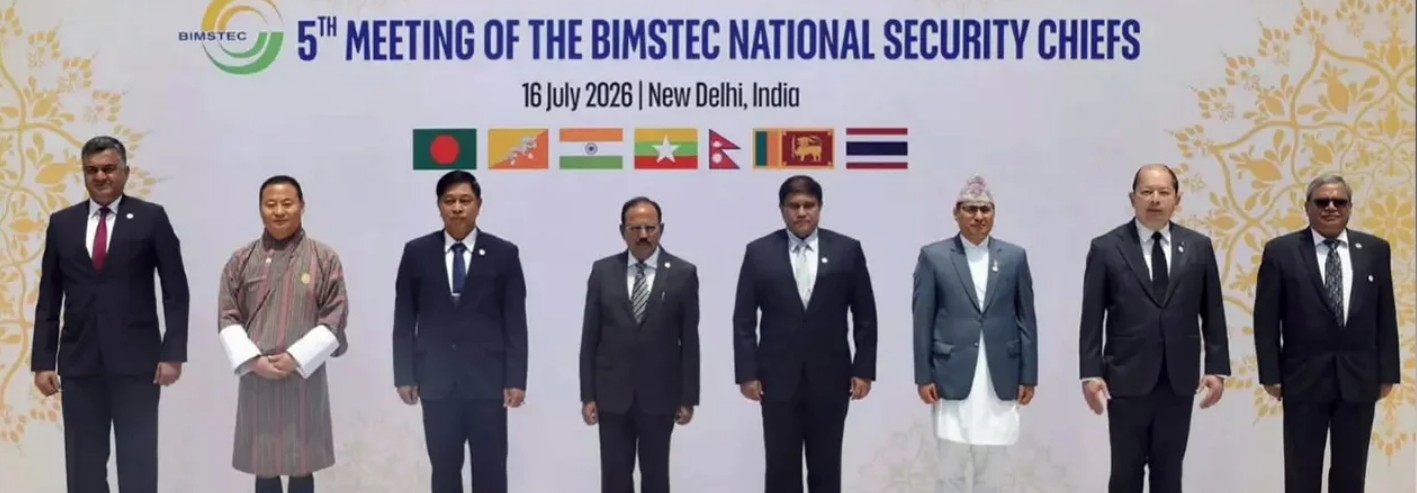
Image Source: Press Trust of India

Adrija Bhattacharjee is an undergraduate student of International Relations with research interests spanning security studies, geopolitics, public policy, and international law. With her minor in World History, her work engages with themes involving hybrid and grey-zone conflicts, border security and strategic studies surrounding South Asia and the Middle East. She is also interested in global governance, humanitarian issues, and policy-oriented research that bridges academic analysis with contemporary geopolitical developments. Adrija enjoys exploring how evolving political realities shape state behaviour and security strategies in the twenty-first century, on a global level.