Strategic Signalling and Great Power Bargaining: Assessing the Trump-Xi Dialogue
The 2025 Trump–Xi dialogue at the APEC Summit in Busan marked a tactical pause in escalating U.S.–China tensions rather than a structural reset. This article analyses the meeting through strategic signalling and game-theoretic perspectives,...
The global distribution of power is unavoidably changing due to the emergence of new powers and significantly non states actors, but the international order US has created in the wake of World War II is still clearly visible. In the recent years, US international prestige and authority have been undermined by China and other regional powers who have utilized this reluctance to push their own interests.[i] Global power dynamics have changed significantly since the beginning of the 21st century, paving the way for the shift from a unipolar to new world order. Growing agreement on the significance of promoting inclusive and productive international relations as globe transition to multipolar order.[ii]
The changing environment indicates the emergence of a more complex and multipolar world, and calls into question the US’s capacity to unilaterally influence international events. With the establishment of financial organizations like BRICS, the Shanghai Cooperation Organization (SCO) and the Asian Infrastructure Investment Bank (AIIB), which have challenged the liberal global order and the US led Bretton Woods System, the economic balance of power is currently shifting in favor of China.[iii] Game theory analysis is the ideal fit for the current geopolitical conflict between the US and China. In this instance, the “game” is a sequential, non-cooperative one in which each players tries to maximize their gains at every move.[iv]
Trump-Xi Jinping Meeting
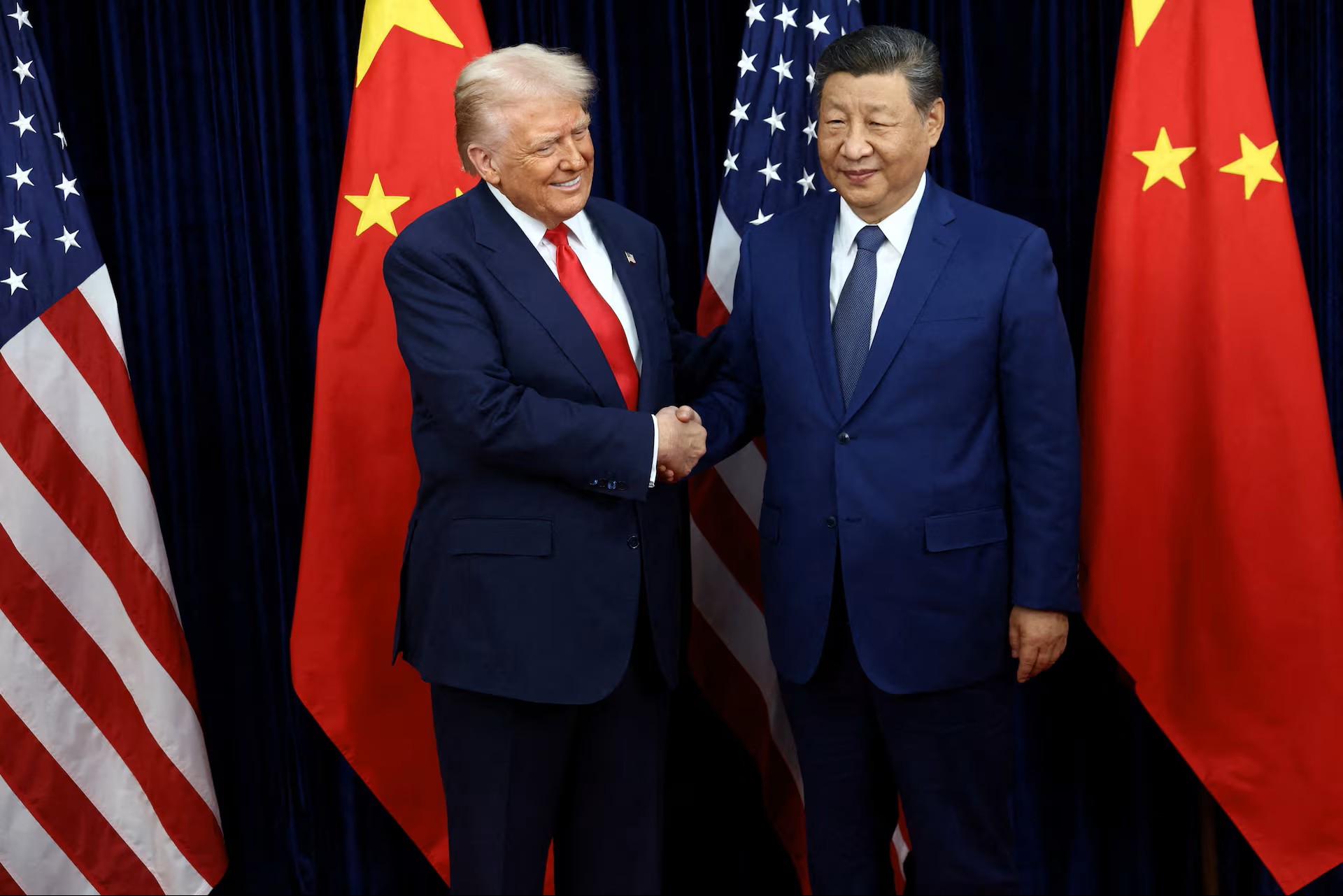
For the first time in six years, US President Donald Trump and Chinese President Xi Jinping met in Busan, South Korea. The dialogue which was held on the sidelines of the Asia-Pacific Economic Cooperation (APEC) summit and ended after ninety minutes, took place amid the current trade war between the US and China.[v] The outcome show that bilateral tensions have significantly decreased. The US has prolonged the 24% reciprocal tariff suspension for an additional year, which keeps the reciprocal tariff rate on China at 10% rather than 34%. In return, China suspends for a year the export control measures that were announced on October, especially the extensive export-licensing regime for rare earths that was similar to the foreign direct production rule of the US government.[vi]
As Beijing has consistently shown a willingness to react against the United States, and now the two countries have returned to the pre-war status quo. The US has reversed a US Commerce Department ruling regarding export restrictions to China. These actions lessen the incentives for businesses to diversify their supply chains away from China and trading with US export regulations.[vii] Even if certain important issues have been addressed, the agreement does not fully tackle all the fundamental issues of the US-China trade dispute, geopolitical flashpoints like Taiwan and Russia-Ukraine war. Tensions still exist despite the ceasefire, especially in the semiconductor and technology industries. This ceasefire is regarded as a tactical rather than a structural resolution to the two nations trade dispute.[viii]
Trump Strategic Signalling
The 2025 National Security Strategy is different from its predecessors not because it prioritizes America, but rather because it has a more limited understanding of what serves American national interests. Washington’s capabilities to present its stances and actions as a defense of international law rather than outright geopolitical rivalry is crucial to its ability to mobilize allies and partners. In the Indo-Pacific, where many states prefer those disagreements be expressed in terms of international law rather than a choice between the US and China.[ix] Although the US has never acknowledged the CCP’s claim to Taiwan’s sovereignty, Washington has generally stayed ambiguous about whether it would step in the case of a Chinese attack, a policy known as “strategic ambiguity”.[x] For years, the United States accused China, its main superpower adversary of engaging in “economic coercion”, which is exactly what Trump is doing at the moment. From Trump’s point of view, it involves working particularly with friends who rely on the US for military defense.[xi]
Xi’s Strategic Signalling
Five-Year Plan has been the cornerstone of Beijing’s policy direction since the foundation of People’s Republic. The main ideas of the next Five-Year Plan indicate a distinct departure from all previous plans since “reform and opening up” era started in 1978. It signifies the ultimate consolidation of the transition to technology as the primary economy. The long-term goals of the Chinese leadership are clear, China wants to raise its per capita GDP to the level of a mid-tier industrialized country.[xii] China has hosted events on security, trade, connectivity, the green and digital economy, and cultural exchanges under the title, “Upholding the Shanghai Spirit: SCO on the Move”. In accordance with the idea, Beijing was positioned as an anchor for the Global South by launching a new Global Governance Initiative, which signalled an attempt to reframe global governance along more inclusive, global norms.[xiii]
Conclusion
One could consider the Busan meeting more as a hiatus than a turning point. The result of positive ties between the two economies lead to market stabilization, the return of investment flows, and the capacity of market of tackle multilateral global concerns including global debt, stability and climate change. On the other hand, a conflict has severe ramifications. Smaller economies are compelled to make decisions that lead to the demise or even suspension of international institutions, and supply chains are disrupted.[xiv] Nonetheless, some export restrictions are still in effect and don’t seem likely to be completely eliminated. This implies that while supply chains shift, businesses will need to keep adjusting to the “new normal” of export licenses. Furthermore, as both US and China continue to play a high priority on strategic competitiveness and national security, there is still a chance that delicate industries like semiconductors, artificial intelligence, and quantum computing may continue to escalate.[xv]
The meeting specifically calls into doubt the long-term viability of its “pragmatic compromise”. The “Four F” issues- Taiwan, transshipments, technology and TikTok were not resolved at the summit, but it did pave the way for diplomatic interaction in April 2026. In conclusion, it seems that Busan summit used a practical tension reduction procedure to recalibrate the strategic equilibrium. Although Trump’s claim that the parties “agreed on almost everything” suggests stability in the immediate future, but it contains global risks. [xvi]
Endnotes
[i] Paul B. Stares, Qingguo Jia, Nathalie Tocci, Dhruva Jaishankar, and Andrey Kortunov, “Perspectives on a Changing World Order”, Council on Foreign Relations, June 2020. https://www.cfr.org/report/perspectives-changing-world-order.
[ii] Bashira Omeed, “Emerging Multipolarity: Critical Analysis of a Shifting Global Order”, Centre for Strategic and Contemporary Research, October 22, 2023. https://cscr.pk/explore/themes/politics-governance/emerging-multipolarity-critical-analysis-of-a-shifting-global-order/.
[iii] Gina Bou Serhal, Abdulla Abdulrahman Alkhaja, “Navigating the New Global Order: U.S. Foreign Policy in a Multipolar Era”, Trends Research and Advisory, November, 2024. https://trendsresearch.org/insight/navigating-the-new-global-order-u-s-foreign-policy-in-a-multipolar-era/.
[iv] José Juan Ruiz, “Shattered hegemony: the rivalry between the US and China in the new era of the politics of force”, Elcano Royal institute, April, 2025. https://www.realinstitutoelcano.org/en/analyses/shattered-hegemony-the-rivalry-between-the-us-and-china-in-the-new-era-of-the-politics-of-force/.
[v] Swati Gandhi, “Trump meets Xi Jinping for first time in 6 years, calls him 'great leader'”, Business Standard, October, 2025. https://www.business-standard.com/world-news/donald-trump-xi-jinping-meeting-south-korea-us-china-trade-ties-125103000099_1.html.
[vi] “Trump-Xi meeting defuses US-China hostility, for now”, Economist Intelligence Unit, November, 2025. https://www.eiu.com/n/blogs/apac-2026-outlook/.
[vii] Jonathan A. Czin, “What happened when Trump met Xi? (Friction without competition)”, Brookings, November, 2025. https://www.brookings.edu/articles/what-happened-when-trump-met-xi/.
[viii] Dr. Nadia Helmy, “Trump-Xi Summit Leads U.S. to Suspend China Tariffs Until 2026”, Modern Diplomacy, November, 2025. https://moderndiplomacy.eu/2025/11/04/trump-xi-summit-leads-u-s-to-suspend-china-tariffs-until-2026/.
[ix] Lynn Kuok, “Breaking down Trump’s 2025 National Security Strategy (Neglecting international order and law threatens ‘America First’)”, Brookings, December, 2025. https://www.brookings.edu/articles/breaking-down-trumps-2025-national-security-strategy/.
[x] Jessie Yeung, Mike Valerio, “Trump’s security strategy is making a hard pivot on China. Why now?”, CNN World, December, 2025. https://edition.cnn.com/2025/12/11/china/trump-national-security-strategy-china-taiwan-intl-hnk.
[xi] Alan Crawford, “Trump embraces economic coercion with tariffs as his big stick”, The Economic Times, August, 2025. https://economictimes.indiatimes.com/news/international/global-trends/trump-embraces-economic-coercion-with-tariffs-as-his-big-stick/articleshow/123033426.cms?from=mdr.
[xii] Dr Yu Jie, “China’s leaders’ meeting confirms Xi’s authority and shows technological self-reliance is now the priority”, Chatham House, October, 2025. https://www.chathamhouse.org/2025/10/chinas-leaders-meeting-confirms-xis-authority-and-shows-technological-self-reliance-now.
[xiii] Ratish Mehta, “China’s Diplomatic Machinery Is Wearing Thin”, The Diplomat, December, 2025. https://thediplomat.com/2025/12/chinas-diplomatic-machinery-is-wearing-thin/.
[xiv] Sujit Kumar Datta, “Success in Busan: U.S.-China Relationship Stabilizes”, China-US Focus, November, 2025. https://www.chinausfocus.com/foreign-policy/success-in-busan-us-china-relationship-stabilizes.
[xv] Arendse Huld, Qian Zhou, “US and China Reach Trade Concessions Following Trump-Xi Meeting: Outcomes and Implications”, China Briefing, November. 2025. https://www.china-briefing.com/news/trump-xi-meeting-outcomes-and-implications/.
[xvi] Zeynep Cagla Erin, “Busan Summit: The Trump-Xi Meeting and the Future of the U.S.- China Trade War”, Belt and Road Initiative Association for Economy and Culture, November, 2025. https://www.kusakveyol.org/en/busan-summit-the-trump-xi-meeting-and-the-future-of-the-u-s-china-trade-war/.
(The views expressed are those of the author and do not represent the views of CESCUBE)
Image Source: Reuters, https://www.reuters.com/world/us/live-trump-xi-meet-south-korea-trade-2025-10-30/

Kushmita Kapoor is a postgraduate in Politics and International Relations with a particular interest in international security, geopolitics, and strategic policy frameworks. She has previously interned at the Future of India Foundation, where she engaged in policy-oriented research and gained hands-on experience in data analysis and policy research. Skilled in OSINT, GIS tools, and multilingual research, she brings a strong analytical lens to the study of strategic policy.