Vladimir Putin’s Visit to New Delhi: Navigating Multipolarity and Future of Russia-India ties
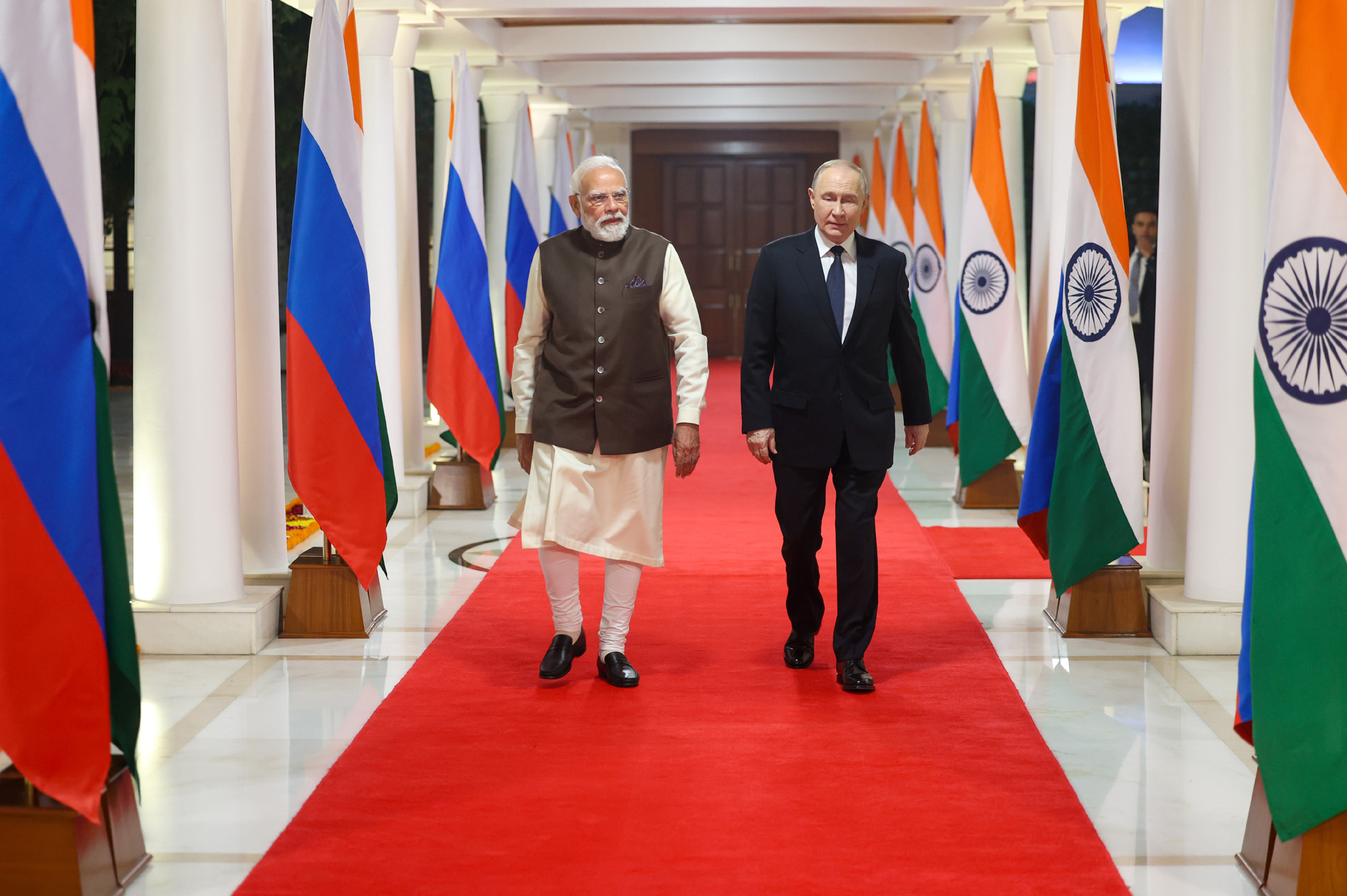
The December 2025 visit by Russian President Vladimir Putin to New Delhi for the 23rd India–Russia Annual Summit represented a significant moment for diplomacy in the history of modern international relations. The visit took place during th...
Framework
The 2025 India – Russia Summit is best understood through a pluralistic theoretical framework of Realism, Strategic Autonomy, Multipolarity Theory and selected insights from Constructivism.
Realism posits that states exist in an anarchistic international system with national interest, power and security determining actions of the state. Russia’s pragmatic calculation when approaching the summit was to counter diplomatic isolation and seek reliable and economically viable partnerships with India for energy. In the same manner, India’s pragmatic calculation was to have energy security, defence preparedness and a degree of flexibility in foreign policy. In the Indian Foreign Policy context, Strategic Autonomy is a core principle that allows India to remain engaged in a calibrated manner. Rather than aligning or isolating, India operates on a principle of issue-oriented collaboration while having the autonomy of decision-making. For instance, the example of hosting President Putin while Western nations were applying sanctions against Russia is a tangible example of Strategic Autonomy being implemented. Multipolarity Theory contextualises the summit in the midst of a larger global transition in the balance of global power. Both Nations support for reforming International Financial Institutions and also supporting coordination between BRICS, SCO, and the United Nations is indicative of the dissatisfaction both Nations have with unipolar power. The insights provided by Constructivism provide additional explanations for the ongoing symbolic and historical narratives (i.e., “time-tested friendship”) that will influence elite perceptions and diplomatic behaviour, independent of material considerations.
Diplomatic Context and Official Narrative
The visit was portrayed by Indian officials as a confirmation of the “Special and Privileged Strategic Partnership” once again. President Murmu's welcome of President Putin at Rashtrapati Bhavan signified the continuity, the trust, and the civilizational depth in the bilateral relations.¹ The Joint Statement that was released after the summit talked about cooperation in the areas of defense, trade, energy, science and technology, space, education, and people-to-people exchanges.² More so, it confirmed the support for multilateralism and the peaceful resolution of international disputes, which, however, was done in such a way that no references to the conflicts arising from geopolitical issues were made, thus maintaining the diplomatic balance.
Economic and Trade Outcomes
A significant result of the summit was the establishment of the Economic Cooperation Program until 2030; a programme signed to reach $100 billion (USD) in annual two-way trade.³ The program shows both a desire and recognition of the limitations. Although Russia has become one of India's largest suppliers of energy, the current trade relationship continues to be out of balance, primarily as a result of India importing large amounts of Oil, Gas and Coal. There were 16 agreements and MOUs signed in a variety of sectors such as health care, maritime cooperation, movement of people, academic exchanges, and agricultural development.4 The signing of these agreements indicates an effort towards broadening the existing bilateral relations between both countries beyond just Defence and Energy to help ensure that the relationship remains viable over the long term.
Strategic Dependence and Energy Security
During this visit, energy diplomacy was of utmost importance. President Putin’s pledge that Russia would continue supplying India with “uninterrupted fuel” reinforced Russia’s significance as a provider of energy for India, given that the current state of global energy markets is unpredictable and will not stabilize, as there is too much geopolitical unrest on a worldwide scale.5 Discounted Russian crude has been extremely important to India’s energy security since 2022, therefore emphasising the importance for India in pursuing long-term energy security, to continue engaging with Russia. The discussions during the dialogue were also focused on ways to enlarge the scope of cooperation between India and Russia in the development of civil nuclear energy, specifically regarding the Kudankulam Nuclear Power Plant and potential future civil nuclear energy projects. The Agreements signed during this visit to Russia form part of India’s strategy to attain long-term energy diversification and add to the already strong interdependence between India and Russia.
Strategic Realignment and Collaboration for Defence
Whereas previous years saw discussions solely focused on an individual defence deal, the discussions that took place during the November 2025 defence summit instead focused on the need for joint production, transfer of technology and defence industry cooperation in line with India's 'Make in India' programme.6 The move towards this stance marks a big change from India's previous defence policy, which used to involve only limited suppliers and was less responsive to external sanctions imposed on countries from which it could buy, and it indicates significant growth in India’s own production capabilities and the introduction of new suppliers for defence systems. Although the defence relationship with Russia continues to be important to India, the emphasis at this summit was more on recalibrating the relationship than the further expansion of relations into new areas of defence acquisitions.
Geopolitical Signalling and Strategic Autonomy
The visit, from a geopolitical angle, was a clear indication of India’s strategic autonomy. Prime Minister Narendra Modi reaffirmed India’s position of always advocating dialogue, diplomacy, and peaceful conflict resolution, including that of Ukraine, without taking the side of any geopolitical bloc.7 The visit by Russia was a way to oppose the notion of being isolated from the world and at the same time, show that Moscow is still relevant in Asia and the Global South. The summit was interpreted by international observers as proof of the limitations of the West's attempts to diplomatically marginalize Russia.8 Multipolarity and the need for reforms in global governance institutions remained as commonalities between both parties and integrated the summit's discussions on the future of global order.
Cultural diplomacy; people-to-people relationships.
The Vedic hospitality of the Varanasi people toward the Russian delegation, along with aspects such as cultural exchanges, academic cooperation, frameworks for labour mobility, etc., strengthen the historical and cultural stories of both countries, thereby assisting to create goodwill between both nations at the level of society and at the elite level.9
Assessment: Ascertainment of Successes or Strategic Limitations
According to its objectives, Putin's 2025 visit to New Delhi was a success but also a qualified success with notable achievements, which included reaffirming diplomatic continuity between India and Russia, increasing energy cooperation, signing a long-term economic roadmap for cooperation, and allowing India to enhance and assert its strategic autonomy without openly antagonizing its western partners. However, despite these positive accomplishments, there are still many limitations that exist in the partnership, such as the failure to make any real defence developments, the ongoing trade imbalance, and India's cautious approach to both the U.S.-led and Russia-directed sanction-related issues, which indicates that the relationship is constrained by these ongoing structural limitations.10 Therefore, rather than representing a massive deepening of ties, the summit was to some extent an example of the stabilisation of the relationship and an easing of tensions between the two countries as they both seek to adapt to changing geopolitical realities rather than seek to transform them.
Conclusion
The meeting highlighted the Resilience, and Evolution, of India-Russia Relations in a Multipolar System, despite Realigning Alliances and Global Geopolitical Pressures. The Summit supported Mutual Perceptions of each country as a Vital Partner to the Other; however, those perceptions were developed within the Framework of Greater Prudence, at best. In this regard, the Moscow/New Delhi Summit was a Statement of Reaffirmation of the Strategic Partnership between the two countries that are navigating an increasingly Complex Global Political System in the Twenty-First Century.
Reference
1. Joint Statement following the 23rd India - Russia Annual Summit (December 05, 2025) https://share.google/Glrg4M2FrlHyApRiT
2. English Translation of Prime Minister's Press Statement during Joint Press Statement with the President of Russia (December 05, 2025) https://share.google/wKFUYw53ncKdWiBv4
3. PRESIDENT OF INDIA HOSTS PRESIDENT OF RUSSIAN FEDERATION | President of India https://share.google/DjjvOObmCwHd0ij6N
4. India | DD News On Air https://share.google/1pRKgeUQrbiTZKpiV
5. India-Russia agree to expand economic partnership till 2030 amid Trump threats - India Today https://share.google/dQaf1Pve5azZgrjTX
6.‘Uninterrupted oil shipments’: Key takeaways from Putin-Modi talks in Delhi | Vladimir Putin News | Al Jazeera https://share.google/Lq2IXpCyDMOy930T9
7. Key takeaways from Modi-Putin press conference https://share.google/JvIkAseMtxe6sbiza
8.Delegation from Russia visits SSU, accorded Vedic welcome https://timesofindia.indiatimes.com/city/varanasi/delegation-from-russia-visits-ssu-accorded-vedic-welcome/articleshow/125874940.cms?utm_source=app&utm_medium=share&utm_campaign=social_share
10. Beyond Diplomacy: The Strategic Stakes of the 2025 India–Russia Summit - NIICE NEPAL https://share.google/CbQwlSM28be7SukFL
(The views expressed are those of the author and do not represent the views of CESCUBE)
Image Source: PM India Website https://www.pmindia.gov.in/en/image-gallery/#gallery16747523-4
Soumyadip Mondal is an international relations scholar whose research focuses on South Asian geopolitics, strategic studies, and foreign policy. He publishes analytical work on regional security and conducts rigorous research on conflict, constitutional change, and multilateral engagement through affiliations with leading academic institutes and think tanks.