Not Just BRICS: Building a Russia-India-Saudi Axis
Russia’s war in Ukraine has redrawn the world’s geopolitical order, pushing the Global South into unprecedented strategic realignments. Amid the uncertainty of U.S. leadership and the breakdown of value-based diplomacy, India faces a rare o...
Republished in collaboration with/with permission from New Eastern Europe (Poland). Original article: https://neweasterneurope.eu/2025/08/26/not-just-brics-building-a-russia-india-saudi-axis/
The war in Ukraine has not only shattered Europe’s post-Cold War security order but also accelerated a profound reordering in the politics of the Global South. As western states rallied around Kyiv with sanctions and military aid, Moscow turned eastward, deepening ties with Beijing, courting Gulf capitals, and selling discounted oil to willing buyers such as India. China, in particular, has positioned itself as a pro-Russia broker in global forums, subtly framing the conflict as part of a broader contest over the rules of the international order.
This realignment has, in effect, united a loose but consequential non-western axis, an evolving constellation of states unwilling to be drawn into a purely values-versus-interests binary. Instead, they are intent on maximizing their own strategic autonomy. For India, this shifting terrain offers both risks and opportunities. Its Russia relationship remains a strategic constant, even as Delhi cultivates ties with the US and Europe. In the Middle East, meanwhile, Riyadh’s growing independence from Washington and its willingness to engage with Moscow on energy policy open the door to novel partnerships.
Against this backdrop – and with India’s NSA and External Affairs Minister’s visits to Moscow in August while Washington continues to flirts with Islamabad – Delhi has multiple incentives to explore new frameworks for cooperation. The Middle East, already facing a leadership void in regional diplomacy, offers fertile ground for such an experiment. This article examines how a Russia-Saudi-India trilateral could emerge, not as an anti-western bloc, but as a pragmatic alignment suited to the multipolar realities of the 21st century.
From bilateral familiarity to trilateral possibility
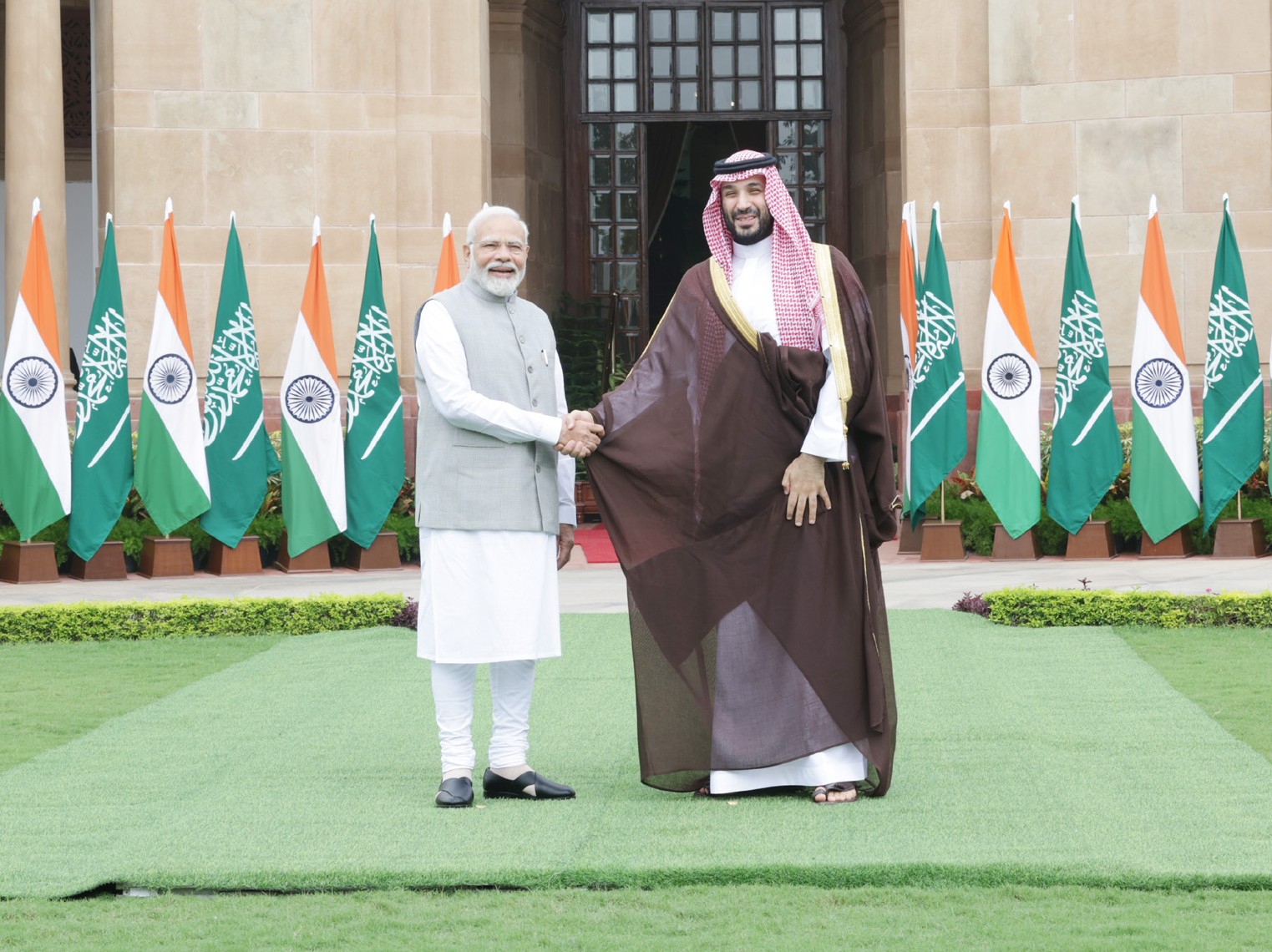
The idea of a Saudi-Russia-India trilateral may seem ambitious, but its foundations are being laid in robust bilateral ties. India-Saudi Arabia relations have surged in recent years, with trade topping 33 billion US dollars and the Kingdom supplying nearly 18 per cent of India’s crude oil. The partnership now extends into petrochemicals, fertilizers and renewables. Riyadh’s “Vision 2030” reform agenda and India’s “Make in India” initiative present a natural complement between a youthful democracy and a modernizing monarchy. The first-ever India-GCC summit in 2024 marked a diplomatic milestone.
India–Russia ties, while more transactional today than during the Cold War, remain strategically significant. Trade has surged to over 68 billion US dollars in 2024–25, fuelled by discounted Russian oil and fertilizers. Defence cooperation endures through projects such as the S-400 air defence system and the BrahMos missile venture. Crucially, India’s nuanced stance on the Ukraine war – refusing to condemn Moscow outright while calling for peace – has preserved access to both markets in the West and energy corridors to the East.
Meanwhile, Saudi Arabia and Russia have developed surprising synergy via the OPEC+ framework since 2016, coordinating oil production to stabilize markets despite their divergent political systems. Riyadh’s cautious overtures toward BRICS and Moscow’s eastward pivot signal a willingness to disrupt traditional alignments. Together, these bilateral threads create the conditions for trilateral engagement.
At the heart of this potential axis lies the issue of energy. India’s surging energy demand, Saudi Arabia’s sheer amount of production, and Russia’s reserves and technical expertise form a powerful triad. A trilateral energy corridor could combine upstream Saudi production, Russian logistics, and Indian refining into joint ventures less vulnerable to western-controlled pricing mechanisms. This “Saudi capital, Russian know-how, Indian markets” model could underpin cooperation in petrochemical hubs, ammonia and fertilizer plants, and even green hydrogen projects.
With the Ukraine war disrupting established supply chains and prompting western sanctions, such arrangements could offer all three states greater insulation from geopolitical shocks. Yet energy trade is also the most vulnerable to the direct wrath of Washington. US President Donald Trump imposed 25 per cent tariffs plus a penalty on imports from India with effect from August 1st 2025, citing the country’s purchases of energy and military equipment from Russia (along with India’s high tariffs and non-monetary barriers to trade). Such measures underscore that energy cooperation may not be the ideal starting point for a trilateral, given its exposure to punitive action from the US.
By contrast, infrastructure, connectivity and multilateral diplomacy are relatively less controversial avenues of cooperation. The International North–South Transport Corridor (INSTC) and the Chennai–Vladivostok Maritime Corridor link India and Russia through Eurasia. Saudi participation via investment and political support could transform these into viable arteries for Eurasian trade, bypassing chokepoints controlled by western-led initiatives. Unlike direct energy trade, such projects are less likely to trigger sanctions or punitive tariffs, as they fall into broader development and logistical frameworks. They also allow each party to contribute distinct capabilities – Saudi financing, Russian logistical networks, and Indian port infrastructure – without overtly challenging western security or economic regimes.
Multilaterally, all three nations share scepticism toward a US-led order increasingly cast in moral terms. Russia champions multipolarity through BRICS; India advocates for a “rules-based” but inclusive order; and Saudi Arabia flirts with non-US dollar oil settlements. The Ukraine war has heightened these impulses, exposing for many in the Global South what they perceive as western selectivity in applying norms of sovereignty and intervention.
Soft power, too, is an underexplored frontier. India, with its democratic ethos, cultural outreach, and leadership in the Global South, can frame the partnership as one of mutual benefit rather than bloc politics. For Russia, long depicted in western discourse as a revisionist power, association with India’s balanced diplomacy and developmental initiatives offers reputational gains. Riyadh’s Mohammad Bin Salman is eager to project a modern, diversified national image beyond oil. His vision could find value in partnering with India’s technology sector and cultural industries. Under the ambit of Vision 2030, Riyadh is investing substantially in human capital development, while Moscow continues to maintain a robust academic and scientific tradition.
In areas of their respective strengths, Indian, Russian and Saudi institutions can initiate joint academic and research programmes, student exchange initiatives, and joint tech incubators for youth entrepreneurship, conferences (online/offline), podcasts and joint publications – domains traditionally dominated by western institutions. This should deliberately involve collaborative mechanisms between private universities, regional think tanks, and provincial cultural bodies, ensuring outreach beyond national capitals and elite institutions.
Trilateral cultural festivals rotating among the three countries, co-produced documentaries on shared historical ties, and halal and heritage tourism circuits must also be promoted. In effect, soft power here is less about exporting ideology and more about humanizing a partnership that might otherwise be seen as purely transactional. In a polarized world, such optics can be as important as trade flows or oil barrels in sustaining long-term cooperation. Such initiatives would not only deepen societal familiarity but also offer a safe, non-contentious, and logical platform to build bridges in an otherwise geopolitically charged environment.
The American factor and value-driven diplomacy
No discussion of this trilateral can sidestep Washington’s role. The US remains vital to both India and Saudi Arabia in the spheres of trade, security and technology. Yet the Ukraine war has strained these relationships. Washington has sought to twist the arm of partner countries into reducing or abandoning their ties with Moscow. Even though it has largely failed in India’s case, the diplomatic pressure – now compounded by the newly imposed 25 per cent tariffs and penalties – has been significant and persistent. It also underscores the limits of value-driven diplomacy when strategic interests diverge. For Saudi Arabia, Washington’s lectures on human rights sit uneasily alongside its own need for diversified security partners.
Here lies a deeper question for Europe and the West: can value-based international politics coexist with a world where many states see themselves as transactional actors in a multipolar arena? For India, the answer is pragmatic: parallel partnerships are not betrayals, but insurance policies against volatility in any single alliance.
War as the obstacle and the catalyst:
An institutionalized trilateral is unlikely while the Ukraine conflict rages. The war has locked Russia into a sanctions regime that limits its financial manoeuvrability and deepens its dependence on the Global South. It has also hardened western attitudes toward any perceived enabling of Moscow’s war effort, complicating the diplomatic space for partners like India and Saudi Arabia.
Yet paradoxically, the same war has catalysed the search for alternative alignments. For India, it is a reminder that reliance on any one bloc, whether to the West or East, carries risks. For Saudi Arabia, it has validated its pivot toward multiple poles of power. And for Russia, outreach to the Global South is now a strategic necessity, not a luxury. In this sense, the Ukraine war is both the primary obstacle to and the driving force behind any Russia-Saudi-India convergence.
Conclusion
India’s foreign policy must remain nimble in a fractured world. As western alliances consolidate around Ukraine and new power centres emerge elsewhere, Delhi must decide not simply who to partner with, but what principles, if any, should underpin those partnerships. The language of value-driven diplomacy may resonate in European capitals, but in much of the Global South, interests remain the primary currency.
A Saudi-Russia-India trilateral may lack the ideological clarity of western alliances, but it offers strategic depth, economic resilience, and a measure of autonomy from the great power rivalries now hardening across Eurasia. With India set to host the next edition of the annual India–Russia Summit later this year – paving the way for President Vladimir Putin’s first visit to the country since 2021, Delhi has reason to look beyond the familiar. The war in Ukraine may have closed some doors, but it has also opened a window for India to quietly help shape a non-western order – one that reflects the world as it is becoming, not as it once was.
Dr. Divya Malhotra is a senior research fellow with Centre for New Age Warfare Studies, Delhi. She holds a PhD from Jawaharlal Nehru University and had been associated with India’s National Security Council’s Advisory Board and Middle East Institute, New Delhi.
Image Source: Press Information Bureau
(The views expressed are those of the author and do not represent the views of CESCUBE.

Divya holds a PhD in geopolitics from School of International Studies, Jawaharlal Nehru University (JNU), New Delhi. She is currently a Senior Research Fellow with Centre for New Age Warfare Studies (CNAWS). She is also a research fellow with Centre for National Security Studies, Bangalore and Middle East Institute New Delhi. She completed her MPhil from JNU, MA Applied Economics from Christ University, Bengaluru and BA Economics Hons from Panjab University, Chandigarh. Previously, she has worked with the National Security Council’s Advisory Board (NSAB) and MP-IDSA, Delhi as a researcher. She was also associated with Rashtriya Raksha University (Ministry of Home Affairs) Gujarat as Assistant Professor and Assistant Director. She has presented her research work at international conferences in various countries including USA, Israel, Afghanistan, Pakistan etc and frequently writes for leading national and international newspapers.