Tariffs, Talks, and Tensions: India’s Foreign Policy Reset in 2025
In a rapidly evolving and fragmented global order, India’s foreign policy is increasingly shaped by the complexities of multipolarity and great power competition. This piece examines the limitations of a unified foreign policy approach in t...
Introduction
In today’s increasingly fragmented and conflict-prone global order, the idea of a unified foreign policy where all national actions in diplomacy, trade, and security are aligned under a single strategic vision faces significant strain. The Russia-Ukraine war, ongoing instability in West Asia, and escalating U.S.-China tensions have made global alliances unpredictable and interests increasingly divergent. For a country like India, which seeks to maintain strategic autonomy while engaging with competing powers, applying a rigid or uniform foreign policy becomes nearly impossible. As India’s External Affairs Minister S. Jaishankar observed, “if you were to look at any big global issue, it’s important to have to carry other countries along, and that, to me, is an indication of how much more multipolarity has become” (India Writes Network, 2024). This statement underscores the shift toward multi-alignment, a strategy India has adopted to protect its interests while navigating the intricacies of a multipolar world. The recent U.S. tariff hikes on Indian exports in 2025 exemplify the limitations of a unified approach. While India continues to uphold its energy partnership with Russia, it simultaneously attempts to strengthen its economic and strategic ties with the United States. These conflicting objectives reveal the fragility of trying to sustain a consistent policy direction in a world shaped by shifting alliances and great power rivalries.
In early August 2025, the United States imposed a 25% tariff on a broad range of Indian exports, including garments, seafood, furniture, and gems. These tariffs excluded only a few sectors, such as pharmaceuticals and electronics (Business Today, 2025). Citing India's continued import of Russian oil despite U.S. sanctions, President Donald Trump’s administration imposed an additional 25% penalty later that month, raising tariffs to a total of 50% on many goods (Reuters, 2025). These measures targeted labour-intensive industries and were seen as a direct response to India’s refusal to align with U.S. geopolitical interests.
However, this crisis also opened up a debate and opportunity for India to rethink its approach to global engagement. Rather than attempting to maintain a rigid, unified front, India has increasingly turned to “multi-alignment,” a strategy that emphasises flexibility, diversified partnerships, and autonomous decision-making. While this approach lacks the simplicity of a unified policy, it offers resilience. By strengthening ties with alternative markets in the Middle East, Southeast Asia, and Europe, India is mitigating its exposure to any single partner. Simultaneously, New Delhi is reviving diplomatic channels with China, including high-level meetings at the upcoming SCO Summit, as part of a broader recalibration in the face of U.S. unpredictability.
Renewing Ties in a Fragmented World Order: India-China Relations
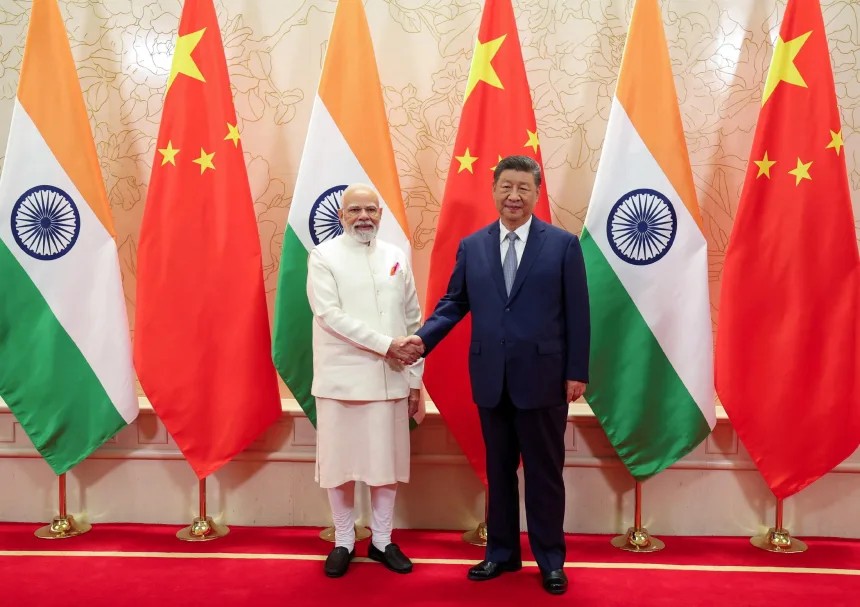
Prime Minister Narendra Modi’s scheduled visit to China from August 31 to September 1, 2025, to attend the Shanghai Cooperation Organisation (SCO) Summit in Tianjin represents a critical juncture in India’s foreign policy. This visit, the first by Modi to China since 2019 and the first high-level engagement since the 2020 Galwan Valley clashes, reflects New Delhi’s calibrated attempt to balance strategic competition with diplomatic engagement in a complex geopolitical environment (Reuters, 2025). Renewed dialogue at this level can help initiate confidence-building measures, reduce misperceptions, and pave the way for incremental progress on sensitive issues such as border management, trade normalisation, and counterterrorism cooperation. It also reflects India’s broader diplomatic strategy of engaging multiple global partners. From both a regional and global standpoint, a stable and cooperative India-China relationship is not just desirable but imperative. Together, India and China represent over 2.8 billion people, more than 16% of global GDP, and significant stakes in virtually every global challenge from climate change and trade reform to digital governance and health security. Their coordinated engagement in multilateral platforms such as BRICS, the SCO, the G20, and the United Nations holds the capacity to reconfigure the global South’s influence within international institutions.
For India, improved ties with China would enhance its strategic flexibility, reduce the resource strain on its Himalayan border, and allow for greater focus on domestic development and regional leadership in South Asia and the Indo-Pacific. From a theoretical perspective, the logic of functionalism offers a pragmatic mechanism for initiating this renewal. As David Mitrany (1966) posited, technical cooperation in non-political areas such as trade, infrastructure, and climate policy can gradually build habits of collaboration and generate the institutional scaffolding for political rapprochement. However, the road to meaningful reconciliation remains fraught with deep-rooted challenges. Most significantly, the trust deficit between India and China is structural, not episodic. Decades of border disputes, differing threat perceptions, and regional strategic ambitions have created institutional inertia that resists rapid or superficial resolution.
Moreover, functional cooperation, while useful for conflict management, cannot substitute for conflict resolution. The failure of increased trade and multilateral cooperation to prevent the 2020 standoff is a stark reminder that economic engagement does not automatically lead to political trust, a key critique of functionalist theory from a realist standpoint (Mearsheimer, 2001). In realist terms, India and China remain competitors with overlapping spheres of influence, particularly in South Asia and the Indo-Pacific, and will likely continue to pursue balancing strategies against each other, even amidst tactical engagement.
Conclusion
In the face of the complex and often contradictory demands of contemporary geopolitics, the pursuit of a rigid, unified foreign policy is increasingly untenable. Instead, the alternative lies in adopting a flexible multi-alignment strategy grounded in strategic autonomy. This approach allows a state like India to engage with multiple global and regional powers based on issue-specific interests rather than ideological or exclusive alliances.
Flexible multi-alignment enables India to maintain cooperative relations with diverse actors such as the United States, China, Russia, and the European Union while managing inherent contradictions through calibrated diplomacy. For example, India’s deepening defence and technological cooperation with the U.S. complements its pragmatic economic engagement with China and continued energy ties with Russia. Such calibrated engagement helps India secure its national interests without being constrained by the demands of a singular bloc or alliance. Moreover, strategic autonomy emphasises decision-making independence, allowing India to navigate shifting international currents with agility. It prioritises national interests, respects domestic political imperatives, and adapts to evolving global power structures without rigid commitments that could limit flexibility.
References
- Business Today. (2025). US imposes 25% tariffs on Indian exports amid geopolitical tensions. Retrieved from https://www.businesstoday.in/latest/international/story/us-imposes-25-tariffs-on-indian-exports-amid-geopolitical-tensions-2025-08-06
- India Writes Network. (2024). India’s multi-alignment strategy in a multipolar world. Retrieved from https://www.indiawrites.org/india-world/indias-multi-alignment-strategy-in-a-multipolar-world
- Mearsheimer, J. J. (2001). The tragedy of great power politics. W.W. Norton & Company.
- Mitrany, D. (1966). A working peace system: An argument for the functional development of international organization. Quadrangle Books.
- Pant, H. V., & Rej, A. (2018). Is India ready for the Indo-Pacific? The Washington Quarterly, 41(2), 47–61. https://doi.org/10.1080/0163660X.2018.1485403
- Pant, H. V., & Rej, A. (2018). Is India ready for the Indo-Pacific? The Washington Quarterly, 41(2), 47–61. https://doi.org/10.1080/0163660X.2018.1485403
- Reuters. (2025a). US raises tariffs on Indian exports to 50% citing Russia oil imports. Retrieved from https://www.reuters.com/business/us-raises-tariffs-indian-exports-50-percent-2025-08-15
- Reuters. (2025b). Modi to visit China for SCO Summit amid thaw in ties. Retrieved from https://www.reuters.com/world/asia-pacific/modi-visit-china-sco-summit-2025-08-19
Image Source: Press Information Bureau
(The views expressed are those of the author and do not represent the views of CESCUBE.

Atul Pathak is a Research Scholar in International Relations at the Department of Humanities and Social Sciences, IIT Guwahati. His research focuses on emerging technologies and their implications for national and international security