ASEAN Summit Meetings 2021: Major Takeaways
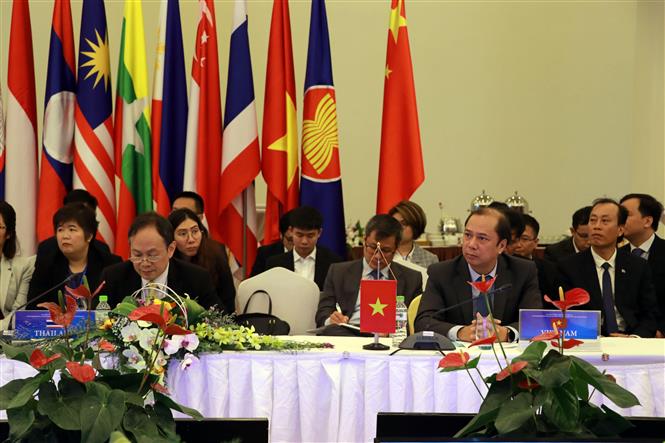
The Association of Southeast Asian Nations (ASEAN) recently held its 38th and 39th summit meetings from 26th October to 28th October 2021. Under the theme "We Care, We Prepare, We Prosper", Brunei Darussalam took over the ASEAN Chairmanship...
The official remarks at the handing over ceremony reiterated “ASEAN solidarity and centrality” [1].
The official post-summit statement mentioned ASEAN Centrality and the ASEAN Community Vision 2025 as the core tenets of the regional group. The deliverables highlighted include climate change, promotion of multilateralism and cooperation, disaster management, blue economy, and digitization.
Challenges Faced By ASEAN
Prior to the summit, political analysts and area experts had outlined key four challenges for the bloc. First, just a month into the new year, an unprecedented crisis hit the 10-nation bloc where one of its members, Myanmar underwent a military coup in which the democratically elected government led by Aung Sang Suu Kyi was toppled by the military junta led by Gen. Min Aung Hlaing. ASEAN’s immediate response spoke of restraint but did not condemn the coup. A five-point consensus was finalised in April, almost three months after the coup which called for a special envoy to act as a mediator for the concerned parties in the political crisis [2]. Since the coup, more than 1,000 people have been killed and over 10,000 arrested by the authorities for protesting the regime. Kavi Chongkittavorn, a senior fellow with the Brookings Institution wrote how this development has put ASEAN under the microscope for its role in mobilizing regional and international efforts to provide humanitarian assistance and ensure peace and stability in the region [3]. In mid-October, ASEAN refused to allow Gen. Min Aung Hlaing to represent Myanmar at the annual summit for his refusal to let ASEAN special envoy, Brunei Second Foreign Minister Erywan Yusof, to meet with Suu Kyi and other detained civilian leaders.
Second, the ongoing COVID-19 pandemic which was slow to enter the region has wreaked havoc in 2021. Vietnam and Singapore, which were presented as model countries who successfully prevented the spread of the virus last year, struggled with a deadly outbreak this year. Indonesia currently has the highest caseload with 4.2 million total cases while Brunei has the least, a little over 13,000. The vaccination pace also varies with Singapore having vaccinated around 83% of its population whereas only 10% are vaccinated in Myanmar.
Third, a direct impact of the pandemic has been the slowdown in the Southeast Asian economy. According to an estimate by Asian Development Bank, the region’s GDP shrunk by 4% in 2020 but it is expected to grow at 3.1% in 2021 [4]. The 2022 estimates look promising at 5% with Vietnam leading the economic recovery at 6.5%.
Fourth, the South China Sea remains the crux of the war cry “free and open Indo-Pacific” led by the U.S and its allies. With an increasing maritime outlook, the ASEAN bloc is facing an aggressive China, growing stronger militarily and economically by the day. It has been more than a decade since the South China Sea has become the centerpoint of a simmering conflict in the region.
Outcome of the 2021 Summit
The summit held in the span of three days concluded with discussions on a diverse range of topics keeping in mind the relevance of ASEAN in present and future. The COVID-19 dominated the agenda, focusing upon the ASEAN Coordinating Council Working Group on Public Health Emergencies and the implementation of a ASEAN Comprehensive Recovery Framework (ACRF) as an exit strategy from the pandemic. The COVID-19 ASEAN Response Fund established last year now has pledged contributions amounting to USD 25.8 million out of which close to USD 10.5 million have been utilized to procure COVID-19 vaccines for the member-states. To kickstart the economy, the summit also welcomed the Post-COVID-19 Recovery Plan for ASEAN Tourism “ to safely reopen the industry while working towards a more sustainable, resilient and inclusive ASEAN tourism.”
The official statement mentioned South China Sea under ‘regional and international issues’ calling out the “damage to the marine environment, which have eroded trust and confidence, increased tensions, and may undermine peace, security, and stability in the region”. It also highlighted the early conclusion of the Code of Conduct in the South China Sea (COC), negotiated with China, consistent with international law, including the 1982 United Nations Convention on Laws of the Sea (UNCLOS), the international regulatory body in the maritime domain [5].
Myanmar skipped the summit in protest after ASEAN’s banned the head of the military junta from attending the summit. The bloc has invited Myanmar’s highest-ranking veteran diplomat, U Chan Aye, as a “non-political” representative but he did not attend. The last part of the summit statement deals with the situation in Myanmar, calling it part of the “family”. Reiterating the theme of five-point consensus and principle of non-interference, ASEAN members have taken a backseat in resolving the crisis by giving “time and political space” to the country for dealing with its complex challenges. Though the group has stepped up its role in providing critical humanitarian assistance, scholars have criticized the policy which restrains the extent of the group’s engagement with the crisis. While the U.S, U.K. and the EU have responded with sanctions, the ASEAN is seen hiding from international responsibility of maintaining peace and stability in the region.
ASEAN also held bilateral meetings with its dialogue partners such as India, U.S, China among others. ASEAN upgraded its ties with China and Australia to comprehensive strategic partnership, the first such agreement undertaken by the bloc. The move is directly seen as a balancing act between the West and the neighbouring China on issues like the South China sea, regional security, and economic recovery. With the formation of AUKUS, a trilateral security arrangement between U.S, U.K and Australia, the latter is looking to provide a strategic alternative to the ASEAN members who largely depend on China. On the other hand, U.S President Biden attended the U.S-ASEAN meeting, four years after the last summit was attended by former President Trump. His presence cements the greater shift of the U.S. foreign policy from the Middle East to the Indo-Pacific amid a full-blown rivalry with China. Biden also attended the 16th edition of the East Asia Summit which includes the leaders of the ASEAN bloc along with participating countries of Participating Countries including Australia, China, Japan, South Korea, Russia, USA, and India. In addition to calling China’s actions as “coercive” and a threat to the regional security order, Biden vowed a "rock-solid" commitment to Taiwan which has been a recent victim of repeated Chinese incursions over its airspace. Beijing sent a strong rebuttal to the comments made on Taiwan, warning Washington "not to send the wrong signals to the forces of Taiwan independence, to avoid seriously harming Sino-U.S. ties and peace and stability in the Taiwan Strait” [6]. Biden also struck a chord over human rights violations in Tibet, Xinxiang, and Hong Kong. However, there were no visible signs of reengaging with the trade initiative known as the Comprehensive and Progressive Agreement for Trans-Pacific Partnership from which the U.S withdrew under Trump in 2017. Contrarily, the 15-member Regional Comprehensive Economic Partnership (RCEP) took one step closer as six ASEAN countries submitted their letter of approval. As the trade agreement looks to come into effect next year, it is expected to further increase the dominance of Chinese goods in the Asia-Pacific region.
In an editorial published in Chinese state-run media Global Times highlighted how the US' recent actions have undermined the Southeast Asian region's own long-standing and effective security and economic cooperation mechanisms. “Facing intensifying wrestling between China and the US, many Southeast Asian countries, including Singapore and Vietnam, have stuck to their approach of not choosing sides,” said Xu Liping, the Director of the Center for Southeast Asian Studies at the Chinese Academy of Social Sciences in Beijing [7].
Meanwhile, India and ASEAN participated in the 18th summit announcing the year 2022 as the India-ASEAN Friendship Year. India supported the establishment of ASEAN Cultural Heritage List along with underlining the synergy between India’s Indo-Pacific Oceans Initiative and ASEAN’S Indo-Pacific Outlook [8].
Scholars and members involved in the foreign affairs department of the respective countries in the ASEAN bloc have expressed concern over Cambodia taking over the Chairmanship next year, Cambodia has been visibly vocal of strict adherence to the non-interference principle and voted in favour of inviting the junta military leader to the summit meetings. Prak Sokhonn, Cambodia’s foreign minister told Reuters that the country will push Myanmar's military rulers to open dialogue with its opponents and appoint a new special envoy when appointed as the ASEAN Chair next year [9].
References
[1] https://asean.org/wp-content/uploads/2021/10/FINAL-Chairmans-Statement-of-the-38th-and-39th-ASEAN-Summits-26-Oct....pdf
[2] https://www.bangkokpost.com/thailand/general/2104915/asean-leaders-agree-5-point-plan-for-myanmar
[3] https://www.brookings.edu/blog/order-from-chaos/2021/08/27/myanmars-crisis-tests-asean/
[4] https://www.adb.org/outlook
[5] https://asean.org/wp-content/uploads/2021/10/FINAL-Chairmans-Statement-of-the-38th-and-39th-ASEAN-Summits-26-Oct....pdf
[6] https://www.reuters.com/world/asia-pacific/summit-with-se-asia-japan-champions-open-seas-australia-defends-aukus-pact-2021-10-27/
[7] https://www.globaltimes.cn/page/202110/1237362.shtml?id=11
[8]https://mea.gov.in/press-releases.htm?dtl/34424/Prime+Minister+cochairs+the+18th+IndiaASEAN+Summit
[9]https://www.reuters.com/world/asia-pacific/new-asean-chair-cambodia-keep-pressure-myanmar-junta-2021-10-28/
Pic Courtesy-ASEAN Secretariat
(The views expressed are those of the author and do not represent views of CESCUBE.)
Apoorva Jain is a graduate in political science from Delhi University. Her interest in politics, governance and international relations led her to pursue a master's degree in Politics and International Studies from Jawaharlal Nehru University. Her research interests include Diplomacy, Indian Foreign Policy and Indo-Pacific Affairs. She is presently research intern with CESCUBE.