Ten Years After Brexit: Regret, Reform, or Reversal?
It has almost been 10 years of the EU referendum that brought Britain's much contended exit from the European Union. Was public support for ‘Leave’ manufactured by populist politics of the time? Nevertheless, the volatility of the economy h...
10 years later, the British stand deeply divided over their decision on Brexit - an extremely consequential one for UK sovereignty and economy; recent surveys show that British discontentment is transforming into a demand to reverse their choice of leaving the EU. But beyond the injured economy that the UK is today, a question remains - Was a hard Brexit just an unforeseen mistake or a suspicious dent in populist politics?
Significant attention has now been drawn to the massive financing of the ‘Leave’ campaign, which investigative experts predict stands at a donation sum of over 18.3 million pounds from the rich. The referendum was tight with 52% voting for ‘Leave’ but while the politicians had been pushing for a quick Brexit, they seemed to have not envisioned nor prepared the British public for the post-Brexit construction of the UK.
Political Theatrics
With Theresa May coming to power after David Cameron’s resignation, a wave of optimism swept over Britain, with a hope that her government would deliver the promises of Brexit. A person against Brexit before prime ministership, May was now put to making rules abiding by the referendum that resulted in the Leave victory. She decided to deliver on the most popular Brexit promise i.e. a cap on immigration but understood the constructive value of keeping in touch with the EU for economic advancement and vouched for a soft Brexit (which would require Britain to continue being in line with many EU rules hence standing in conflict with Britain’s hardliner and popular demand for complete sovereignty). She met with immense conservative backlash ‘betraying’ the majoritarian Brexit decision.
A very staunch supporter of a complete and radical Brexit - Boris Johnson rose up to counter Theresa May - pushing the agenda on grounds that the road to prosperity was complete deregulation laced with the idea of taking back control of our borders, manufacturing, funding, fishing, and take ownership of our state and people. Advertisements persuading people to stand by their leave vote multiplied by folds. Ads were pushing people to ask their local constituency leaders to give a nod to Brexit and were also using social media for garnering extensive support by convincing the public to not let Brexit be stolen. Most of these were anonymously funded. Investigative reports found most to be handled by CTF - a lobby firm that handled previous campaigns of Boris Johnson.
The efforts were a visible success as they brought the British public on the street opposing a soft Brexit through Leave means Leave marching movement. This was in fact considered to be a manufactured movement by Richard Tice, a British business man and member of the parliament with quite some strategic influence on British media, who was able to convince the people of May’s government and allying elites attempting to thwart Brexit and that the citizens should express their rage against it. He also created a stir when he brought Nigel Farage to be the face of his Brexit campaign - a man of brilliant populist tactics who was able to transform the mundane Brexit technicalities into popular intriguing slogans and demands on the public’s behalf. Farage introduced nationalism in the movement and induced heavy persuasion to the citizens for getting Britain's independence back. His campaigns were flashy and loud, and emotionally charged the Brexiteers like never before. However, there was massive polarisation of the public as well that continues to fuel extreme populist politics between the left and the right. Another key figure who popularly came to be called the Brexiteer’s Brain - Shankar Singham - was widely elevated by the Pro-Brexit for answering trade related queries and offering quick fix solutions. Critics however question his knowledge and experience, as to how relevant his skills are as a trade lawyer and policy specialist. Singham works for the IEA - Institute of Economic Affairs - which is a neo liberal think tank that supports privatising the NHS, defending the deregulation of tobacco and tax havens. It also supports the idea of a hard Brexit. Shamir Sunny, formerly associated with the IEA, calls the free-market institute a network of right-wing lobby groups instead of a think tank run by donors.
Wealthy British businessmen Christopher Harbourns and Jeremy Hoskins have donated humongous amounts to the Brexit Party (legally constituted as a private company not a traditional political party, later transformed into Reform UK and stood for elections). Sir John Major, former Prime Minister of the UK has raised the issue of transparency especially demanding accountability from Nigel Farage asking him to explain a £5m donation from a cryptocurrency billionaire.
UK’s political fractures have never been more visible than ever, now with PM Keir Starmer too announcing his resignation after just 2 years in office. The UK is about to get its 7th Prime ministerial reset since Brexit and it is hard to not connect the repeated resignations with the state of the UK economy as a consequence of Brexit coupled with Covid-19, and the Ukraine and Iran War. If Brexit in itself did not create a crisis, it is now widely accepted that it aggravated and magnified the existing crises.
Economic Effect
The UK is still suffering the impact of the 2008 financial crisis as its housing crisis continues. Leaving Brexit has caused significant economic damage as it stands at an estimated loss of $100 billion in GDP relative to staying in the EU. There is lowered business investment in the UK. Investment in the UK has fallen behind other countries by 18%.
Before Brexit, trade was extremely flexible and access to the EU was seamless, and the single market accounted for almost 50% of British imports. UK exports to the EU fell by 14% while the loss was only 7% the other way round resulting in lesser competitiveness, hence lower industrial outputs and eventually inflation.
A very persuasive argument that Brexiteers posed was the tightening of borders and restriction of mass immigration, but data tells that channel crossings have been the highest ever after Brexit. In 2022, more than 45000 people crossed the English Channel in small boats compared to a figure of just 299 in 2018. In 2025, more than 39000 people crossed the same from France - a 6.7% surge from 2024. Net migration exceeded 6 lakhs, above the pre Brexit average. It has however, also fallen sharply especially from the EU countries, causing stagnation in the labour market.
Richard Partington from The Guardian writes;
“Employers have struggled with staff shortages amid the loss of previously readily available EU workers, particularly in construction, hospitality and manufacturing.” Brexit related red tape has hiked food prices by 6% since 2020. Post the referendum the value of a very strong pound suffered a sharp fall and now fairs lower against the dollar and the euro. It is yet to touch its pre-referendum highs.

The UK has also now been amongst the lowest performing countries in the G7. It has ranked the lowest in business investment, been barely afloat in public investment and lagged behind in trade by average G7 standards. Amid all of these, there is a rise of fresh demands to mend the mistake and rejoin the EU. Following is an online survey conducted by the ECFR, that asked the youth (people who were too young to vote for the Brexit referendum in 2016) if they would consider rejoining the EU should there be held such a referendum.

Rejoin - the right choice?
Sir John Mayor in a sharp critique of the economic impact Brexit has had in the country, remarked that it is crucial that the UK rejoin the EU in the next five years. He firmly believes that the youth of the generation will do the needful. A slowed economy, fractured politics, polarised population and a rising right fuelling the anti-immigration wave - a number of reasons prove why the rejoining may be a far-fetched dream. But whether or not the British want to rejoin, it is important to take into consideration the mood of the EU on having the UK back. Apart from the tedious technicalities of rejoining, the EU is right to be skeptical of having a semi-detached country back with the bloc, when the UK has proved to not be an effective team player and is prone to re-exit, throwing the EU to suffer more turmoil. Starmer was elected Prime Minister with hopes that he could strike a balance between being close to Europe and actively being out of the EU but his popularity faded just within two years of office. The new face of the position, Andy Burnham has explicitly stated his hope for Britain to be able to rejoin the EU within his lifetime. Nick Clegg counts Brexit as a damaging mistake saying it almost defied geography and that Britain should be able to be back with the bloc by 2036.
The UK-EU relationship reset that Starmer sort, seeking to build deeper ties, was manifested in the TCA (Trade and Cooperation Agreement) in May 2025. This agreement covers energy, migration, transport, fisheries, trade, etc. and while it may offer lesser advantages to the UK than that of EU member countries, it is still a beneficial one for the UK in times of global uncertainty.
There are also the EU-UK Security and Defence Partnership. Here, the focus lies especially on defence and security and to decrease military dependency on the US. The UK now has access to a new EU rearmament financing instrument called SAFE.
In 2016, Theresa May used the phrase ‘Global Britain’ for referring to her government's proposed post brexit strategy signalling that exiting from the EU would not mean inward attention only but a global outlook beyond the EU to pursue the UK’s international ambition. After its exit from the EU, the UK has had several deals in energy, trade, defence, etc. across the globe, mostly bilateral. For instance, in July 2026, commences the much-awaited FTA between the UK and India.
“This FTA is forecast to boost Indian GDP by £5.1 billion, the U.K. 's GDP by £4.8 billion and increase bilateral trade by £25.5 billion every year in the long run.” states The Hindu, June 2026.
The approach was criticised as having colonial undertones, defensive and reactive in nature, being largely domestic oriented and remains widely accepted as simply a linguistic shield from the expected shock owing to the hard departure from the EU. The speeches and policy documents on Global Britain involve Britain going out but says nothing about welcoming the world in Britain. The value of Britain's existing cultural diversity or even the British diaspora globally, has no mention in the concept of Global Britain. In such a scenario, the hesitation of EU members on granting the UK its membership back if it demands so, beyond the procedural technicalities, is justified. As the UK works extensively to build personal relations on the global forum, critics maintain that Brexit is essentially a ‘decade lost’.
(The views expressed are those of the author and do not represent the views of CESCUBE)
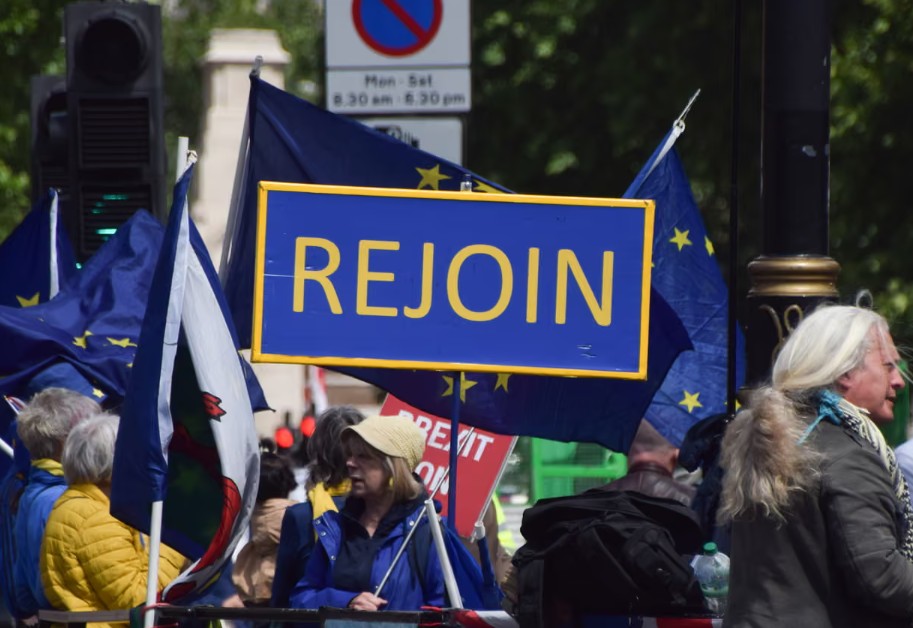
Image Source: Anti-Brexit and pro-EU activists stage their weekly protest in Parliament Square, Vuk Valcic/Zuma/Shutterstock
https://www.theguardian.com/politics/2026/jun/18/brexit-customs-union-exports-single-market-research

Rishika Robert is a Public Policy post-graduate from St Xavier's College (Autonomous), Mumbai. She also holds a double-major undergraduate degree in Political Science and History from Sophia College (Autonomous) and currently works as a visiting lecturer of politics across colleges in Mumbai. She takes keen interest in the history of geopolitics and international statecraft that shapes the contemporary strategies of states and non-state actors. She also seeks to dive deeper into political thought and contribute to academia through the application of theories in understanding the existing ways of the world.