CASA 1000: Will it fulfill electricity requirements of South Asia?
In the 21st century, where the world is highly globalised and technological progress has become a vital component of politics all levels, energy needs of all the countries across the globe has increased. Given the growing deterioration of t...
CASA 1000: What and Why?
It is no secret that the Central Asian counties have copious amounts of resources which are yet to be exploited. Central Asia has always been an important region in world politics due to its strategic location. The fact that it is located in the centre, has led to the region playing an important role during different empires and kingdoms. Nowadays, its geopolitical location at the crossroads of Eurasia, along with the availability of natural resources, has made it a significant player in the international politics. Central Asia has become the hub of many infrastructural projects which mainly deal with making the region a market for new sources of energy. Many countries and organisations have invested heavily in various projects which has led to rapid industrialisation and modernisation of the region.
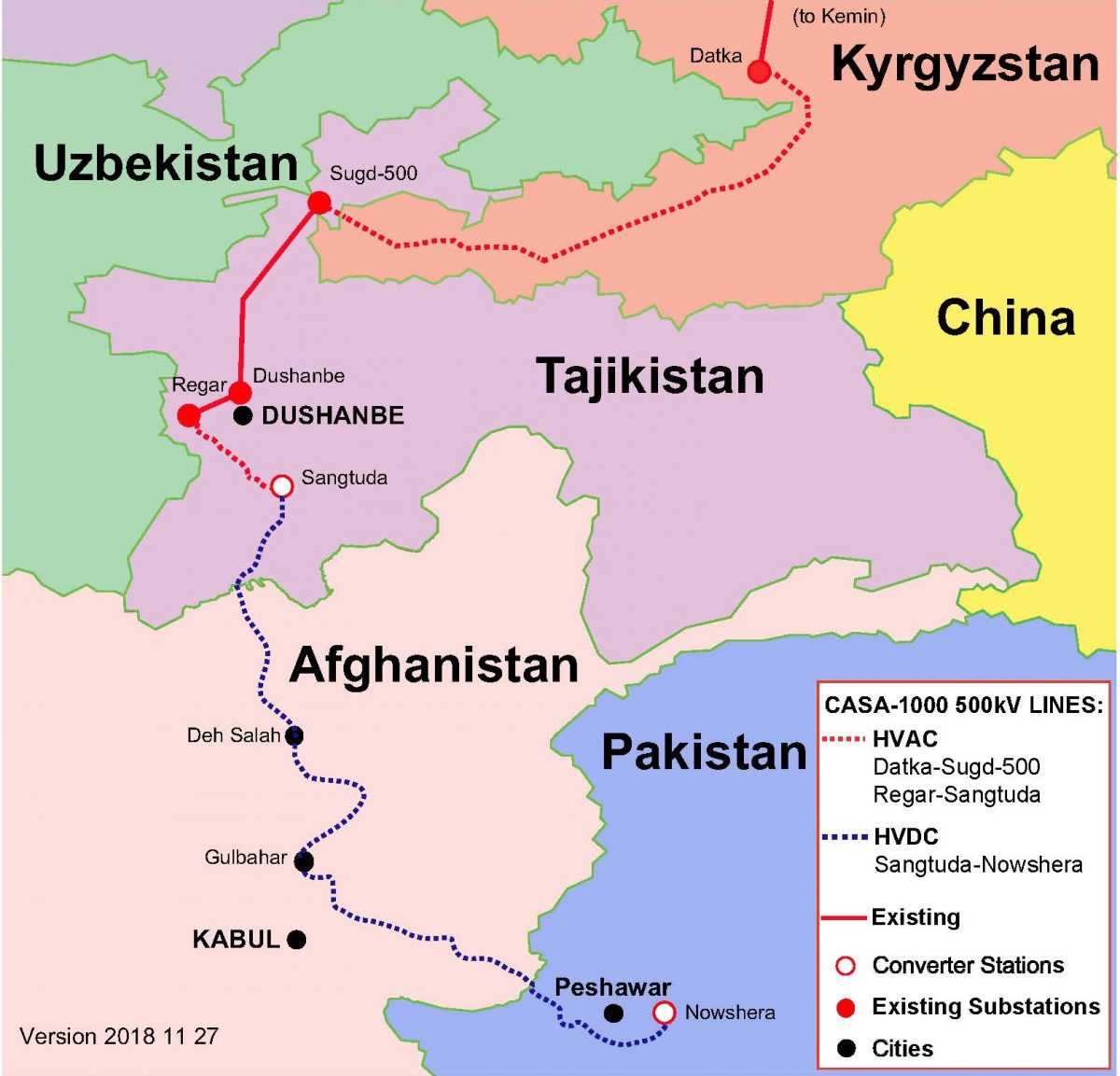
Kyrgyzstan and Tajikistan have abundant resources which can produce renewable sources of energy like hydropower. These countries have high mountain ranges which huge waterfalls which also helps in filling the rivers every summer. These countries generate surplus electricity during while the neighbouring countries in South Asia like Pakistan and Afghanistan suffer from electricity shortages. The demand for electricity has just gone up and will increase manifolds in future. These countries are unable to meet the growing electricity and leads to frequent power cuts which leads to huge economic losses as industrial production drops and small business have to remain shut which leads to loss of jobs. Additionally, there are millions of people who lead their lives without electricity altogether. This project is profitable for both the exporting Central Asian countries (Kyrgyzstan and Tajikistan) would be able to generate revenue from the surplus energy produced by them and it would not go to waste. The importing South Asian countries (Afghanistan and Pakistan) which are rapidly developing would fulfill their increasing demand of electricity, which can help expand their trade and market.
CASA 1000 is one such infrastructural development project, which aims to generate renewable energy from the natural resources. It is an important step to build an efficient electricity system across Central Asia and South Asia which would help in developing a strong economy with good jobs, modern infrastructure, proper social services and inclusive and sustainable growth. The new electricity transmissions aim to supply clean hydropower to the countries through a sustainable solution of water resource management.
CASA 1000: Can the Project Overcome its Challenges?
Planned to export a total of 1,300 MW of excess summer electricity from the two Central Asian countries to the South Asian countries was supposed to be completed in 2018. There is no doubt, that if completed, the project would fulfill needs of the participant countries, but the constant delay in the project has not surprised the scholars. Most of the infrastructural projects which include Central Asian and South Asian countries meet the same fate, a fate of delays and postponements. While on paper these projects seem perfect and achievable, the implementation project lacks proper planning and efficient governance and administration.
Unlike the TAPI project where Turkmenistan has the requisite gas to reach Pakistani and Indian market; CASA 1000 cannot boast of sufficient water supply. This has raised many questions about the about the long-term sustainability of the project. Water sharing and management is an important component of this project and sadly, Central Asian countries have not done a good job at it so far.
Over the years, the Central Asian countries have seen a huge reduction in their water resources. The increasing threat of climate change and global warming has had a drastic implication on water resources. This also comes a time when the climate crises are threatening the world order and all the countries are rushing towards inventing new forms of renewable sources of energy which are both affordable and accessible. This has put led to immense pressure on the water as a resource as people are scavenging across the world to generate energy from it.
The regional water security of Central Asia has been questioned multiple times. This has only led increase in the competition for water in the region and there are many ongoing water disputes in the region which are yet to be solved. The five Central Asian states (Tajikistan, Kyrgyzstan, Kazakhstan, Turkmenistan and Uzbekistan) are connected by two rivers, the Syr Darya and the Amu Darya, which are fundamental for their survival. Since the time of Soviet control, the upstream states, namely, (Kyrgyzstan and Tajikistan) had dams and hydroelectric energy generation facilities, and were able to both produce electricity part of the year, and provide water to the downstream states (Uzbekistan and Turkmenistan) for irrigation during drier periods. For their part, the downstream states provided the upstream states with coal and natural gas to supplement their energy needs. After the breakdown of USSR, all the Central Asian countries retreated into isolation and controlled their respective resources (water and energy) and used it for their benefit without the consideration of their neighbouring states.
At the same time, the countries agreed to follow the Soviet era quota system of water sharing but this has become unworkable. Kyrgyzstan and Tajikistan say that the three downstream countries are all exceeding quotas. Uzbekistan is heavily dependent on the upstream states for its hydro-imports and the lack of water cooperation has led to rising tensions between the states not only water sharing but also on the trade payments. Since energy deliveries from Uzbekistan have been unreliable and the rising tensions have been prevalent, Kyrgyzstan has responded by releasing more water through hydropower dam in winters, which has resulted in downstream states being flooded and having less water for summer irrigation but the downstream countries continue to resist the demand to increase payment put forth by Kyrgyzstan.
Both Kyrgyzstan and Tajikistan have included their major hydropower projects and dams in the grid which would be a part of CASA 1000. The countries state that if these dams are excluded from the project, then they will not be able to generate revenue, and hence the project will not be profitable for them. Uzbekistan has pushed back against the whole concept of CASA 1000 from the start as it fears that to would face the huge risk of energy and water shortages as the exports will be shifted to South Asia.
This project would provide 70 per cent of electricity for South Asia while Kyrgyzstan would contribute another 30 per cent. While this remains fool proof on paper, Kyrgyzstan faced such huge shortages of hydroelectricity in 2007-08, that it had to import hydroelectricity from Kazakhstan. There is no assurance that Kyrgyzstan would not face this kind of a shortage in the future especially given that we are facing resource scarcity globally and climate change is depleting the resources.
CASA 1000 has received support from Washington and has been hailed as one of Americas’ foremost efforts of regional integration as it has invested heavily in the project. The project also has backing from United Kingdom Department for International Development, as well as the World Bank. But investors too have failed to answer how the project will be sustainable in the long run. There have been no clarifications about how Tajikistan will alone handle the hydroelectricity export as Kyrgyzstan has been facing such extreme electricity shortages that it has to import electricity from the neighbouring countries. The Russian investors pulled out of the project in 2016 because Russia was going through economic troubles. This has led to huge delay in the construction of infrastructure which has delayed the transmission.
Conclusion
These issues can have led to serious disputes between the neighbouring states and have also led to situations where war was a possibility. The remaining three Central Asian states are not happy about the CASA 1000 project and have been vocal about it. The project has done nothing but aggravate regional tensions. The project has faced several pushbacks from the Central Asian countries and many fear that this might translate in water wars.
The project has also been facing financial pull-outs which has delayed the construction of the transmission lines. Additionally, the sustainability of the project has been questioned many times but there have been no answers yet.
CASA 1000 is highly advantageous for both Central Asia and South Asia, from both economic and regional cooperation point of view, and technically achievable on paper, but unfortunately lack of stability and political unpredictability poses serious challenges to realization of this project. While this project might be a success to fulfill short term goals and electricity needs, it seems highly implausible that it will fulfill the long-term demands. In my opinion, this is a huge cause of concern, as one of the exporting states, Kyrgyzstan is not even able to fulfill its own needs. So how is it going to supply 70 percent of the hydroelectricity to South Asia? An infrastructural development project which is not sustainable in long term is highly disadvantageous. Therefore, CASA 1000 seems like a fantasy project, which, even if it is finalised and completed, would not be useful after 20 years.
Pic Courtesy-http://www.casa-1000.org/
(The views expressed are personal.)

Krupa Vasani is a current Scholar at The Vedica’s Scholar Program, New Delhi and is pursuing her MBA in Management and Leadership. An undergraduate from O. P Jindal Global University, Krupa holds a bachelors in International Relations. Over the course of three years as an undergraduate, Krupa has developed an interest in the Security and Strategic Studies and Development Sector. Indian Foreign Policy, South South Cooperation and the Strategy in Indo-Pacific and South Asian Politics and the emerging Quadrilateral Diplomacy are some of her areas of interest. She is currently associated with CESCUBE as part time researcher.