China contemplating ADIZ in South China Sea
China imposed the universal fishing ban in the South China Sea starting from May to mid-August for all fishermen from the Spratly islands claimant countries. Imposing a ban on fishing during catch season impacts the livelihood of fishermen....
As per the media reports, there was apprehension that China would announce Air Defence Identification Zone (ADIZ) in the South China Sea much like it had done in 2013 in East China Sea. The purpose of declaring ADIZ is to control skies, and also force the civilian airlines to take permission before flying over the ADIZ. China had earlier imposed anti-access/area denial (A2/AD) strategy in South China Sea in 2017 in the wake of the US attacks on Syrian military bases. With an increasing number of surveillance sorties and deployment of Chinese maritime aircrafts conducting operations in the area, declaration of ADIZ would bring China and US at the cusp of military confrontation. China has already attacked US maritime surveillance aircrafts with laser rays and deployed surface to air missiles with a range of 200 kilometers in its occupied islands in South China Sea.
Earlier in 2013 China had imposed ADIZ in the East China Sea which had been strongly assailed by countries like Japan and the US. In recent months, US has been conducting exercises with Taiwan as well as conducting surveillance sorties with its P-8I Poseidon maritime aircrafts to reinforce freedom of navigation. This has been responded by the China with stationing of its troops and few maritime aircrafts in the reclaimed islands of South China Sea. The stationing of troops and also establishing power generation facility, and water desalination plants shows that China is not going to relent with regard to any peace initiatives or demilitarization requests by the other claimant countries.
The discussion with regard to the signing of the Code of Conduct in the South China Sea is also not being referred by the mandarins in Beijing. US, because of the aggressive tactics by the China, has also deployed its nuclear submarines in forward positions closer to the South China Sea. The fighter aircrafts located in Guam and nearby military bases have been put on operational alert. China, on the other hand, has deployed its Y-8 aircrafts, KJ-500 airborne early warning and control (AEW&C) system, at Yongshu Reef and expanded the military infrastructure in Subi, Fiery Cross and Mischief Reefs. This includes extending runways, building hardened shelters, placing mobile missile launchers and placing signals interceptors and radars. Chinese paranoia is escalating tensions in the region.
Recent Chinese activities, both in terms of annoying India through its cross border transgressions in the Ladakh region, and also under taking serious maneuvers in South China Sea through surveillance aircrafts, missile boats and fast crafts have serious repercussions on peace and tranquility in the region. Recently, there have been reports that Vietnam would be offering Cam Ranh Bay to the US ships, and this would mean a psychological advantage to the US with tactical benefits in the long run. However, Vietnam has denied any such proposition.
If one looks into Chinese strategy, it is more like a regional bully which wants to dictate terms for peace. China is posing a serious threat to regional and international security, and there is a need for all countries to unite. In recent press conferences from the US State Department, Chinese military activities and aggressive moves by its coast guard closer to Natuna islands (Indonesia) have been criticized. Now at a time when the global community is fighting the COVID 19, China is undertaking aggressive military posturing and intimidating tactics to deter the claimants and the Quad countries to undertake any group sail or related activities.
The declaration of ADIZ would serve three purposes for China. First, it could force compliance among weaker countries. Compliance would mean that China would buttress its claims in whole of South China Sea. Second, it can look into response time of major players such as Japan, US, India and Australia, and understand international position on the subject. Last, China would try to utilize its air defence systems in case of any perceived transgression by any aircrafts in its ‘territory’. However, ADIZ has huge repercussions in terms of scrambling of jets in case of any incursion in air space, activating air defence systems to shoot down enemy aircrafts, and keeping its doom radars in hyper active mode to detect any flying aircrafts. ADIZ, on the other hand, has the benefit of giving a valid reason for inadvertent shooting down of a military aircraft or drone. Also, it gives a situational awareness to the military assets and equipment in those reclaimed islands to activate emergency procedures simulating an aerial attack. However, this would create unnecessary tensions and any error in judgment might lead to a mistake with any unfortunate civilian airliner getting shot down by Chinese air defence systems. This has happened in January this year when Iranian air defence system shot down a Ukraine International Airlines Flight 752 killing all 176 passengers on board. Any such incident in South China Sea would bring strong condemnation on China, thereby jeopardizing its position in South China Sea dispute. Also ADIZ in disputed area would infringe on freedom of navigation and innocent passage. The smaller claimant countries might also feel bullied by the Chinese approach and therefore might seek international intervention. More importantly, the civilian airliners would have to seek permission which would be completely undermining international aviation safety and protocols.
Within ASEAN, Malaysia and Philippines have supported Vietnam on raising the issue with the UN and garnering international attention. In fact, China is becoming increasingly criticized for its role in the spread of the Coronavirus and its non-cooperative attitude in sharing vital data. It is also becoming increasingly obvious that with the flight of capital from China, given the possibility of sanctions, and the withdrawal of the foreign companies to relocate to other countries, the Chinese establishment is getting paranoid with the post COVID-19 recessionary phase, as a result of which it is trying to intimidate India and Vietnam, the two beneficiaries of the likely flight of capital from China.
Further, with India becoming the Chairman of the Executive Board of the World Health Organization (WHO) and India having shown that it will abide by the majority decision related to the investigation of Corona virus genesis, China is trying to bully India to accept its demand, related to non-entertainment of Taiwan in the World Health Assembly.
Vietnam, is preparing for the ASEAN summit, and it being the Chairman is seen as a thorn in the Chinese strategic game plan. Vietnam has developed a good partnership with the US and as it is expected that it might sign a strategic partnership agreement with the US, this is giving sleepless nights to Chinese policy makers. Taiwan has already adopted strong measures with the re-election of the incumbent president. This shows that the choices for China in international forums are getting restrained.
Also, as US senator Scott Perry has moved a bill (May 25) to recognize Tibet as a separate and independent country, it is creating more tensions between the two countries. Scholars and strategic analysts have already forecasted that this will be the start of a new Cold War and South China Sea would be the trigger point, with US and China on the opposite sides. It would be interesting to note the response of the two countries during the East Asia summit and also during the ASEAN plus one meetings.
The declaration of ADIZ would further vitiate the atmosphere, but with the US taking a hardened stance, it would be an opportunity to bring China into compliance mode and demilitarize the islands. Otherwise, it would be too late for any change and the South China Sea / East Vietnam Sea would become a story of international apathy, leading to Beijing’s rule of law imposed in the region. A just order would require fair intervention and strong rebuttal of Chinese claims.
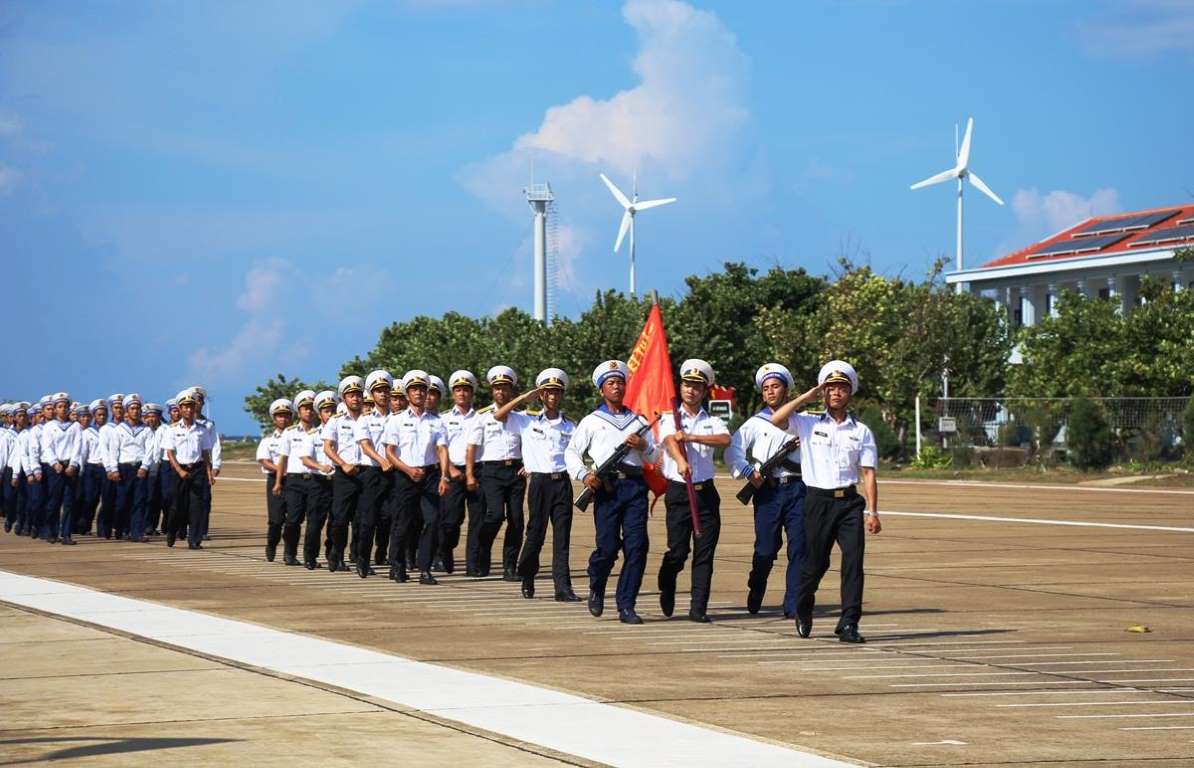
Pic courtsey- Vietnam News Agency
(The views expressed are personal)
Senior Research Fellow at Centre for Security & Strategic Studies.