China’s New Strategy in Cuba
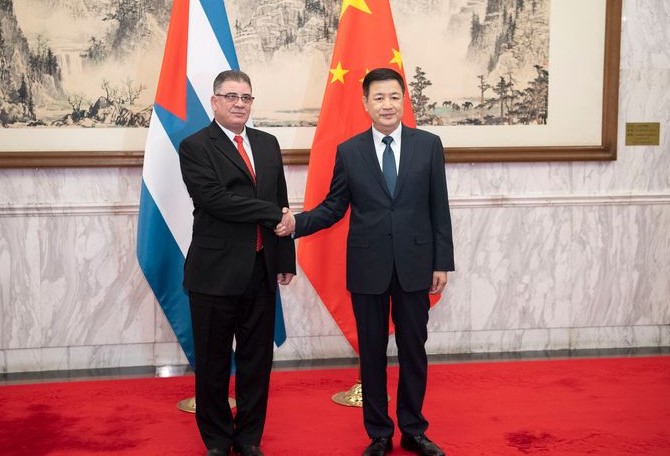
Relations between China and Cuba have been close since the mid-19th century. Until now, the relationship between the two continues to be strengthened, marked by visits between state leaders. The close relationship between the two has made C...
Cooperation between China and Cuba is increasingly being extended to the telecommunications, mining and energy sectors. Communist-ruled Cuba and China have had stable ties for years, and have pursued joint trade and development initiatives. The close relationship between the two is certainly supported by the similarity of their respective national interests.
However, the proximity of the two countries raises great concerns for the United States. In June, a classified intelligence report suggested that China had signed a closed deal to build a reconnaissance base in Cuba, which could monitor southeastern United States communications.
Reporting from the Wall Street Journal (WSJ), On June 9, 2023 this information was disclosed by a United States (US) intelligence official whose identity was kept secret. According to him, China has signed deals worth billions of dollars to be able to build such spying facilities.
The official said the surveillance base in Cuba would allow China to carry out espionage by gathering electronic information from the US, such as e-mails, phone calls to satellite transmissions.
The electronic wiretapping facility is only 100 miles (about 160 km) off the coast of Florida. Meanwhile, Florida itself is the headquarters for the US Central Command at MacDill Air Force Base.
The official, speaking on condition of anonymity to discuss sensitive intelligence, said spying bases were a problem the Biden administration inherited from former President Donald J. Trump. After Biden took office, his administration was briefed on bases in Cuba as well as plans China is considering to build similar facilities around the world, the official said.
News of a deal to build Chinese spy facilities in Cuba has prompted a strong response from Capitol Hill. In a joint statement, Senator Mark Warner, Democrat of Virginia and chair of the Senate Intelligence Committee, and Republican panel member, Senator Marco Rubio of Florida, said they were "deeply disturbed by reports that Havana and Beijing are working together to target the United States and people-our people.”
China and Cuba are alleged to have set up electronic wiretapping in Cuba to spy on US electronic communications at close range. China has been spying from Cuba for some time and upgrading its intelligence gathering facilities there since 2019, a Bidden administration official said on June 10, 2023, following reports of new spying efforts under way in the island.
China has reached a secret agreement with Cuba to build an electronic wiretapping facility on the island roughly 100 miles (160 km) from Florida, the Wall Street Journal (WSJ) reported on June 8, 2023 but the US and Cuban governments have cast doubt on the report.
The White House initially labeled the Wall Street Journal report "incorrect." However, in its press statement, the government finally acknowledged how the threat of Chinese espionage in Cuba had been known for a long time.
Chinese and Cuban Responses to US Accusations
On June 12, 2023 through a regular press briefing, Chinese Foreign Ministry spokesman Wang Wenbin, addressed the Biden administration's claims that China had been spying for the US from Cuba to constitute false information and criticized the US government and media for releasing what it called inconsistent information.
"Over the past two days, we have seen the US government and media release a lot of inconsistent information about the so-called accusations... This is a display of the 'US contradicting each other'," Wang said.
Cuban Deputy Foreign Minister Carlos Fernandez de Cossio has also dismissed the Journal report, calling it a US engineering intended to justify a decades-old US economic embargo on the island nation. He said Cuba rejected all foreign military presence in Latin America and the Caribbean. Cuban Foreign Minister Bruni Rodriguez further said that the report was a fabrication meant to further the US' own political goals.
It can be analyzed that what is done by the US is in accordance with the perspective of neorealism by Kenneth Waltz. In the perspective of neorealism from Kenneth Waltz, international structure is emphasized as an important factor in shaping state behavior, as the international system does not have a world government which is considered effective so that states act in anarchy and interact in conditions of uncertainty.
Neorealism Waltz recognizes that the state acts based on rational calculations regarding its strength so that it prioritizes security by trying to defend itself and prevent the domination of other countries. In this case, the US seeks to prevent cooperation between China and Cuba because of fears of the dominance of the two when they become a unified force.
In developing the theory of Neorealism, Hans Morgenthau also confirmed the existence of basic principles that emphasized competition, strength, power, national interests, and diplomacy. The US accusations against China and Cuba show that there is concern that military strength if the two join forces could lead to competition, weaken US strength and power over China and Cuba, and affect US national interests themselves. The Taiwan issue and economic competition are the reasons underlying the accusations filed by the US. Plus America has an unstable relationship with the two countries.
The US acts as an actor who looks at other actors on the international stage like an international structure. The US sees China starting to spread its influence from Asia, Europe, to Latin America, including Cuba, which is one of China's efforts to become the most powerful in the international structure to defeat the US. It aims to maintain an anarchic international structure so that there is no power other than the US on the international stage.
Previously, Cuba had also been used as a military base for the Soviet Union because of its very strategic location and could attack the US at any time. The same thing is feared by the US-China trade war and the strengthening of China-Cuba relations. In addition, Cuba and China also have similarities in the ideology of communism and state goals, so that solidarity and good relations are more easily established.
In the perspective of Neorealism, it can be seen that the US accusation is a form of self-defense, both its strength, power and national interest in the relationship between China and Cuba. This is also supported by the fact that until now there has been no confirmation regarding the justification of China's military base in Cuba, both from China and Cuba itself.
As there is increasing evidence that China is ready to take full advantage of Cuba's geographical proximity to America, various efforts are being made by the US although with great caution, such as approaching countries around China, increasing counter-intelligence operations in Cuba, information gathering operations, and considering closing or relocating US military and diplomatic facilities in Cuba, along with further sanctions and embargoes.
It can be concluded that the United States has special concerns about the cooperative relationship between China and Cuba. This is due to the fear of China's dominance in the global arena, one of which is through the use of bilateral relations with Cuba in the economic and security fields.
Various efforts were made by the US to prevent this, because if China and Cuba supported each other in various economic and military sectors, US strength would surely be rivaled. In the analysis of the perspective of neo realism, what is done by the US is an effort to maintain its strength, power and national interests.
Pic Courtesy-miamiherald.com
(The views expressed are those of the author and do not represent views of CESCUBE.)

Silvanah Silva is a student of International Relations at the Islamic University of Indonesia and a researcher at the Center for Indonesia-China Studies (CICS)