LIVE DISPATCH
Loss and Damage Finance: From COP28 Pledges to Policy Architecture Extended Deterrence Under Strain: Credibility, Assurance, and the Stability-Instability Paradox in the Indo-Pacific Beyond Consultation: BIMSTEC's Emerging Role in Regional Intelligence and Security Cooperation Maritime India: Security, Trade, and Great Power Competition Between the Desert and the Savannah: Conflict and the Political Economy of Instability in the Sahel Beyond Ukraine: Understanding Putin's Vision of Russian Power The Politics of Ali Khamenei's Funeral Silicon Sovereignty: How Semiconductors Are Redrawing Global Power Hierarchies Operation Sindoor and the Changing Dynamics of India–Pakistan Security The Negative Impact of US–Iran War on the Pacific Region Generative AI, Labour Sovereignty, and the Geoeconomics of India's Service Economy BRICS Expansion and the Multipolar Moment: Opportunity or Strategic Contradiction? India's AI Diplomacy and the Future of Strategic Technologies Foot-Dragging as Feminism: Iran, South Korea, and the Ungovernable Body Lethal Autonomous Weapons Systems and the Governance Deficit: Challenges to International Humanitarian Law and Accountability Beyond Proximity: Why the UAE Occupies a Growing Place in Iran’s Strategic Calculus Great Power Rivalry and the Crisis of the United Nations Why Fiji Matters: The New Geopolitics of the Indo-Pacific Islands Ten Years After Brexit: Regret, Reform, or Reversal? The Long Shadow of 1953: Understanding the Iran–US Conflict Sports, Strategy and Statecraft of Mega Sporting Events as Geoeconomic Instruments: Qatar 2022 to Saudi Arabia 2034 Border Fencing and National security: India’s Strategy along the Bangladesh Border Hardening the Quad: From Strategic Dialogue to Operational Cooperation Lingering Effects of the Bush Doctrine on Contemporary US Foreign Policy The Maghreb of States: Identity, Sovereignty, and the Limits of Non-Interference India’s BRICS 2026 Chairmanship Navigating a tightrope Amidst the Chinese Geopolitical Rise Beyond the Battlefield: Understanding Unconventional Security Challenges in Contemporary Geopolitics The Control Paradox: How Proxy Warfare Enables Strategic Deniability While Constraining Strategic Control Trapped in Deterrence: Nuclear Stability and the Persistence of Conflict in South Asia The Return of Unipolarity? U.S Strategic Primacy and the Future of the Global Order Supply Chains and Complicity: The Role of Global Corporations in Forced Labour in Xinjiang The Distant Threat: Is Israel Constructing a Strategic Rival in Pakistan Island Militarisation and Techno-Diplomacy: Turkey’s Eastern Mediterranean Fault Lines Amid India-Greece Alignment India’s Security Scenario: An Assessment of its Continental and Maritime Challenges The Geopolitical Architecture of European Defence: Navigating NATO Synergies, Transatlantic Retrenchment, and the Hybrid Threat Landscape The Artemis Accords and the Future of Global Space Governance AI and the Securitization of Critical Infrastructure: Implications of India's AI Summit Beyond Rhetoric: Evaluating the Effectiveness of International Sanctions on China’s Treatment of Uyghur Muslims The Emerging Maritime Rivalry in the Western Indian Ocean: India’s Response to Extra-Regional Powers India's Maritime Grand Strategy on Trial : The IRIS Dena Incident and the Indian Ocean Question Loss and Damage Finance: From COP28 Pledges to Policy Architecture Extended Deterrence Under Strain: Credibility, Assurance, and the Stability-Instability Paradox in the Indo-Pacific Beyond Consultation: BIMSTEC's Emerging Role in Regional Intelligence and Security Cooperation Maritime India: Security, Trade, and Great Power Competition Between the Desert and the Savannah: Conflict and the Political Economy of Instability in the Sahel Beyond Ukraine: Understanding Putin's Vision of Russian Power The Politics of Ali Khamenei's Funeral Silicon Sovereignty: How Semiconductors Are Redrawing Global Power Hierarchies Operation Sindoor and the Changing Dynamics of India–Pakistan Security The Negative Impact of US–Iran War on the Pacific Region Generative AI, Labour Sovereignty, and the Geoeconomics of India's Service Economy BRICS Expansion and the Multipolar Moment: Opportunity or Strategic Contradiction? India's AI Diplomacy and the Future of Strategic Technologies Foot-Dragging as Feminism: Iran, South Korea, and the Ungovernable Body Lethal Autonomous Weapons Systems and the Governance Deficit: Challenges to International Humanitarian Law and Accountability Beyond Proximity: Why the UAE Occupies a Growing Place in Iran’s Strategic Calculus Great Power Rivalry and the Crisis of the United Nations Why Fiji Matters: The New Geopolitics of the Indo-Pacific Islands Ten Years After Brexit: Regret, Reform, or Reversal? The Long Shadow of 1953: Understanding the Iran–US Conflict Sports, Strategy and Statecraft of Mega Sporting Events as Geoeconomic Instruments: Qatar 2022 to Saudi Arabia 2034 Border Fencing and National security: India’s Strategy along the Bangladesh Border Hardening the Quad: From Strategic Dialogue to Operational Cooperation Lingering Effects of the Bush Doctrine on Contemporary US Foreign Policy The Maghreb of States: Identity, Sovereignty, and the Limits of Non-Interference India’s BRICS 2026 Chairmanship Navigating a tightrope Amidst the Chinese Geopolitical Rise Beyond the Battlefield: Understanding Unconventional Security Challenges in Contemporary Geopolitics The Control Paradox: How Proxy Warfare Enables Strategic Deniability While Constraining Strategic Control Trapped in Deterrence: Nuclear Stability and the Persistence of Conflict in South Asia The Return of Unipolarity? U.S Strategic Primacy and the Future of the Global Order Supply Chains and Complicity: The Role of Global Corporations in Forced Labour in Xinjiang The Distant Threat: Is Israel Constructing a Strategic Rival in Pakistan Island Militarisation and Techno-Diplomacy: Turkey’s Eastern Mediterranean Fault Lines Amid India-Greece Alignment India’s Security Scenario: An Assessment of its Continental and Maritime Challenges The Geopolitical Architecture of European Defence: Navigating NATO Synergies, Transatlantic Retrenchment, and the Hybrid Threat Landscape The Artemis Accords and the Future of Global Space Governance AI and the Securitization of Critical Infrastructure: Implications of India's AI Summit Beyond Rhetoric: Evaluating the Effectiveness of International Sanctions on China’s Treatment of Uyghur Muslims The Emerging Maritime Rivalry in the Western Indian Ocean: India’s Response to Extra-Regional Powers India's Maritime Grand Strategy on Trial : The IRIS Dena Incident and the Indian Ocean Question
ADVERTISEMENT
Intelligence July 7, 2020 18350 Reads

Has India activated its ‘Double Fish Hook’ strategy in the Indian Ocean?
P
By Pankaj Jha
Author • Centre for Security & Strategic Studies
Has India activated its ‘Double Fish Hook’ strategy in the Indian Ocean?
Share Analysis:
EXECUTIVE SUMMARY & STRATEGIC TAKEAWAYS

The Fish hook strategy was a US propelled strategy highlighted by Taiwan military intelligence official Liao Wen-chung. He described it as a “Fish Hook Undersea Defence Line”. The purpose of this defence line was the US developing unde...

ADVERTISEMENT

During the late 1980s there were apprehensions that Russia might use Andaman and Nicobar islands as a launching pad for its ambitions in the Indian Ocean region. This has perturbed the countries such as Indonesia, Singapore and Thailand which were seen as closest allies of the US in Southeast Asia. In the due course of time the concept of the ‘’String of Pearls’ also came into being. Under this concept it was propagated that China is building ports and related infrastructure in the South Asian region in countries such as Pakistan, Sri Lanka, Bangladesh and Myanmar. Over a period of time with Chinese investment in port development at Gwadar(Pakistan), Hambantota (Sri Lanka), Chittagong(Bangladesh) and Kyaukpyu(Myanmar), buttress the fact that a string of pearls might be a possibility.

India's strategy to counter this string of pearls was not highlighted and it was stated that India is complacent with regard to countering Chinese strategy in the Indian Ocean region. However, this has changed with India taking due cognisance of the fact that in order to counter China, it will have to strengthen its Andaman and Nicobar Islands.  For that objective in mind, the new Chief of Defence Staff (CDS) Bipin Rawat commissioned these islands as the one of the theatre command centres. With D K Joshi, the former Chief of Navy staff as the Lt Governor of these islands the development of infrastructure would be in sync with the maritime objectives of the Indian navy as well as developing cooperation among three wings of armed forces. 

For Andaman and Nicobar to be elevated as an effective countermeasure against Chinese incursions in Indian Ocean region, there is a need for cooperation among the Quad countries so that Chinese activities in this region can be curbed. Chinese opening up of the base in Djibouti as well as developing military capacities in Gwadar for dual use purposes, showcases China's desperation to secure its energy supply lines. These islands were also referred in one of the RAND studies for operationalising US drone operations. India has also taken up the initiative for upgrading the infrastructure in few of the islands such as building new jetties, extending the airstrips in two air ports, building hangers for Sukhoi aircrafts and building two new airports in Northern region of these islands.

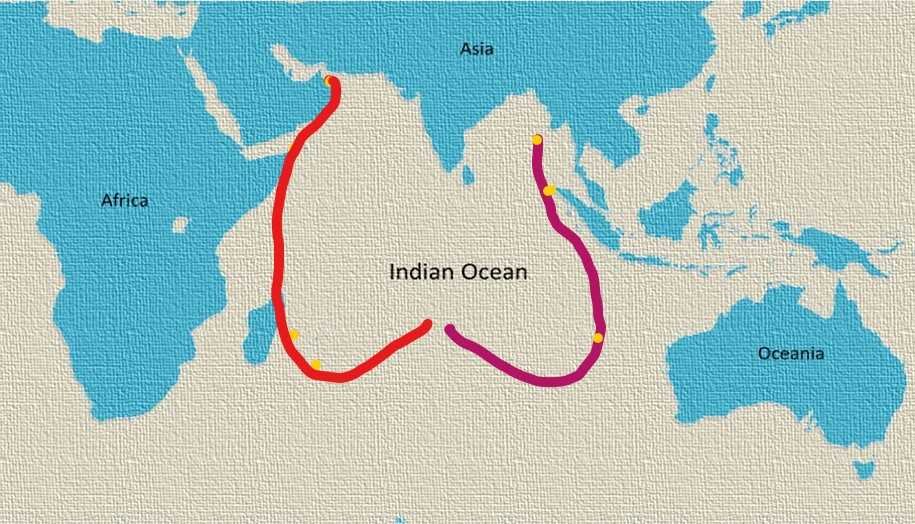
China has reclaimed and developed Feydhoo Finolhu Island, one of the Maldivian islands nearly 600 kilometres from Indian coastline as part of its maritime civilian infrastructure development in the Indian Ocean. Chinese reclamation activities in South China Sea have opened multiple avenues of island reclamation for those countries which are threatened by the climate change and sea level rise. Maldives has always worried about the sea level rise because many of its low lying islands which are tourist destinations would be submerged in the next three decades. India, on its part, has been working with its partners to develop its own version of the ‘’fish hook strategy’ which will encompass Andaman and Nicobar island chain, Sabang port in Indonesia and Coco(Keeling) Islands in Australia in eastern region. The MoU for development of Sabang and the Mutual Logistics Support Agreement (MLSA) with Australia are part of this larger strategy. While connecting these ports and military bases, the last landing point would be Diego Garcia controlled by the US.

As a mirror image of this strategy India has gained rights for berthing and logistics support at Duqm port in Oman and has been working on establishing foothold in Djibouti. It has existing infrastructure in Mauritius and Seychelles while at the same time it has signed a logistics support agreement with France (signed during the visit of French President Macron in 2018) to provide reciprocal supplies, logistical support, and services and has started fortnightly sorties with maritime surveillance aircrafts. India has stationed a naval aircraft at France’s Reunion island. India has been working with Oman and developing its Duqm port for logistics purposes. An agreement in this regard has already been signed in 2018. Indian navy has secured access facilities at Duqm port. India has engaged Seychelles (Assumption island), Mauritius (Agalega Island) and Madagascar along with logistic support agreement with France and utilising its assets in the western Indian Ocean region. In case all of these are marked on the map then it will mirror the earlier fish hook, with end point at Diego Garcia.

The need for developing this network has been felt by the military establishment meant so that any Chinese venture closer to Indian coast can be met with interruption as well as interjection of rogue ships in case of an emergency. This double hook strategy would work for strategic operations among the Quad members for countering piracy or undertaking disaster relief missions. Further, it will help in undertaking comprehensive sweeping operations for survivors in case any disaster such as the MH-370.

This double fish hook strategy would have three nodes – the Andaman and Nicobar Islands, Diego Garcia and Djibouti base. In a way this would create an effective triangle which could be operationalised for sea dominance and denial operations. The maritime surveillance aircrafts such as P-3C Orion or P-8 Poseidon would help in long range missions. India and France has undertaken these kinds of missions in the past. Also with logistics support agreement with Australia on a quid pro quo basis, both India and Australia can undertake long term and long range missions.In this network, the US would play a critical role and India is well aware of the fact that operationalisation of this fish hook would complement the US fish hook strategy existent in the Pacific region.


The rights of the pictorial representation are reserved. All rights@Pankaj K Jha

(The views expressed are personal)

P
About Pankaj Jha →

Senior Research Fellow at Centre for Security & Strategic Studies.
ADVERTISEMENT

Related Strategic Analysis