India-Middle East-Europe Economic Corridor(IMEC):The Unravelling Avenues Traversing Golden Sands
The Prime Minister of India, Narendra Modi, made a significant statement on a very ambitious initiative during the G20 meeting held on Saturday. This effort not only poses a challenge to China's Belt and Road effort (BRI), but also has the ...
The potential impact of the India-Middle East-Europe Economic Corridor on global geopolitics can be seen in the remarks made by Mr. Biden on October 25, 2023. He claimed that the progress being made in establishing this corridor may have contributed to the motivations behind Hamas' attack on Israel.[1] President Biden has mentioned the India-Middle East-Europe Economic Corridor on two separate occasions in less than a week, implying a possible connection between this economic endeavour and the recent terrorist attack carried out by Hamas.
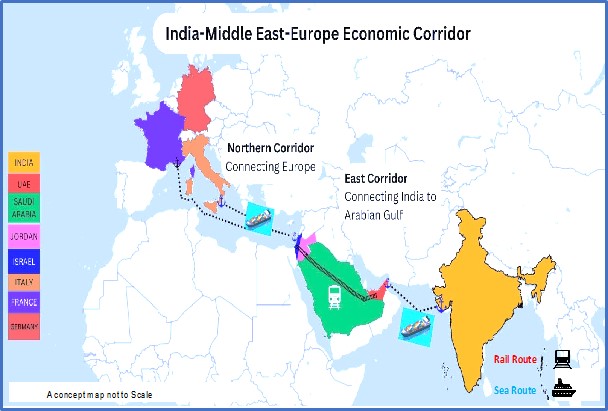
A memorandum of agreement has been signed by many nations and entities, including the United States of America, Saudi Arabia, the European Union, India, the United Arab Emirates, France, Germany, and Italy, in relation to the project. The India Middle East Europe Economic Corridor (IMEC) comprises two separate corridors, namely the eastern corridor, facilitating the connection between India and the Arabian Gulf, and the northern corridor, enabling the linkage between the Arabian Gulf and Europe.[2] The proposed initiative encompasses railway endeavours that aim to establish a dependable and economically viable transnational ship-to-rail transportation network. This network will serve as a complementary option to the current maritime and road transport routes, facilitating the seamless movement of goods and services between India, the United Arab Emirates, Saudi Arabia, Jordan, Israel, and Europe. The proposed solution involves the implementation of a network infrastructure that would provide connectivity between maritime vessels and railway systems at international boundaries. This phenomenon will not only lead to a surge in digital communication, but it will also facilitate the transportation of environmentally friendly hydrogen from one geographical area to another.[3]
The Project Has Three parts
The designated name for this economic corridor is the India Middle East-Europe Economic Corridor. Moreover, it is being presented as a contemporary iteration of the historic 'Spice Route'. This project consists of three primary components.
Firstly, the establishment of maritime connectivity would facilitate the connection between India and the Arabian Peninsula.
Secondly, the construction of rail links inside the Arabian Peninsula will enable connectivity with the United Arab Emirates, Saudi Arabia, Jordan, and Israel.
Additionally, there exists a proposal to establish a maritime connection between Israel's eastern Mediterranean coastline and Greece and Italy, as well as a train link to the other regions of the European continent.
This project will include the use of both new and existing railroads and ports. A Memorandum of Understanding (MoU) has been signed by India, the United States of America, the United Arab Emirates, Saudi Arabia, France, Germany, Italy, and the European Union Commission. According to reports, discussions on this initiative were initiated by President Joe Biden of the United States in January 2023, including his regional allies. The concept gained traction at the Hiroshima G7 conference, which took place in May 2023. This project is a component of the Partnership for Global Infrastructure Investment (PGII), a programme established by the United States.[4]
This project aims to provide connectivity between the Indian market and the markets of West Asia and Europe. Additionally, it is noteworthy that there are plans to extend this network to Africa as well. The proposed initiative, known as the 'Trans Africa Corridor,' aims to construct a transport network inside the Sub-Saharan African region, with the involvement of the European Union as a collaborative partner.[5] The establishment of this railway network would enable the integration of the western coast of Angola with the Indian Ocean, extending its reach beyond the territories of Congo and Zambia. Consequently, this connectivity will enhance trade opportunities between Central Africa, Asia, and Latin America.
This initiative is also seen as achieving many objectives simultaneously. This endeavour undertaken by the United States is aimed at mitigating the increasing ties between Saudi Arabia and China as well as Russia, while simultaneously fostering a deeper relationship between Israel and Saudi Arabia.[6] If reports are to be believed, a high level delegation had gone to Riyadh a week before the G20 conference, only then the Saudi government had given its official approval to this agreement.
Changing the Geostrategic Landscape
This initiative is widely supported by all member nations, with notable backing from the United nations and the European Union. These stakeholders saw it as an opportunity to tap into India's growing consumer market and to counteract the escalating influence of China in the area.
The United States aims to preserve its position in the region as a regulating entity via its engagement with Saudi Arabia, the United Arab Emirates, Israel, and other states in the Gulf area. This geopolitical manoeuvre is in accordance with the 'Abraham Accords' and the larger strategy known as I2U2 (India, Israel, US, and UAE).[7]
The project in question has economic potential for India because to its substantial diaspora residing in the Middle-East, hence bolstering energy security and providing a market for Indian products. India's geopolitical positioning enables it to exert influence across the Indian Ocean while also extending its reach into the Mediterranean and Atlantic areas.
It offers several strategic benefits for India:
· China has deliberately sought to encircle India via the implementation of the China-Pakistan Economic Corridor (CPEC) and the Belt and Road Initiative (BRI). This initiative has the potential to facilitate India's departure from the aforementioned cycle.
· As a result of this development, India will get the privilege of unhindered marine transit across the Hormuz Strait, Suez Canal, and Bab Al Mandab Strait.
· Approximately 33.33% of the global oil and gas supply is transported across the Strait of Hormuz. The chosen path has significant implications for India's fuel security.
· The Suez Canal facilitates around 12 percent of worldwide trade, making it a significant conduit for international commerce. This initiative enables the monitoring of commercial activities occurring inside the canal.
Its strategic and economic significance to India:
· The overall pattern of business in the whole Indian Ocean would significantly shift if this trade corridor is created.
· The current marine route takes 14 days from Mumbai to reach the European market, whereas the new route via the UAE and Haifa port in Israel just takes 10 days.
· The diplomatic ties between India and Arab states are expected to strengthen, leading to an enhancement in the level of camaraderie. Additionally, the calibre of India's connections with Israel is anticipated to improve.
· Re-evaluating the prevailing notion of India just as a market might contribute to elevating its significance as a crucial component inside the global supply chain.
India's Hopes and Fears
It is envisaged that the 'Build-Back-Better World (B3W)' initiative and the infrastructure investments made by member nations would be the funding sources for this ambitious corridor; however, none of these factors is yet certain. The Belt and Road Initiative (BRI) of China offers a variety of loans, grants, and other financial instruments, whilst the US-led B3W effort seeks to entice private sector investments.
The protracted process of planning of infrastructure projects, in conjunction with elevated private investor anticipations, has the potential to inflate expenses and compromise the financial viability of such endeavours. Therefore, the task of guaranteeing stable finance for B3W initiatives poses difficulties, since recipient countries may encounter uncertainty in obtaining commitments from global donors or private investors. The delays that occur in the distribution of funds may have many negative consequences, including delays in projects, increased costs, and diminished feasibility.
Therefore, India should argue for a combination of public and private finance, acknowledging that certain projects, owing to their lengthy gestation periods, may not be economically viable without government support or grants. In doing so, India can help ensure that these projects are able to proceed.
Natural gas is much more inexpensive for regular Indians when considering the present infrastructure and the expense of switching over to the usage of hydrogen, therefore India should take into consideration a plan to build a dedicated gas pipeline from the Middle East to India.
The Challenges That Loom in Front of Us
The implementation of the planned corridor is anticipated to encounter several political obstacles. It is noteworthy that Israel and Saudi Arabia don't currently have any formal relations. However, any disagreements they may have as partners may be resolved via a process of compromise and discussion. Although there is no hostility between the two countries, even than it is hard to ignore Saudi Arabia's position about the ongoing fight between Hamas and Israel, which began on October 7, 2023. Israel has not yet released a public statement supporting or criticising the resolution. However, if we consider the cordial connection between Prime Minister Modi and Benjamin Netanyahu, we can be optimistic. Additionally, it is envisaged that the project will get finance via a public-private partnership model. The project is quite likely to take a long time to complete, and it is yet unclear if it will be able to have an impact on the changing geopolitical situations, which calls for closer monitoring. India must thus continue to be committed to and involved in a number of transport and energy corridors, including the Suez Canal, the Arctic Route via Vladivostok, and the North-South Transport Corridor (NSTC). India should maintain a stance of neutrality while being watchful in response to the changing dynamics of global politics, with a focus on safeguarding national interests.
Notes
[1] The Hindu (2023, October 26). https://www.thehindu.com/news/international/biden-says-progress-on-india-middle-east-europe-economic-corridor-could-be-one-of-the-reasons-for-hamas-attack-on-israel/article67461134.ece#
[2] Rajagopalan, R. P. (2023, September 29). The Geopolitics of the New India-Middle East-Europe Corridor. ORF. https://www.orfonline.org/research/the-geopolitics-of-the-new-india-middle-east-europe-corridor/
[3] Geopolitics of the Energy Transformation: The Hydrogen Factor. (n.d.). https://www.irena.org/Digital-Report/Geopolitics-of-the-Energy-Transformation
[4] Singh, R. (2023, September 11). India-Europe Economic Corridor: What is the Partnership for Global Infrastructure Investment that is behind the project? The Indian Express. https://indianexpress.com/article/explained/everyday-explainers/india-europe-economic-corridor-pgii-explained-8933335/
[5] Press corner. (n.d.). European Commission - European Commission. https://ec.europa.eu/commission/presscorner/detail/en/statement_23_4419
[6] Taneja, K. (2023, October 17). The Dragon in the Sands: Unpacking China’s Presence in Contemporary West Asia. ORF. https://www.orfonline.org/research/the-dragon-in-the-sands/
[7] G. (2022, July 22). The Abraham Accords and the Genesis of I2U2. Financial Express. https://www.financialexpress.com/business/defence-the-abraham-accords-and-the-genesis-of-i2u2-2600593/
Pic Courtsey-Uttam Kumar
(The views expressed are thsoe of the author and do not represent views of CESCUBE.)
Uttam Kumar is Professor in Geography at MMH College, (Ch. Charan Singh University) Ghaziabad,Uttar Pradesh, India. He has more than 22 years of professional experience with a throughout first class academics and career. He has been a contributor in Social Science research, Geographical learning and specialises in geopolitics of landlocked countries; various publications in national and international journals,edited books along with active presence as resource person and presenter in IUAES Dubrovnic, 2016, IGU Congress Beijing, 2016, IGU Moscow, 2018, etc. He can be reached at uttam158@gmail.com