India’s Inland Waterways Projects as Economic Multipliers
Development of large-scale commercial shipping and navigation on the inland waterways to transport bulk and hazardous goods led the Indian Parliament to enact the National Waterways Act, 2016 creating 106 new waterways on many rivers, river...
Pushing for the development and active use of inland waterways is only going to ease out the burden on the freight corridors. In addition to this, India, in specific has an added advantage. Rivers are living embodiments of a great civilisation. In the context of the Indian subcontinent, people have an abiding relationship with the eight major river systems of the homeland. The government’s emphasis on developing national waterways is centred around this civilisational identity. India owns about 14, 500 km of navigable waterways. A fuel-efficient Inland Water Transport (IWT) is responsible for moving 55 million tonnes of cargo annually. This capacity needs to proliferate.
National waterways on rivers are potential economic multipliers that can generate jobs, boost tourism, create smart cities along their banks, ensure cleaner water supplies to cities and towns, foster aquatic life, and most importantly, enrich trade and transport not just across the region, but also open up alternative routes for the movement of cargo and people to foreign countries. To commemorate the 75 years of progressive India, more than 200 metric tonnes of food grains was supposed to travel from Patna to Pandu to mark an inflexion point in India’s cargo movement infrastructure. The policy makers have also analysed the importance of the river Ganga for India as 40% of the population depends on it for livelihood. Keeping this in mind, “Project Arth” was conceived to re-engineer the Jal Marg Vikas Project (JMVP) by involving the locals. This project aims to create infrastructure of values exceeding Rs 4, 600 crores for the sustainable movement of vessels up to 2,000 tonnes.
The ripple effect created by the inland waterways spreads far beyond the rivers’ shores. These waterways, once functional, will create various sub-ecosystems themselves. When goods and people travel on ferries and ships, it also helps create an attendant ecosystem that benefits intermediate industries such as cement and steel, besides sustaining a range of service-driven economic activities that come along with trade and commerce. In March last year, the Prime Minister remarked that India is going to invest in waterways in a way that has never been seen before. This infrastructure will open up new growth hotspots where new factories and plants can be set up. Areas that were previously labelled unviable because of lack of efficient cargo movement infrastructure will be transformed into cradles of economic growth.
Reports by the think-tank (Manthan Adhayayan) suggest that the government has failed to keep its promises. 37 national waterways (NW) were prioritised in 2016 and were supposed to be built by 2019. On 21 of these, however, no work has even started yet. Waterways on the Gandak, Ghaghara, and Kosi rivers were among the 37 NWs that were highlighted for their potential to offer connectivity to Nepal. However, after some preliminary work, construction was halted in 2020. Now, the Inland Rivers Authority of India's April 2020 Action Plan does not even include these waterways on its list of NWs chosen for development.
Action Plan of Inland Waterways Authority of India (IWAI) has revealed that 63 out of the 106 newly declared waterways are not feasible for cargo or passenger transport. Development of these waterways requires funding and capital investment. Nitin Gadkari, the then shipping minister had promised that the government would provide 20 billion Indian rupees per annum for the waterways from the Central Roads Fund and that 10 waterways would be operationalised by December, 2018. To the country’s dismay, the total funds spent on the entire programme in the last five years are estimated to be around 40 billion.
Prime Minister Gati Shakti Master Plan which was launched on 13th October, 2021 aims to provide multimodal connectivity infrastructure to various economic zones. Cabinet Committee on Economic Affairs (CCEA) accorded approval for the implementation of PM Gati Shakti Master Plan on 21st October, 2021. This plan lays down a transformative approach for economic growth and sustainable development. It’s primarily driven by 7 engines with the development of waterways being one of them. Therefore, it is expected that the current waterway situation is likely to change for good. Myriad projects are in the pipeline with another myriad waiting in the queue to get into the pipeline. The real question is the question of implementation, timeline and physical results. As capital investment is supremely important for creating a permanent and state of art infrastructure, this whole process of inland waterways taking shape will take a lengthy amount of time.
This is not to deny that planning is equally important and as patient citizens and stakeholders, keeping track of the latest developments is imperative. According to the Union Minister Sarbanda Sonawal, the ministry of ports, shipping and waterways has identified 101 projects under PM Gati Shakti Master Plan to enhance port connectivity with production and consumption centres. The government is taking long leaps to reach the goal of strengthening the logistics ecosystem. These plans need to materialise quickly as the maritime sector plays a crucial role in an economy’s overall trade and growth. The pace will surely increase if the private sector steps in to play a role. The private sector needs to keep aside its risk aversion. With the government proactively encouraging private sector participation in development, the private sector should jump right in and seize the opportunity.
Some of the constraints in the development of inland water transport are presented by the lack of adequate terminal facilities at the loading and unloading points, excessive silt roads from the erosion of uplands due to bad catchment management and increased deforestation. Even then, some progress has been made, but only in the projects that were funded by the World Bank. Jal Marg Vikas Project (JMVP) on NW-01 on Ganga-Bhagirathi and Hooghly, West Bengal Inland Water Transport also on the Hooghly, Logistics and Spatial Development Project on Brahmaputra, and Assam Inland Water Transport Project on Barak are largely the World Bank funded projects. The achievements so far are miniscule with respect to the progress that should have been made long ago. For example, in the 14 months of JMPV’s inauguration, it has handled only 280 tonnes of cargo in contrast to the projected 3.5 million tonnes.
Cargo movement is only one of the priorities. The government is also interested in introducing sea planes and luxury cruises. This implies that the local communities and fishers will have to bear the brunt. Cruises that have been introduced in Varanasi on NW-01 will negatively impact the livelihoods of small boat operators on Ganga. The government is trying to indicate that the projects like Arth Ganga and JMVP will be modified to create safety nets for the local communities. However, the efforts aren’t so visible as of now. How will the needs of both the stakeholders be met? Will the government side with the big corporate owners? Or will the marginal communities win this interminable tussle for once?
References
1. 25th November, 2021, Govt has identified 101 projects under PM Gati Shakti Plan: Sonawal, https://timesofindia.indiatimes.com/business/india-business/govt-has-identified-101-projects-under-pm-gati-shakti-plan-sonowal/articleshow/87916523.cms
2. Shripad Dharmadhikary, Avli Sharma, India’s waterways programme a tale of unkept promises, https://www.thethirdpole.net/en/livelihoods/india-inland-waterways-programme-unkept-promises/#:~:text=These%20projects%20include%20Jal%20Marg,Brahmaputra)%20and%20NW%2D16%20(
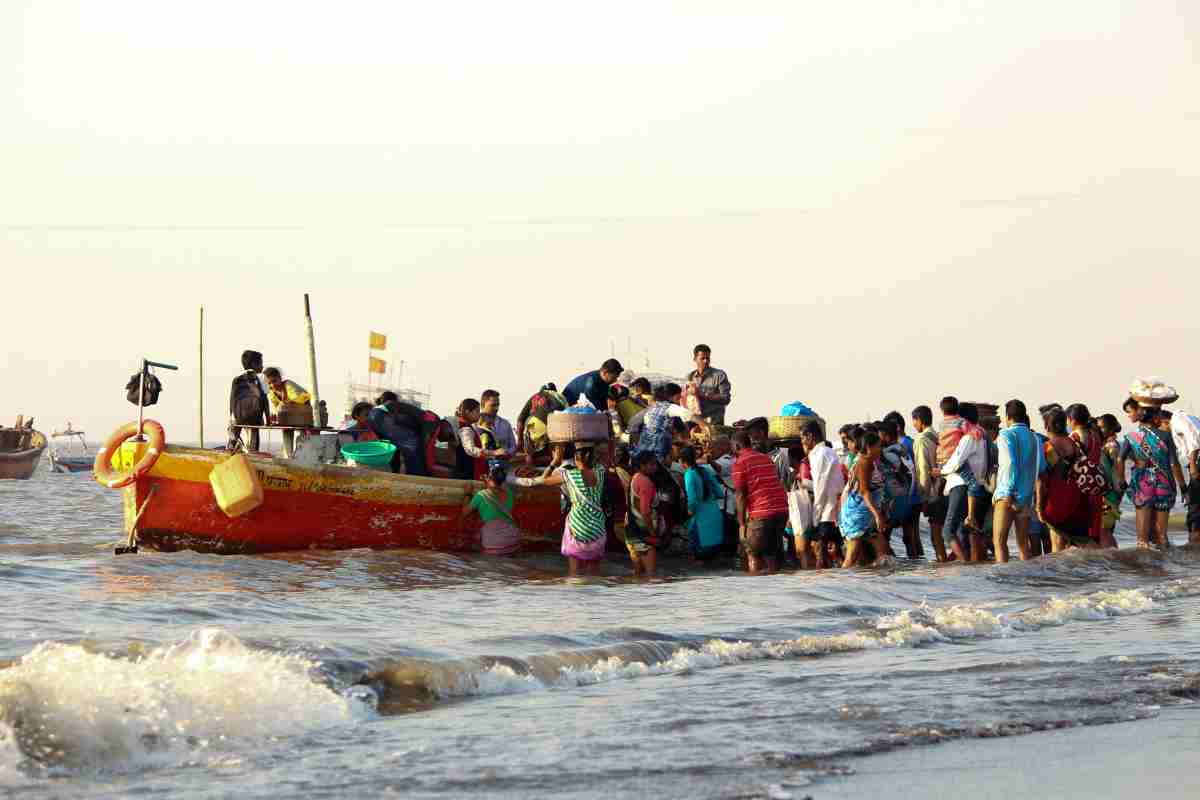
Pic Courtsey-Sheetal Nyalpelly at unsplash.com
(The views expressed are those of the author and do not represent views of CESCUBE.)

Annesha Sarkar, a first year student pursuing a Bachelor of Arts (Honours) in Economics with a minor in Psychology from Lady Shri Ram College for Women, University of Delhi. She is currently working as a Resource Liaison for Dweebs Global North India which aims to provide free mentorship, career advice and mental health help. Her areas of interest include writing, economics and dramatics.