India’s Stakes in BRICS-Evaluating Last Summit Meeting
With the aim to promote peace, security, development and cooperation, BRIC was coined in 2001 by Roopa Purushotaman who was a Research Assistant in Jim O’ Neill’s publication (Building Better Global Economic BRICs) for Goldman Sachs. It was...
The leaders of BRIC countries met for the first time in St. Petersburg, Russia on the margins of G8 Outreach Summit in July 2006. After a series of high-level meetings, the 1st BRIC summit was held in Yekaterinburg, Russia on 16th June 2009. Brazil, Russia, India, China, and South Africa had come together to review economic issues of self-interest. They came together to deliberate on important issues under the three pillars of political and security, economic and financial and cultural and people to people exchanges. However, in the recent years the umbrella of agendas has widened to include more topical and global issues with special focus on finance and central banks, trade, business forum, academic and think tank council, health, science, technology, security, agriculture, and statistics.
This association of the five countries has been a productive one as it’s predicted to overtake United States and G7 in terms of GDP by 2030. Empirical evidence suggests that BRICS alone accounts for 41% of the population and 24% of the world GDP. The combined GDP of the BRICS countries has grown by a whopping 300%. Some of its most notable milestones are trade expansion, setting up of Contingent Reserve Arrangement, and establishment of New Development Bank. Political and diplomatic friction between the member states, and worldwide economic slowdown are some of the impediments that have somewhat dampened BRICS’ growth trajectory. This organisation is attempting to establish a multilateral international government. A multilateral government brings another set of challenges. The rise of China and its resultant impact on the world order has raised questions about the impact of a rising power on multilateral processes. However, the BRICS association has been nurtured for quite some time now. This continued BRICS cooperation has been based on specific calculations made by the member-states in terms of their defined national interests and achievement of foreign policy goals.
India has outperformed its fellow members in the current context of the global economic slowdown as rupee emerged as the best performing currency. In light of the current happenings, Indian rupee is at an all-time low versus the US Dollar but fundamentally it’s still a strong currency that has been progressively depreciating to counterbalance the historically high inflation rate within the country. BRICS for India is a means to an end. It provides a platform to build multilateral relations with Latin America, and African and Asian countries. In the initial years of its conception, BRICS had facilitated the blotting out of the age-old mistrust and complicated relationship with China. The setting up of New Development Bank also saw India’s involvement. The revival of American economy presented a predicament for BRICS. With the hike in the US interest rates, investors pulled out from BRICS countries as US securities became more lucrative for them. India has emerged as the “only bright light” in the BRICS, owing its credit largely to the nouveau policy reforms.
Since 2009, the governments of the BRICS states have met annually at formal summits. The cohesiveness among the member states has strengthened with the fourteen years of association. The association helped the members sail through the global pandemic. All formal meets since the onset of the pandemic have take place virtually. The 12th, 13th and 14th summit provide evidence in support of the organisation’s willingness to go on through thick and thin. The 2020 BRICS summit which was also the 12th summit was scheduled to take place in St. Petersburg in July. The uncertainties caused by the pandemic led to a delay and the summit took place virtually. This meet was focused on global stability, shared security and innovative growth. Measures to mitigate the then ongoing covid-19 pandemic was one of the locus points. Subsequently, India had taken over the chairmanship of BRICS.
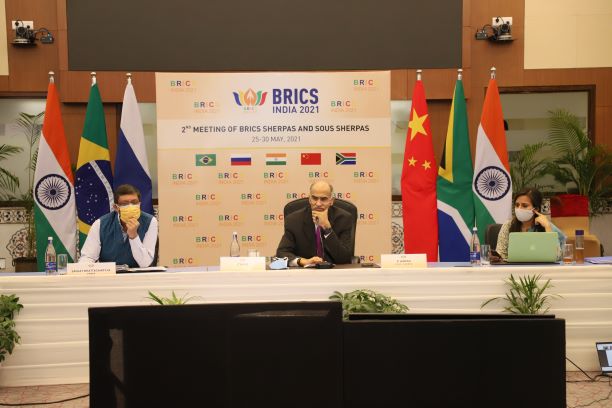
The 13th BRICS summit was India’s third BRICS Presidency since its inception. The founding principles of BRICS cooperation based on continuity, consolidation and consensus were celebrated. BRICS has been a beacon of multilateralism-based equality, mutual respect and trust. With intra-BRICS cooperation for continuity, consolidation, and consensus at its core, India pledged to work on a few specific deliverables. Counter terrorism cooperation, implementation of the BRICS Economic Partnership Strategy 2020-25, Cooperation on Disaster resilience being some of the most significant ones. Exchanges between parliamentarians and young scientists was also supposed to be facilitated to qualitatively enrich and enhance intra-BRICS people to people contacts in cultural, academic, youth, sports and business development.
The 14th BRICS Summit was convened under the chairmanship of Xi Jinping, President of China on 23-24 June 2022 in a virtual format. Narendra Modi called for the strengthening of BRICS Identity and proposed establishment of Online Database for BRICS documents, BRICS Railway Research Network, and strengthening cooperation among MSMEs. The binding glue is making instruments of global governance more inclusive, representative, and participatory. The New Development Bank which had its launch in 2015 funded around 30 billion dollars’ worth of project in emerging nations. According to the news agency Reuters, Iran and Argentina have applied to join the BRICS owing to its ever-increasing influence. There are myriad areas of conflict for the member states where reaching a consensus doesn’t stand a ghost of a chance. In such a scenario, working in areas where interests align becomes imperative. Superordinate goals will confederate the five nations. Inter-country conflicts are here to stay. Creating ultimate goals that require the joint efforts of each and every patron will lead to unity. Win for one stand as a loss for other has historically been at the core of intergroup conflict. India and China will keep their border skirmishes aside only if they realize that the both are indispensable for each other’s well-being. With respect to the conflicts and differences, India and China have been willing to attend the BRICS summit despite the standoff between their armies since 2020, indicating that the Modi government is willing to put its differences with China aside. Workings of New Development Bank, climate change and space cooperation wherein all five countries have agreed to create a joint constellation of remote sensing satellites are some examples of superordinate goals.
India has assumed the role of a big brother in BRICS. As India has been a stakeholder since its foundation, it has considerable power. Like a brother, India wishes to hold hands and progress together by sharing ideas and technology in each field. BRICS has seen its fair share of naysayers and has been derided as a talk shop. Despite the backlash, BRICS has successfully emerged as an institution of immense importance. Brick by brick, BRICS countries have emerged as the main engines of global economic growth.
REFERENCES
1. 25th June, 2022, Brick by Brick: On the 14th BRICS Summit, https://www.thehindu.com/opinion/editorial/brick-by-brick-the-hindu-editorial-on-the-14th-brics-summit/article65560894.ece
2. Suhasini Haidar, 24th June, 2022, What are the key takeaways from the 14th BRICS Summit, https://www.thehindu.com/news/international/worldview-with-suhasini-haidar-what-are-the-key-takeaways-from-the-14th-brics-summit/article65562321.ece
3. 24th June, 2022, PM participates in the 14th BRICS Summit, https://pib.gov.in/PressReleaseIframePage.aspx?PRID=1836853#:~:text=Prime%20Minister%20Shri%20Narendra%20Modi,2022%2C%20in%20a%20virtual%20format
Pic Courtesy-MEA ,India
(The views expressed are those of the author and do not represent views of CESCUBE.)

Annesha Sarkar, a first year student pursuing a Bachelor of Arts (Honours) in Economics with a minor in Psychology from Lady Shri Ram College for Women, University of Delhi. She is currently working as a Resource Liaison for Dweebs Global North India which aims to provide free mentorship, career advice and mental health help. Her areas of interest include writing, economics and dramatics.