LIVE DISPATCH
Loss and Damage Finance: From COP28 Pledges to Policy Architecture Extended Deterrence Under Strain: Credibility, Assurance, and the Stability-Instability Paradox in the Indo-Pacific Beyond Consultation: BIMSTEC's Emerging Role in Regional Intelligence and Security Cooperation Maritime India: Security, Trade, and Great Power Competition Between the Desert and the Savannah: Conflict and the Political Economy of Instability in the Sahel Beyond Ukraine: Understanding Putin's Vision of Russian Power The Politics of Ali Khamenei's Funeral Silicon Sovereignty: How Semiconductors Are Redrawing Global Power Hierarchies Operation Sindoor and the Changing Dynamics of India–Pakistan Security The Negative Impact of US–Iran War on the Pacific Region Generative AI, Labour Sovereignty, and the Geoeconomics of India's Service Economy BRICS Expansion and the Multipolar Moment: Opportunity or Strategic Contradiction? India's AI Diplomacy and the Future of Strategic Technologies Foot-Dragging as Feminism: Iran, South Korea, and the Ungovernable Body Lethal Autonomous Weapons Systems and the Governance Deficit: Challenges to International Humanitarian Law and Accountability Beyond Proximity: Why the UAE Occupies a Growing Place in Iran’s Strategic Calculus Great Power Rivalry and the Crisis of the United Nations Why Fiji Matters: The New Geopolitics of the Indo-Pacific Islands Ten Years After Brexit: Regret, Reform, or Reversal? The Long Shadow of 1953: Understanding the Iran–US Conflict Sports, Strategy and Statecraft of Mega Sporting Events as Geoeconomic Instruments: Qatar 2022 to Saudi Arabia 2034 Border Fencing and National security: India’s Strategy along the Bangladesh Border Hardening the Quad: From Strategic Dialogue to Operational Cooperation Lingering Effects of the Bush Doctrine on Contemporary US Foreign Policy The Maghreb of States: Identity, Sovereignty, and the Limits of Non-Interference India’s BRICS 2026 Chairmanship Navigating a tightrope Amidst the Chinese Geopolitical Rise Beyond the Battlefield: Understanding Unconventional Security Challenges in Contemporary Geopolitics The Control Paradox: How Proxy Warfare Enables Strategic Deniability While Constraining Strategic Control Trapped in Deterrence: Nuclear Stability and the Persistence of Conflict in South Asia The Return of Unipolarity? U.S Strategic Primacy and the Future of the Global Order Supply Chains and Complicity: The Role of Global Corporations in Forced Labour in Xinjiang The Distant Threat: Is Israel Constructing a Strategic Rival in Pakistan Island Militarisation and Techno-Diplomacy: Turkey’s Eastern Mediterranean Fault Lines Amid India-Greece Alignment India’s Security Scenario: An Assessment of its Continental and Maritime Challenges The Geopolitical Architecture of European Defence: Navigating NATO Synergies, Transatlantic Retrenchment, and the Hybrid Threat Landscape The Artemis Accords and the Future of Global Space Governance AI and the Securitization of Critical Infrastructure: Implications of India's AI Summit Beyond Rhetoric: Evaluating the Effectiveness of International Sanctions on China’s Treatment of Uyghur Muslims The Emerging Maritime Rivalry in the Western Indian Ocean: India’s Response to Extra-Regional Powers India's Maritime Grand Strategy on Trial : The IRIS Dena Incident and the Indian Ocean Question Loss and Damage Finance: From COP28 Pledges to Policy Architecture Extended Deterrence Under Strain: Credibility, Assurance, and the Stability-Instability Paradox in the Indo-Pacific Beyond Consultation: BIMSTEC's Emerging Role in Regional Intelligence and Security Cooperation Maritime India: Security, Trade, and Great Power Competition Between the Desert and the Savannah: Conflict and the Political Economy of Instability in the Sahel Beyond Ukraine: Understanding Putin's Vision of Russian Power The Politics of Ali Khamenei's Funeral Silicon Sovereignty: How Semiconductors Are Redrawing Global Power Hierarchies Operation Sindoor and the Changing Dynamics of India–Pakistan Security The Negative Impact of US–Iran War on the Pacific Region Generative AI, Labour Sovereignty, and the Geoeconomics of India's Service Economy BRICS Expansion and the Multipolar Moment: Opportunity or Strategic Contradiction? India's AI Diplomacy and the Future of Strategic Technologies Foot-Dragging as Feminism: Iran, South Korea, and the Ungovernable Body Lethal Autonomous Weapons Systems and the Governance Deficit: Challenges to International Humanitarian Law and Accountability Beyond Proximity: Why the UAE Occupies a Growing Place in Iran’s Strategic Calculus Great Power Rivalry and the Crisis of the United Nations Why Fiji Matters: The New Geopolitics of the Indo-Pacific Islands Ten Years After Brexit: Regret, Reform, or Reversal? The Long Shadow of 1953: Understanding the Iran–US Conflict Sports, Strategy and Statecraft of Mega Sporting Events as Geoeconomic Instruments: Qatar 2022 to Saudi Arabia 2034 Border Fencing and National security: India’s Strategy along the Bangladesh Border Hardening the Quad: From Strategic Dialogue to Operational Cooperation Lingering Effects of the Bush Doctrine on Contemporary US Foreign Policy The Maghreb of States: Identity, Sovereignty, and the Limits of Non-Interference India’s BRICS 2026 Chairmanship Navigating a tightrope Amidst the Chinese Geopolitical Rise Beyond the Battlefield: Understanding Unconventional Security Challenges in Contemporary Geopolitics The Control Paradox: How Proxy Warfare Enables Strategic Deniability While Constraining Strategic Control Trapped in Deterrence: Nuclear Stability and the Persistence of Conflict in South Asia The Return of Unipolarity? U.S Strategic Primacy and the Future of the Global Order Supply Chains and Complicity: The Role of Global Corporations in Forced Labour in Xinjiang The Distant Threat: Is Israel Constructing a Strategic Rival in Pakistan Island Militarisation and Techno-Diplomacy: Turkey’s Eastern Mediterranean Fault Lines Amid India-Greece Alignment India’s Security Scenario: An Assessment of its Continental and Maritime Challenges The Geopolitical Architecture of European Defence: Navigating NATO Synergies, Transatlantic Retrenchment, and the Hybrid Threat Landscape The Artemis Accords and the Future of Global Space Governance AI and the Securitization of Critical Infrastructure: Implications of India's AI Summit Beyond Rhetoric: Evaluating the Effectiveness of International Sanctions on China’s Treatment of Uyghur Muslims The Emerging Maritime Rivalry in the Western Indian Ocean: India’s Response to Extra-Regional Powers India's Maritime Grand Strategy on Trial : The IRIS Dena Incident and the Indian Ocean Question
ADVERTISEMENT
History September 1, 2020 12883 Reads

Julian Corbett: The overlooked doyen of maritime security
P
By Paritosh Tengshe
Author • Centre for Security & Strategic Studies
Julian Corbett: The overlooked doyen of maritime security
Share Analysis:
EXECUTIVE SUMMARY & STRATEGIC TAKEAWAYS

While much of the academic work in the realm of maritime security cites Alfred Mahan Thayer and extrapolates his thinking to apply it to contemporary maritime issues, the work of Julian Corbett is often ignored. Golaya (2020) believes one o...

ADVERTISEMENT

An example of Corbett’s effect on naval doctrines is evidenced in the British Naval Doctrine of 2004, wherein its stress on “manoeuvre not attrition,” “expeditionary operations,” “joint approach,” and insistence that “doctrine should not degenerate into dogma”, the naval doctrine reflected Corbett’s ways of thinking in naval matters (Widen, 2009, p.170). Widen (2009) asserts that Corbett’s influence is more on the military-strategic level and for this, he evidences the fact that the initial chapters of the 2004 doctrine are described by the authors as “the core maritime doctrinal principles at the military strategic level. . .” (p. 180). Golaya (2020) believes that Corbett’s thinking has influenced “basic operational philosophy, tactics, and deployment of the IN [Indian Navy]”. He accords the reason for it to be that the Indian Navy imbibed the structure and culture of that of its colonial predecessor and its navy, i.e. the British Royal Navy. However, he goes on to admit that Mahan’s work too has been imbibed by the Indian Navy.

Mahanian ideas’ tangible manifestation could also be found in the maritime workings of the Chinese Navy, i.e. the People’s Liberation Army Navy (PLAN). Holmes and Yoshihara (2006) in an article expound on this further wherein they associate Mahan’s concept of ‘sea power’ to China’s maritime strategy, and state that Mahan’s disposition towards economics finds a strong resonance in China. They are prescient in stating that China “will presumably seek bases from which to protect commerce and project naval power” (p.26). China currently has a military base in Djibouti and there is evidence that it might use ports that it has established in forward locations such as Gwadar as military bases in the future[1]. Mahan’s concept of power projection can therefore be seen as something that has been applied by China. For Mahan, the navy was simply the logical outgrowth of maritime commerce. Taking this precept into consideration, China’s naval modernization drive only logically makes sense. As of 2019, the Chinese Navy consisted of 335 ships, making it larger than the 296 vessels comprising the deployable battle force of the US Navy [2].

According to Mahan, commerce, and thus national prosperity, hinged on sea power, as embodied in commercial and naval shipping and control of critical geographic nodes. Xi Jinping’s declaration of China’s pursuit of being a “maritime power”[3] being followed up with strategic programs such as BRI and MSR, along with development of hub port facilities in its own country lend credence to the fact that Mahan’s ideas have influenced China’s contemporary maritime strategy However, Holmes and Yoshihara in 2010 would pen another paper, wherein now they would now advocate that China’s strategic direction shifted towards the application of Corbett’s thinking (Sekine, 2012).

The stark contrast between Mahan and Corbett’s thinking is found in the differing views that they both had when it came to the concept of ‘command of the sea’ (ibid.):

He [Corbett] insisted that command of the sea is not a dualistic concept like “black or white” or “winner takes all.” He clarified the difference between land and sea as strategic spaces, saying, “The object of naval warfare is the control of communications, and not, as in land warfare, the conquest of territory.” While he acknowledged that the navy’s ideal is to wipe out the enemy’s fleets, as Mahan held, he pointed out that this ideal might not be realized. He believed that one of the two goals of naval operations was to obtain or dispute the command of the sea and the other was to exercise such control of communications as it previously had. Corbett emphasised the superiority of defence and dispersion of forces in naval war and insisted on the significance of silent pressure using the navy’s presence, like the “fleet in being,” a strategy to temporarily disperse and avoid the enemy’s forces. Such opinions differed significantly from those of Mahan, who placed importance on the concentration of forces and a decisive fleet battle. Undeniably, Corbett was challenging Mahan’s idea.

According to Widen (2009), “the value of ‘jointness’ and a combined strategy in maritime operations, together with maritime power projection, have been considered the two most important aspects of Corbettian thinking during the post–Cold War period.” (p.178). Evidence of this is found in the Indo-Pacific vision and the corresponding policies formulated by India and its strategic partners in the vision, namely USA, Japan, and Australia (the Quadrilateral framework). Attention to Corbettian thinking is therefore as important in the extant time as is the intellectual contribution of other maritime historians and strategists, and one would be remiss to not read Corbett before venturing further in their study of maritime security.


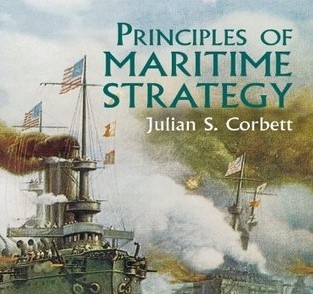
Pic Courtesy- www.goodreads.com/book/show/1531663.Principles_of_Maritime_Strategy

( Paritosh Tengshe is student of BA in Global Affairs at Jindal School of International Affairs, O P Jindal University, India. The views expressed are personal.)


End- Notes

[1] All that Xi Wants: China Attempts to Ace Bases Overseas. (2019). Retrieved from https://www.brookings.edu/wp-content/uploads/2019/09/FP_20190930_china_basing_karlin_dreyfuss.pdf

[2] For more, see ‘How is China modernizing its navy?’, CSIS. Retrieved from https://chinapower.csis.org/china-naval-modernization/

[3] For more, read ‘Xi Jinping and China’s maritime policy’. (2019). Brookings. Retrieved from https://www.brookings.edu/articles/xi-jinping-and-chinas-maritime-policy/

References

Golaya, A. P. (2020, June 17). CONCEPTUAL FOUNDATIONS OF INDIAN NAVAL STRATEGY (or How ‘Mahanian’ are We?). National Maritime Foundation. https://maritimeindia.org/conceptual-foundations-of-indian-naval-strategy-3/


Holmes, J. R., & Yoshihara, T. (2005). The Influence of Mahan upon China’s Maritime Strategy. Comparative Strategy24(1), 23–51. https://doi.org/10.1080/01495930590929663


Seikine, D. (2012). Review of From Mahan to Corbett? Intelligence Analysis. Sasakawa Peace Foundation (SPF). https://www.spf.org/oceans/analysis_en/c1202.html


Widen, J. J. (2009). Julian Corbett and the Current British Maritime Doctrine. Comparative Strategy28(2), 170–185. https://doi.org/10.1080/01495930902799764


P
About Paritosh Tengshe →

Paritosh Tengshe is student of BA in Global Affairs at Jindal School of International Affairs, O P Jindal University, India
ADVERTISEMENT

Related Strategic Analysis