New Developments in maritime technology
In today's world, it is frequently asserted that if a maritime nation seeks to safeguard its national interests, it must first secure its maritime interests. As part of this effort, in India, we saw the release of the Maritime India Vision ...
This increased emphasis on the marine industry, however, is not new. India understands how essential the marine industry has been, is, and will continue to be in the country's growth and sustainability. This is thanks to India's first-hand knowledge of the maritime sector as its marine history dates back to the third millennium BCE, when the Indus Valley civilisation developed commercial links with Mesopotamia, which now comprises Iraq, Syria, Kuwait, and Turkey. We had dynasties like the Kalingas, Pandyas, Cholas, and Cheras on the east coast as well, who used to sail to nations in Southeast Asia. However, with the arrival of the Portuguese, who were later followed by Dutch, British, and French seamen, India gradually lost its dominance over the surrounding oceans. India, however, did not stop there. It has persisted and still continues to make technological improvements and inventions in order to become the world's premier blue economy and reclaim its ancient position.
Today, India has a coastline of 7,516 km along which it carries out more than 90% of its trade by volume and over 75% by value. Furthermore, India has a well-developed network of major and minor ports too. However, there are still challenges that India seeks to solve, such as the high cost of traveling via sea, low efficiency, unsustainable mode of transportation, environmental pollution from the shipping industry, high accident risks, high fuel costs, inefficient weather forecasting systems, and so on. Further, there are also voices that argue that “India is languishing well below global standards in almost all parameters of maritime power. They argue that the Indian Navy may rank amongst the best in the world and is central to India’s maritime aspirations, but it is only one of the many constituents that define maritime power (Singh, 2021). Thus, this article is an attempt to comprehend how India is developing new solutions to address the aforementioned issues in the maritime sector.
India’s first solar-powered ferry boat ‘Aditya’
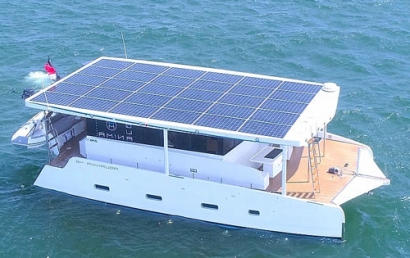
Aditya, India's first solar-powered ferry boat, was inaugurated on January 12, 2017 in Kerala to fight the issue of maritime pollution. With its launch, Aditya became not only India's first solar-powered ferry but also the country's largest solar-powered boat. According to the official website of Aditya, the majority of the ferries run on diesel, which is extremely polluting. Furthermore, there are issues about water pollution; noise and vibration from diesel engines, which make the voyage taxing for passengers and crew; the smell of gasoline, which makes the ride unpleasant; and high running expenses, which make the boats unsustainable.
Furthermore, they emit carbon dioxide, which causes ocean water to become acidic and marine animals and ecosystems to become increasingly susceptible. As per a study from the European Union Monitoring, Reporting and Verification of CO2 Emissions Report, which states that while ferries account for just 3% of all vessels, they account for 10% of all marine pollution (Agarwal, 2022).
Keeping these problems in mind, NavAlt Solar and Electric Boats in Kochi, India, developed and manufactured the Aditya vessel. NavAlt is a partnership formed by Navgathi Marine Design and Construction, Alternative Energies (France), and EVE Systems. Aditya runs in Kerala, India, between Vaikkom and Thavanakkadavu. The boat saves 35,000 litres of diesel each year and helps reduce carbon dioxide emissions by increasing the use of sustainable energy. Aditya was named the Gustave Trouve Award winner for the World's Best Electric Ferry in 2020.
Furthermore, the boat was designed as a catamaran, which is a sailboat with two hulls, to improve safety because two hulls give more stability. The boat can carry 200 passengers securely while satisfying the IMO's stringent stability rules for sea-going ships. Further, there are three levels of safety warning in Aditya: the first is a warning that certain parameters are approaching the limit; the second is a warning that limits have been reached and a slowdown is required; and the third is a warning that limits have breached the upper limit and the system must shut down to protect itself.
Rapid application of Robotics in Maritime sector
New opportunities in the marine sector are emerging as a result of rapid advancements in AI, low-cost sensors, satellite systems, big data and, more importantly, robotics. In addition to revolutionizing the world, the industrial revolution propelled by robots is also reshaping the oceans. Anti-piracy efforts, underwater mapping, underwater cleaning, and water rescue operations all stand to gain from robotics.
With these uses in mind, Planys Technologies, a company founded by IIT Madras alumni and faculty, developed Mike, a remotely operated vehicle. The Mike is not only indigenous and inexpensive, but it is also bite-sized, which the creators claim is ideal for traversing the Indian peninsula's 7,516-kilometer coast (Rao, 2016). Through its ability to record underwater film, the vehicle has successfully proved its potential by detecting a leak in an undersea oil pipeline.
In 2016, Planys Technologies unveiled their second underwater robot, "Beluga." "Beluga," which has an HD camera and a 20x optical zoom, aids in the collection of underwater photos (Mathew, 2016). The ROV can reach a depth of 200 meters at a ?speed of 4 knots and be used for acoustic surveys such as side-scan surveys for sea-bed mapping and environmental studies. According to Planys Technologies' CEO, Beluga was primarily built for the oil and gas and shipping sectors, but the platform is adaptable enough to assist a range of other industries.
EYEROVTUNA is the next significant advancement. It is India's first underwater robotic drone, created by EyeROV Technologies (The Economic Times , 2018). Soon after its introduction in 2018, it was given over to the Kochi-based DRDO facility "Naval Physical and Oceanographic Laboratory (NPOL)." The drone can deliver real-time footage of ships and other underwater structures to aid in the repair and maintenance of these structures. It can also be utilized for research and development, which will culminate in a commercial product for defense usage. The robotic drone can be guided up to a depth of 50 meters to acquire real-time HD video photos of ship hulls, subsea cables, or bridge moorings, potentially eliminating the need for more expensive and risky human inspection by divers.
Autopilot ships
India is also making strides by developing autopilot gears, which are incredibly beneficial to boaters in a multitude of ways, including convenience, efficient navigation, fuel savings, and safety. “An autopilot is a combination of electric or electronic navigation equipment that guides a vessel without the need for continual human interaction” (GETMYBOAT, 2018). Autopilots enable sailors and boaters to leave the helm while trimming or rigging sails, changing lines, setting anchor, eating uninterrupted, taking short naps, or completing other duties.
Way forward
Technology pervades practically every aspect of human existence, and the marine industry is no different. The marine industry has a long history of embracing and adapting to new technologies. Because we are living in the fourth industrial revolution, it is not only the duty of our government but also of other sectors, such as the private sector, to develop and adopt new technological solutions in the marine sector. In our Maritime Industry, Artificial Technology, Sensor Technology, Big Data, IOT, Autonomous Control, and Augmented Reality have enormous potential. Therefore, sufficient attention must be given to them in order for our nation to establish itself as a global leader in the blue economy.
References
- (2018, December 6). Retrieved from GETMYBOAT: https://www.getmyboat.com/journal/how-to/autopilot-systems-on-boats/
- (2018, September 15). Retrieved from The Economic Times : https://economictimes.indiatimes.com/industry/transportation/shipping-/-transport/meet-eyerov-tuna-indias-1st-commercial-underwater-drone/indias-first-underwater-robotic-drone/slideshow/65820968.cms
- Agarwal, P. (2022, April 26). Retrieved from SMBSTORY: https://yourstory.com/smbstory/india-solar-ferry-boat-aditya-navalt-kerala-green-clean-energy-ships/amp
- Mathew, P. (2016, November 19). Retrieved from The News Minute : https://www.thenewsminute.com/article/meet-beluga-underwater-robot-set-revolutionise-shipping-industry-53130
- Rao, M. (2016, September 6). Retrieved from TECHINASIA : https://www.techinasia.com/planys-technologies-underwater-robots
- Singh, A. J. (2021, September 6). Retrieved from India Foundation : https://indiafoundation.in/articles-and-commentaries/a-technology-driven-maritime-vision-for-india/
Pic Courtsey-renewableenergymagazine.com
(The views expressed are those of the author and do not represent views of CESCUBE.)

Neha Dayma has recently completed her Masters in Politics with Specialization in International Studies from Jawaharlal Nehru University. She is a political science graduate and also a current intern at Online Foreign Policy School. Her areas of interest include South- East Asia, West Asia, geopolitics, Indo- Pacific and India's foreign policy.