Reimagining BRICS in a Post-COVID World
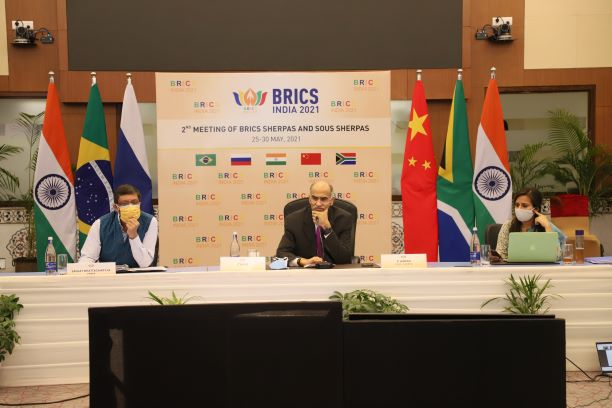
India entered the month of June with a virtual meeting between the Foreign Ministers of the BRICS nations. Attended by the Brazilian Foreign Minister Carlos Alberto Franco, Russia’s Foreign Minister Sergey Lavrov, External Affairs Minister ...
A Brief History
What began as a geo-economic group and naturally evolved into a geopolitical group, the history of BRICS goes as far as 2001 when the term “BRIC” was heard for the first time in Jim O’Neil’s publication Building Better Global Economic BRICs, the then-chairman of Goldman Sachs.
The idea took shape in 2006 when the Foreign Ministers of the BRIC member-states (excluding South Africa) held the first meeting in New York on the sidelines of the UN General Assembly. South Africa was accepted as a full member in 2010 followed by the 3rd summit in China where the group came into existence in its present form.
What makes the BRICS group unique is the individual strengths that each member-state possesses. Brazil is the largest Latin American country, Russia is the largest country in the world, India is the largest democracy in the world, China is the most populated country and South Africa is the second largest economy of Africa.
With 27% of the total landmass of the world and 42% of the world’s population, the group represents five emerging economies of the world, out of which two are permanent members of Security Council while the other three are aspiring for that seat. One of the biggest achievements for the group has been the set-up of New Development Bank (NDB) in 2014. A democratic institution with each country having an equal share despite the size of their economy, it was created to serve regional interests for the developing economies in the world. Headquartered in Shanghai with regional branches in all member-states except India, the New Development Bank has successfully completed 65 sustainable development and infrastructure projects across all BRICS economies worth $21 billion by its 5th anniversary in 2020.[1] During the COVID-19 crisis, the NBD was quick to commit $10 billion Emergency Assistance Program to help BRICS countries.
The West has always been skeptical of the group, from questioning its existence to predicting its demise. Critics argue that recurring bilateral frictions between member-states, lack of geographical proximity and fundamentally different political and economic realities. With the rise of China, this asymmetry seems more evident in present times than the beginning years when people pointed it out. But experts on the side of the spectrum believe that BRICS is here to stay. [2]
Setting the Agenda
Drawing up the calendar for BRICS 2021, India focused on the three pillars of intra-BRICS cooperation. One, the political and security pillar includes the issues of reform of multilateral system and a consensus on counter terrorism. Two, economic and financial pillar promotes cooperation on sectors such as trade, agriculture, infrastructure, small and medium enterprises, energy and finance & banking. Three, the cultural pillars looks to enhance the intra-BRICS people to people ties in cultural, academic, youth, sports and business. [3]
Before the official summit to be held in September 2021, various committees have held their annual meetings. The BRICS Astronomy Working Group (BAWG) met in May and recommended networking of telescopes in member countries and creating a regional data network. India hosted its first BRICS Energy meet where it prioritized to work on renewable energy, energy efficiency and smart grid.
There are four areas of cooperation that cements the relevancy of the BRICS grouping for contemporary times. First, COVID-19 remains the primary challenge for the world including the member countries that have faced devastating loss of people and economy. While China is identified as the origin-place, dangerous variants of the virus have emerged from different parts of the world and three of them Brazil, India and South Africa, isolating their population and businesses. The group identified the pandemic as one of the most serious challenges before the world. Health sector is an industry that the group can seek to further deepen their ties. Establishment and effective operationalization of the BRICS Vaccine Research and Development Centre and proposal for BRICS Integrated Early Warning System for Preventing Mass Infectious Diseases Risks is a step towards this realization.
Second, the World Trade Organisation is one place where the group has been most united and voiced the concerns of the developing world. One such development is the developing world’s demand for Trade-Related Aspects of Intellectual Property Rights (TRIPS) waiver for COVID-19 vaccines lead by India and South Africa. China recently displayed its support on the cause committing to “things that are conducive to developing countries' fight against the virus and support all actions that can help developing countries acquire vaccines in an equitable way.”[4] With diplomatic efforts and persuasion, the US also agreed to support IPR waiver in WTO.
Third, the post-pandemic recovery will be shaped by changing realities in the world and BRICS encompasses this changing framework of global economic governance. Jim O’Neil in a recent article on 20 years of the term ‘BRIC’ said that “[The]sheer scale of China means that the BRIC economies combined are now larger than that of the European Union and are approaching the size of the United States.”[5] The implementation of ‘Strategy for BRICS Economic Partnership 2025’ will play a decisive role in minimizing the pandemic losses and getting the economy back on track. The document calls for cooperation on trade, investment, digital economy and matters related to sustainable development. [6]
Fourth, India has been the flag bearer of institutional reforms of multilateralism under the United Nations setting. One of the long-term agenda for India is to bring Russia and China on the table for this ‘reformed multilateralism’. On Tuesday’s meeting, a historic consensus has been reached to have a joint statement on reforming the multilateral system. [7] The future of BRICS lies in its ability to harness the nature of changing world order and throw weight in favour of multilateral institutions.
What the Future Holds
The 13th summit is being mooted by academicians as an opportunity to reset bilateral ties between India and Russia. In 2020, their annual bilateral summit was cancelled for the first time two decades. Some analysts reported it is due to unease of QUAD while others speculated over China. The Galwan clash that took a toll to India-China bilateral ties has been kept out of discussions at the BRICS forum.
Global issues of SDGs, climate change, UNSC reforms, international terrorism, and disaster management continue to remain possible areas of effective and long-term cooperation. New Development Bank has agreed to trade in each other’s currency to decrease the dependency cost on US dollars but this hasn’t been implemented yet. Low levels of trade remains yet another roadblock in elevating the BRICS system. At present, BRICS hold 16% share of world trade. In 2019, Prime Minster Modi called for a roadmap to take the intra-BRICS trade to US$500 billion but the share of total value of trade of individual states remain largely tied to China.
The summit is scheduled for September 2021 which will be attended by the heads of state, where the Chinese Premier Xi Jinping is expected to visit India, his first since the India-China standoff began in June 2020.
References:
[2] https://thediplomat.com/2020/11/why-the-brics-grouping-is-here-to-stay/
[3] https://brics2021.gov.in/index#intro
[5] https://www.imf.org/external/pubs/ft/fandd/2021/06/jim-oneill-revisits-brics-emerging-markets.htm
[6]November 2020, “Strategy for BRICS Economic Partnership 2025”, BRICS Russia.
[7] June 1ST 2021, Media statement - “Meeting of the BRICS Ministers of Foreign Affairs/International Relations”, Ministry of External Affairs, New Delhi.
Pic Courtesy- BRICS India website(https://www.brics2021.gov.in/)
(The views expressed are those of the author and do not represent views of CESCUBE.)

Apoorva Jain is a graduate in political science from Delhi University. Her interest in politics, governance and international relations led her to pursue a master's degree in Politics and International Studies from Jawaharlal Nehru University. Her research interests include Diplomacy, Indian Foreign Policy and Indo-Pacific Affairs. She is presently research intern with CESCUBE.