Renewed vigour in the US Indonesia defence ties
In the last week of February 2020, Indonesia's government approved the defence agreements which were previously formed with United States of America. Many scholars across the world have hailed this development as a significant step in Indon...
These two examples show that there is a new focus on improving the defence ties between both the countries. While many scholars are of a view that increasing US interest in Indonesia is a move to counter the rise of China in the region. This article gives an insight about the Indonesia-US defence ties and its progress.
Indonesia, since 1970, has pursued low level security cooperation with United States of America. The relationship between both the countries has not been free of tension as Indonesia clearly is not very fond of free and active foreign policy which the US follows. Military ties between both the countries were frozen in 1992 over the abuses committed during the occupation of East Timor. The bilateral ties dwindled as the anti-USA sentiment in Indonesia increased. The Suharto regime's democratisation provided a new engagement to the souring relations.
One of the key interests for Indonesia has been modernizing its armed forces, something which they could not do before. The defence relationship has improved over the years as visits, exchanges and regular exercises began, after US restrictions on Indonesia lifted in 1990's under George Bush’s regime. Over the years, US has placed emphasis on Indonesia's importance as the world's largest archipelagic state and biggest Muslim majority country in the world. It has hailed Indonesia as a significant partner in Southeast Asia on issues ranging from Islamic terrorism to maritime security.
In 2005, Washington re-instated Indonesia in its International Military Education and Training (IMET) programme and restarted Foreign Military Sales (FMS). In 2011, training links, joint military exercises and dialogues have increased over the years. Now US vessels visit the Indonesian ports frequently, and military exercises have increased frequently. In 2015, both the navies held joint exercises off Batam, and Indonesia wanted to hold more drills with the US Navy around Natuna Islands. In 2016, US marines and Indonesian air forces held first joint combat in northern Sulawesi. Indonesia has now become a regular participant in Cobra Gold exercise. In mid-2019 USA lifted the restrictions which it had earlier placed on working with Indonesia's elite special forces unit, Kopassusm a frontline force in Natuna.
Under the Obama regime, focus was placed on Southeast Asia and ASEAN centrality which provided a strong foundation to both the countries to increase their defence cooperation. Obama's administration made significant advancements while working with Yudhoyono administration which laid emphasis on regional cooperation. Similarly, Jokowi's vision for establishing Indonesia as a Global Maritime Fulcrum aligned with the priorities of the Obama government in the region.
But under the Trump administration, the great power competition between USA and China has increased by a huge margin. The United States National Security Strategy and its Free and Open Indo-Pacific Strategy had initially produced anxiety and uncertainty. However, a positive development in Indo-US defence relationship has been moving beyond its targeted areas of defence cooperation (counterterrorism) to maritime defence cooperation. While this comes in the light of increased Chinese aggression in the South China Sea through naval deployments, seizure of atolls, island building and fortification. This has led to increasing closeness between Indonesia and United States, as in the face of China's fierce ambitions and growing capabilities, US would require Indonesia's support to maintain its maritime position.
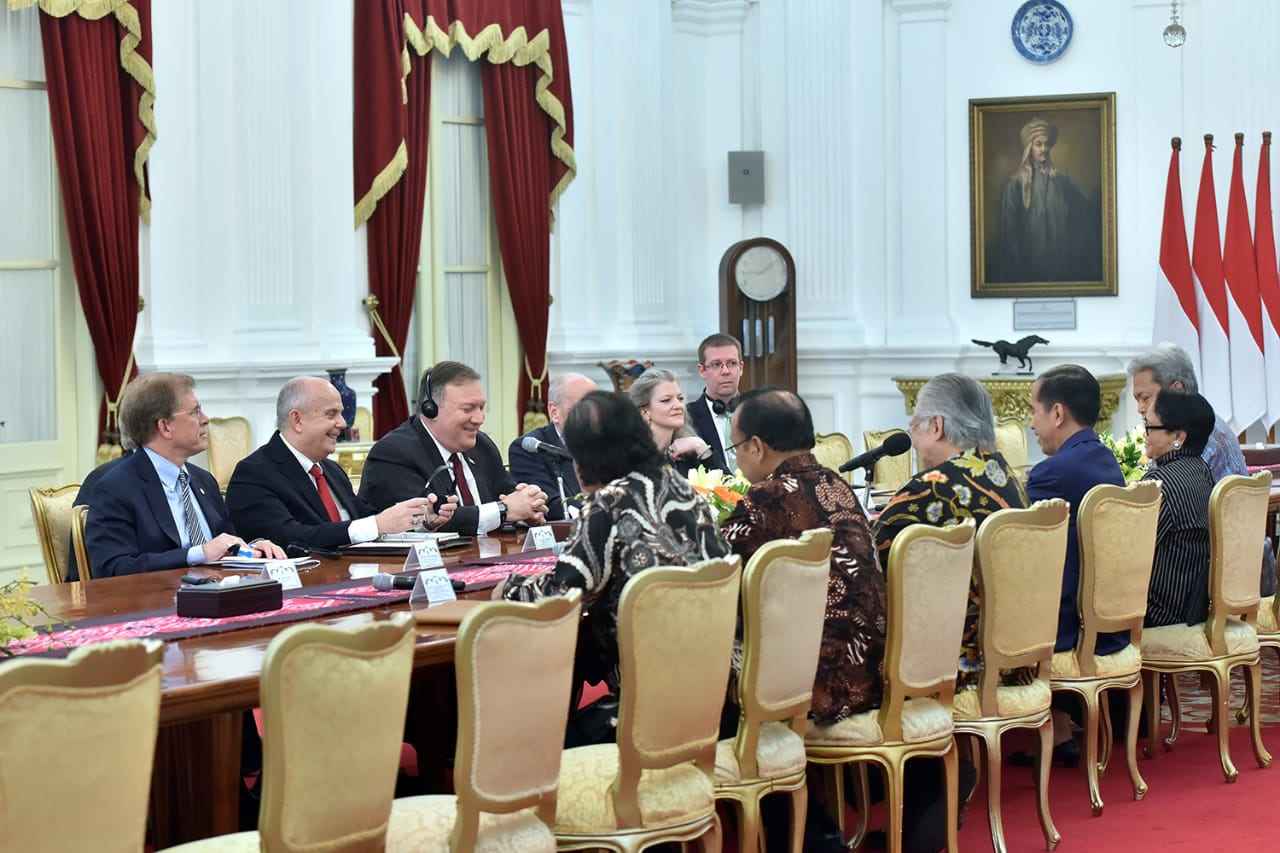
Indonesian Defence Minister Prabowo Subinato's visit to United States for talks with US Defence Secretary Marl Esper about regional security and defence cooperation in October revealed the need to protect Indonesia's security and strategic interests. In October 2020, US Secretary of State Mike Pompeo visited Indonesia for the first time after Indonesia rejected the proposal to host the US spy planes. Indonesia's decision was a clear indicator of not getting tangled between the US-China rivalry.
While visits of officials and ministries of both the countries has increased and is a sign of both the countries wanting to do more than they are doing, no new significant steps have been taken by the governments of both the countries. While it has been decided that Indonesia-USA defence relationship will flourish in the spheres of research and development, education and training and arms procurement, and joint military exercises, the relationship is still underdeveloped. One of the reasons for this is the US restrictions on the defence technology transfers. It is not a secret that US has the most complex and sophisticated defence technology in the world and has placed export control on it. Its refusal to share the sensitive technology with its allies has made US an unfavourable partner, especially for Indonesia, as it is unable to meet its local defence needs.
This has led to Indonesia exploring the markets for other countries like Turkey, France and even China for possible partnerships. Indonesia’s cooperation with Turkey has led to Indonesia’s Pindad (weapon making company) and Turkey’s FNSS Defence Systems to cooperate to develop Kaplan medium tanks. The defence ministries of both the countries have agreed to deepen their defence industry cooperation. Indonesia has been trying to acquire license from China to produce C-705 missile. Since 2015, France has offered to transfer its Rafale technology to Indonesia. There are talks the defence ministries of both the countries (France and Indonesia) will be signing a Defence Cooperation Agreement.
Prabowo’s ministry on all these visits has not shied away from its interests – to deepen the defence ties and also to procure major weapon systems. It has been a long time since the Indonesia and USA have partnered on the selling of defence technology. While it is difficult to say whether Prabowo’s visit to USA will yield any results, it is safe to say that for Indonesia, the US is not the only option. While the defence relationship can be strengthened between the two countries, more policy making and implementation is necessary.
Interestingly, the Quad countries have been focusing on the two countries- Vietnam and Indonesia in a big way and the visits of the Quad leaders shows it. Prime Minister Suga, and US Secretary of State Mike Pompeo visited the two countries within a short span of time. Also talks between the Quad members and the leadership of the two countries shows that Quad plus is in motion, and Indonesia figures prominently in that equation.
Pic Courtesy-Cabinet Secretariat of the Republic of Indonesia at https://setkab.go.id/
(The views expressed are personal.)

Krupa Vasani is a current Scholar at The Vedica’s Scholar Program, New Delhi and is pursuing her MBA in Management and Leadership. An undergraduate from O. P Jindal Global University, Krupa holds a bachelors in International Relations. Over the course of three years as an undergraduate, Krupa has developed an interest in the Security and Strategic Studies and Development Sector. Indian Foreign Policy, South South Cooperation and the Strategy in Indo-Pacific and South Asian Politics and the emerging Quadrilateral Diplomacy are some of her areas of interest. She is currently associated with CESCUBE as part time researcher.