LIVE DISPATCH
Loss and Damage Finance: From COP28 Pledges to Policy Architecture Extended Deterrence Under Strain: Credibility, Assurance, and the Stability-Instability Paradox in the Indo-Pacific Beyond Consultation: BIMSTEC's Emerging Role in Regional Intelligence and Security Cooperation Maritime India: Security, Trade, and Great Power Competition Between the Desert and the Savannah: Conflict and the Political Economy of Instability in the Sahel Beyond Ukraine: Understanding Putin's Vision of Russian Power The Politics of Ali Khamenei's Funeral Silicon Sovereignty: How Semiconductors Are Redrawing Global Power Hierarchies Operation Sindoor and the Changing Dynamics of India–Pakistan Security The Negative Impact of US–Iran War on the Pacific Region Generative AI, Labour Sovereignty, and the Geoeconomics of India's Service Economy BRICS Expansion and the Multipolar Moment: Opportunity or Strategic Contradiction? India's AI Diplomacy and the Future of Strategic Technologies Foot-Dragging as Feminism: Iran, South Korea, and the Ungovernable Body Lethal Autonomous Weapons Systems and the Governance Deficit: Challenges to International Humanitarian Law and Accountability Beyond Proximity: Why the UAE Occupies a Growing Place in Iran’s Strategic Calculus Great Power Rivalry and the Crisis of the United Nations Why Fiji Matters: The New Geopolitics of the Indo-Pacific Islands Ten Years After Brexit: Regret, Reform, or Reversal? The Long Shadow of 1953: Understanding the Iran–US Conflict Sports, Strategy and Statecraft of Mega Sporting Events as Geoeconomic Instruments: Qatar 2022 to Saudi Arabia 2034 Border Fencing and National security: India’s Strategy along the Bangladesh Border Hardening the Quad: From Strategic Dialogue to Operational Cooperation Lingering Effects of the Bush Doctrine on Contemporary US Foreign Policy The Maghreb of States: Identity, Sovereignty, and the Limits of Non-Interference India’s BRICS 2026 Chairmanship Navigating a tightrope Amidst the Chinese Geopolitical Rise Beyond the Battlefield: Understanding Unconventional Security Challenges in Contemporary Geopolitics The Control Paradox: How Proxy Warfare Enables Strategic Deniability While Constraining Strategic Control Trapped in Deterrence: Nuclear Stability and the Persistence of Conflict in South Asia The Return of Unipolarity? U.S Strategic Primacy and the Future of the Global Order Supply Chains and Complicity: The Role of Global Corporations in Forced Labour in Xinjiang The Distant Threat: Is Israel Constructing a Strategic Rival in Pakistan Island Militarisation and Techno-Diplomacy: Turkey’s Eastern Mediterranean Fault Lines Amid India-Greece Alignment India’s Security Scenario: An Assessment of its Continental and Maritime Challenges The Geopolitical Architecture of European Defence: Navigating NATO Synergies, Transatlantic Retrenchment, and the Hybrid Threat Landscape The Artemis Accords and the Future of Global Space Governance AI and the Securitization of Critical Infrastructure: Implications of India's AI Summit Beyond Rhetoric: Evaluating the Effectiveness of International Sanctions on China’s Treatment of Uyghur Muslims The Emerging Maritime Rivalry in the Western Indian Ocean: India’s Response to Extra-Regional Powers India's Maritime Grand Strategy on Trial : The IRIS Dena Incident and the Indian Ocean Question Loss and Damage Finance: From COP28 Pledges to Policy Architecture Extended Deterrence Under Strain: Credibility, Assurance, and the Stability-Instability Paradox in the Indo-Pacific Beyond Consultation: BIMSTEC's Emerging Role in Regional Intelligence and Security Cooperation Maritime India: Security, Trade, and Great Power Competition Between the Desert and the Savannah: Conflict and the Political Economy of Instability in the Sahel Beyond Ukraine: Understanding Putin's Vision of Russian Power The Politics of Ali Khamenei's Funeral Silicon Sovereignty: How Semiconductors Are Redrawing Global Power Hierarchies Operation Sindoor and the Changing Dynamics of India–Pakistan Security The Negative Impact of US–Iran War on the Pacific Region Generative AI, Labour Sovereignty, and the Geoeconomics of India's Service Economy BRICS Expansion and the Multipolar Moment: Opportunity or Strategic Contradiction? India's AI Diplomacy and the Future of Strategic Technologies Foot-Dragging as Feminism: Iran, South Korea, and the Ungovernable Body Lethal Autonomous Weapons Systems and the Governance Deficit: Challenges to International Humanitarian Law and Accountability Beyond Proximity: Why the UAE Occupies a Growing Place in Iran’s Strategic Calculus Great Power Rivalry and the Crisis of the United Nations Why Fiji Matters: The New Geopolitics of the Indo-Pacific Islands Ten Years After Brexit: Regret, Reform, or Reversal? The Long Shadow of 1953: Understanding the Iran–US Conflict Sports, Strategy and Statecraft of Mega Sporting Events as Geoeconomic Instruments: Qatar 2022 to Saudi Arabia 2034 Border Fencing and National security: India’s Strategy along the Bangladesh Border Hardening the Quad: From Strategic Dialogue to Operational Cooperation Lingering Effects of the Bush Doctrine on Contemporary US Foreign Policy The Maghreb of States: Identity, Sovereignty, and the Limits of Non-Interference India’s BRICS 2026 Chairmanship Navigating a tightrope Amidst the Chinese Geopolitical Rise Beyond the Battlefield: Understanding Unconventional Security Challenges in Contemporary Geopolitics The Control Paradox: How Proxy Warfare Enables Strategic Deniability While Constraining Strategic Control Trapped in Deterrence: Nuclear Stability and the Persistence of Conflict in South Asia The Return of Unipolarity? U.S Strategic Primacy and the Future of the Global Order Supply Chains and Complicity: The Role of Global Corporations in Forced Labour in Xinjiang The Distant Threat: Is Israel Constructing a Strategic Rival in Pakistan Island Militarisation and Techno-Diplomacy: Turkey’s Eastern Mediterranean Fault Lines Amid India-Greece Alignment India’s Security Scenario: An Assessment of its Continental and Maritime Challenges The Geopolitical Architecture of European Defence: Navigating NATO Synergies, Transatlantic Retrenchment, and the Hybrid Threat Landscape The Artemis Accords and the Future of Global Space Governance AI and the Securitization of Critical Infrastructure: Implications of India's AI Summit Beyond Rhetoric: Evaluating the Effectiveness of International Sanctions on China’s Treatment of Uyghur Muslims The Emerging Maritime Rivalry in the Western Indian Ocean: India’s Response to Extra-Regional Powers India's Maritime Grand Strategy on Trial : The IRIS Dena Incident and the Indian Ocean Question
ADVERTISEMENT
Politics November 23, 2020 1706 Reads

Why ASEAN centrality will be challenged under formalized East Asian Summit?
P
By Pankaj Jha
Author • Centre for Security & Strategic Studies
Why ASEAN centrality will be challenged under formalized East Asian Summit?
Share Analysis:
EXECUTIVE SUMMARY & STRATEGIC TAKEAWAYS

The question of ASEAN centrality and its relevance in the international security as well as addressing regional security concerns has been heavily highlighted. ASEAN has accepted that as the Indo-Pacific is a new formation, it needs to be g...

ADVERTISEMENT

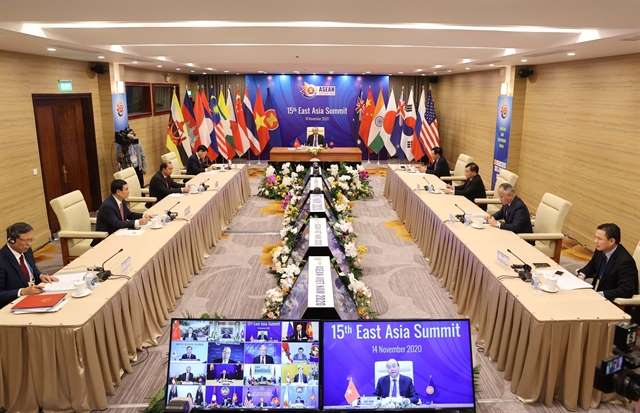
The recently concluded East Asia summit meeting which was held through video conference on 14th of November 2020 outlined the need for identifying priority areas and develop mutually beneficial relations so as to promote peace, prosperity and security in the region. This year’s meeting highlighted the need for working together on the non-traditional security threats particularly with regard to COVID-19 and addressing public health emergencies of the magnitude that the world has witnessed in the year 2020. The 2020 East Asia summit meeting was in virtual mode, was not seen as an informal meeting, but a more formal interaction among the participating countries. While the East Asia summit meeting declaration addressed the issue of ASEAN unity and stability while buttressing that fact that there is need for transparency, predictability, and undertaking benign behaviour. 

The one interesting fact which was outlined in the declaration was the veiled assertion that East Asia summit is on the top of the ASEAN led multilateral architecture. It acknowledged the need to subscribe to these ASEAN led processes and help in bringing about transparency , open and inclusive architecture but it has also stated very clearly that it is above ASEAN and its affiliate organizations. This primarily meant that dialogue partners are the legitimate stakeholders in regional architecture. The signing of Regional Comprehensive Economic Partnership among 15 members also highlights that ASEAN led economic processes have reached higher geo-political orbits. India chose to remain outside fearing that RCEP would grant unwanted leverages to Chinese exports thereby seriously affecting the domestic manufacturers.  

The East Asia Summit is due for organic institutional growth and would emerge independent of the ASEAN architecture in the near future. The EAS Declaration also addresses the fact that in order to address trans-regional aspects and strengthening multilateralism in different arenas, it is critical that the participants should be equal stakeholders and should contribute to strengthening the multilateralism. The deployment of non-ASEAN ambassadors to Jakarta shows that the blueprint is already in place.

Celebrating the 15th anniversary of the informal EAS it was clearly outlined that efforts for promoting security, stability peace and prosperity in the region would be a paramount importance. One of the points alluded in the declaration was related to the conformity to the principles of UN charter and compliance to the international law. 

The declaration stated that there is a need for building regional capacities, and also reviewing areas of cooperation in terms of countering infectious diseases and collaborating in addressing public health emergencies. It showed interest in the ASEAN plan on connectivity and also short possible contributions from the ASEAN dialogue partners. The declaration also highlighted the need for fostering synergy and regular interaction between the permanent representatives of ASEAN members and the non-ASEAN ambassadors of dialogue partners for the East Asia summit. It has also highlighted the need for supporting East Asia summit within the ASEAN secretariat framework. This clearly highlights that East Asia summit would be seeking better positioning in the East Asia region in terms of maintaining regional peace and security, promoting compliance to the UNCLOS, economic cooperation and developing an inclusive architecture for promoting trade and investment under the ambit of East Asia summit and utilising ASEAN as a vehicle of promoting better credibility of the East Asia summit.

Within ASEAN the fractures are emerging because the former permanent secretary of Singapore Bilahari Kausikan alluded to the fact that Laos and Cambodia should be removed from ASEAN as the two countries are acting on behalf of China in the ASEAN meeting. In that case the role of dialogue partners would increase. As it has been seen in the case of APEC that ASEAN-6 have gained entry into it as default members and have been dictated by the APEC charter so the same might be possible in the case of EAS when ASEAN select members having capability and resources for deployment and contribution to promoting peace and security would be counted as viable partners.

For all those who think that ASEAN centrality is non-negotiable must wake up to the fact that a formal EAS would displace this phrase from all declarations in future. The other possibility is that ASEAN would work on political and socio-economic aspects while EAS takes the mantle of addressing core security issues in regional context. 


Pic Courtesy- Vietnam News

(The views expressed are personal.) 


P
About Pankaj Jha →

Senior Research Fellow at Centre for Security & Strategic Studies.
ADVERTISEMENT

Related Strategic Analysis