Why US base in Diego Garcia is critical for maritime security in the Indian Ocean
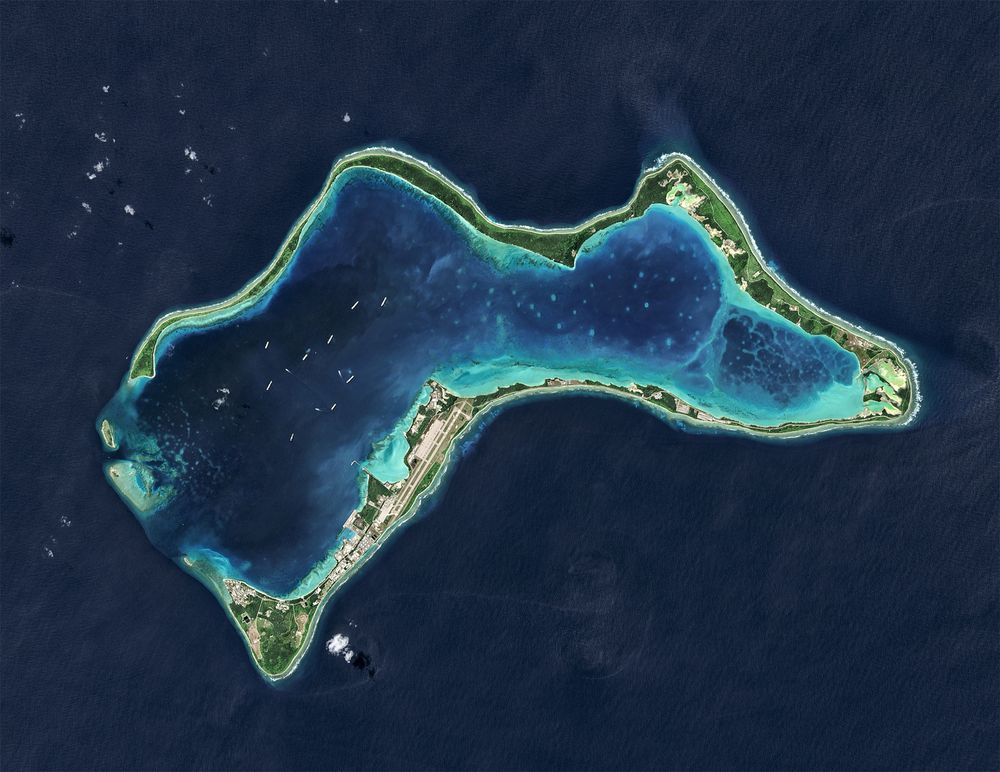
Diego Garcia, a 30 square kilometer island, the largest in the Chagos Archipelago lies within the maritime boundary of Mauritius. It is a seen as a secretive military base which has been used by the US to send its aircrafts and warships acr...
The main issue with regard to Diego Garcia goes back to the post-colonial period when Britain granted Independence to Mauritius in 1968, they retained the archipelago through a bribe worth 3 million and the promise to support Mauritius’ sugar preferences. It was thus classified the British Indian Ocean Territory. In December 1966, UK leased the Archipelago to the United States for military use for a period of 50 years with an automatic extension of 20 years which was granted in 2016.
A non-binding advisory was passed by the International Court of Justice on 25 February 2019 which said that the Chagos Archipelago falls under Mauritian territory and the decolonization process was incomplete as it continued to exercise sovereignty over the territory. President Yusuf, Vice President Xue, Judges Tomka, Abraham, Bennouna, Cancado Trindade, Gaja, Sebutinde, Bhandari, Robinson, Gevorgian, Salam, Iwasawa from Somalia, China, Czechoslovakia, France, Brazil, Italy, Uganda, India, Jamaica, Russia, Lebanon, Japan respectively voted in favour the motion while Judge Donoghue of US voted against it. The 13 judges who voted in favour of the motion opined that UK has an obligation to withdraw its colonial administration from the area as quickly as possible to complete the decolonization process. Judge Donoghue’s opinion was that the court should refrain from giving an advisory opinion as UK had not given consent to the judicial settlement of the bilateral dispute with Mauritius.
Karen Pierce, the permanent representative of the United Kingdom to United Nations rejected Mauritius claim on sovereignty over the archipelago arguing that the UK has exercised sovereignty over the archipelago since 1814. She also said that the agreement signed with Mauritius mentions that UK will hand over control of the territory when it is longer required for defence purposes.
Furthermore, a United Nations Resolution 73/295 was held in the General Assembly on 22 May 2019, which echoed the argument that the archipelago indeed falls under Mauritian territory by a vote of 116-6 where Australia, Hungary, Israel, Maldives, UK, and the US voted against it. The resolution urged the UK to evacuate from the area and set a deadline of 6 months.
The general assembly also declared that since the decolonization of Mauritius was not conducted under the right of self-determination as Britain continued to exercise sovereignty illegally over the archipelago. Hence, they said that the historical wrong needs to be corrected and urged the UK government to work with the Mauritian government to ensure resettlement of their nationals who were forcefully sent out of the region when it was decided to make the archipelago a military base. UK did not adhere either to the Hague advisory or to the United Nations Resolution and argued that both the advisory opinion passed by the International Court of Justice and the United Nations Resolution were not legally binding.
Mauritius has decided to lease the military base to the US for 99 years to further isolate the UK and pressurize it to hand over the control of the archipelago to Mauritius. It welcomes US’ continued presence and recognizes the strategic importance of the base. While the Trump administration in 2019 supported the UK’s stance and voted against the United Nations Resolution.
The US now has a choice between negotiating with Mauritius which would enable it to retain foothold in the Indian ocean through its lone overseas military base for next 99 years or continue supporting and risk losing the lone military base located in the Indian ocean after 2036. America would be better served by dealing with Port Luis directly rather than through London, as it would not only enable it to retain control over the archipelago but losing Diego Garcia would put a dent on US’ ability to challenge China’s aggressive behavior in the South China Sea.
Also, UK’s position is being repeatedly challenged as manifested by the Hague’s advisory opinion and the United Nations Resolution. The current US stance on the issue is problematic as it displays US’ hypocritical behavior, for instance, on one hand, US slams China repeatedly for not respecting international rules and norms in the South China sea. On the other hand, by standing with its European ally, it is not only going against the UN’s principle of self-determination, but the attitude also undercuts its credibility and soft power.
The first problem with regards to the disputed territory is that if the US were to recognize Mauritius claim of the archipelago, then it would not only be recognizing the historical wrong done by both the UK and the US, but America would also be turning back on its European ally. The second problem is that if America decides to not act, then it would lose a key strategic base which has not only been useful in the wars conducted in the Middle East and Afghanistan since 1991. For example, US launched attacks in the first gulf war, on Afghanistan after 9/11, and during the invasion of Iraq in 2003. If the UK decides to handover the Chagos archipelago without consulting the US, that would be a disaster. UK is already facing pressure from the Hague, United Nations to withdraw from the area. Therefore, America needs to deal directly with Port Luis rather than through London as it is no longer the landlord it once was.
Diego Garcia would be vital for America in the future as well as it is the only overseas military base located in the Indian Ocean. It is located within the striking distance of all maritime chokepoints. For instance, Djibouti and Bab al Mandeb (2170 nautical miles-nm), Strait of Hormuz (2240nm), Gwadar Port, Pakistan (2030nm), the eight-degree channel between India and Maldives (896nm), Hambantota Port, Sri Lanka (1550nm), Kyauphyu, Myanmar (2030nm), Strait of Malacca (1770nm), Lombok Strait (2625nm). It also acts as a refueling point for the Navy and the Air Force as the deep port can accommodate aircraft carriers, nuclear submarines.
Losing the access to the base would be disastrous for America as the central location of the base allows it to project power across the whole Indian ocean encompassing all the way from middle east to south east Asia including west Africa and South Asia. The base would enable it to counter Chinese aggression in the South China sea.
As China is expanding in the Indian ocean, it is developing ‘string of pearls’ strategy with port developments in Myanmar, Bangladesh, Sri Lanka and Pakistan. Diego Garcia would be vital for America to counter Beijing’s expansion in the Indian ocean. US needs to retain control of the base if it hopes to challenge a resurgent China. A long-term deal could be the only solution, the prospects for such a deal looks positive as the Mauritian Prime Minister Pravind Jugnauth has promised to lease the base for 99 years to the US when it falls under its sovereignty.
China is expanding its naval capacity by developing its submarine fleet, aircraft carriers. Djibouti naval base acquired in 2017 as a logistic support unit is being enhanced to become the only naval base in the Indian ocean. Beijing also held four-day joint naval exercises with Moscow and Tehran in the Gulf of Oman in 2019. China has been expanding its naval capacity as it already has two operational aircraft carriers with third under construction. Submarines have been regularly deployed in the Indian ocean since 2013.
China first expanded in the South China sea and now is looking at the Indian ocean. Judging by history, China may flout international rules and bully the weaker nations as it has done in the South China sea. This explains why US needs to act quickly and save Diego Garcia by engaging directly with Mauritius before it is too late.
End Notes
1)https://asia.nikkei.com/Editor-s-Picks/Interview/Mauritius-makes-play-for-future-with-US-base-on-Diego-Garcia
2)https://www.un.org/press/en/2019/ga12146.doc.htm#:~:text=The%20General%20Assembly%20adopted%20a,administration%20from%20the%20area%20within
3)https://www.downtoearth.org.in/coverage/the-saga-of-diego-garcias-chagossian-evacuees-8050
4)https://www.maritime-executive.com/editorials/op-ed-a-deal-with-mauritius-over-diego-garcia-would-benefit-the-u-s
5)https://www.un.org/press/en/2019/gaspd696.doc.htm
6)https://www.icj-cij.org/public/files/case-related/169/169-20190225-SUM-01-00-EN.pdf
7)https://www.lowyinstitute.org/the-interpreter/diego-garcia-american-perspective
8)https://www.businessinsider.in/slideshows/miscellaneous/see-inside-diego-garcia-a-secretive-us-navy-base-on-british-land-at-the-center-of-a-bitter-tug-of-war-in-the-indian-ocean/slidelist/70945173.cms#slideid=70945188
9)https://militarybases.com/overseas/diego-garcia/
10)http://www.internationalist.org/britishcolonialismindianocean1801.html
11)https://www.lowyinstitute.org/the-interpreter/diego-garcia-costs-defending-indian-ocean-outpost
12)https://www.sundayguardianlive.com/news/chinas-global-navy-eyeing-sea-control-2030-superiority-2049
Pic Courtsey-Bloomberg.com
(The views expressed are personal.)

Abhijeet Nehra is a M.A. International Relations from University of Sheffield and has done his graduation in Global Affairs from Jindal School of International Affairs, O P Jindal Global University . He was research associate with CESCUBE.